When you start shopping for solar panels, the first thing you notice is how different each quote looks. One installer promises thousands in annual savings. Another shows a much smaller number. A third quote might include a battery you never asked for. Sorting through these numbers can feel overwhelming, but the difference between an accurate quote and an inflated one can cost you tens of thousands of dollars over the life of your system. Understanding how to evaluate solar quote accuracy is the single most important skill you can develop before signing any contract.
This guide walks you through the specific line items, assumptions, and red flags that separate a trustworthy solar quote from one designed to look good on paper. By the end, you will know exactly what questions to ask and which numbers to verify. For a deeper look at how individual factors influence your bottom line, see our analysis of what affects solar quote accuracy and key factors for savings.
The Core Components of Every Solar Quote
Every solar proposal contains the same basic building blocks: system size, equipment specifications, total cost, financing terms, and projected savings. The accuracy of the quote depends on how honestly each of these components is presented. A quote that underestimates system size or overstates energy production will produce savings projections that never materialize.
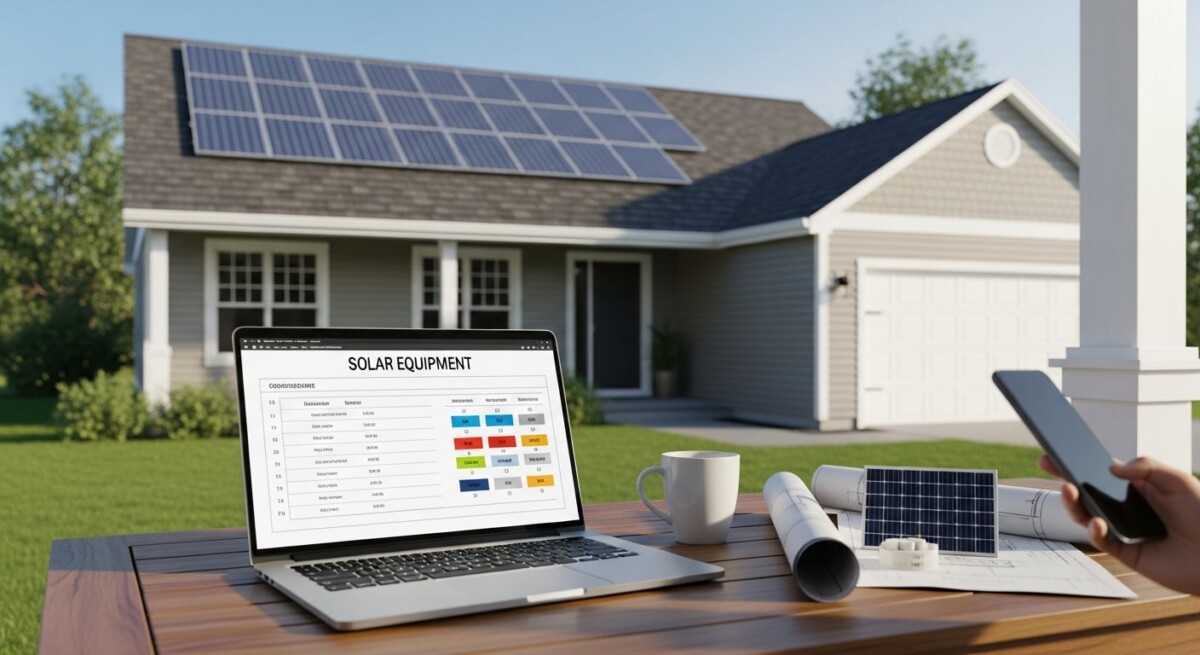
Start by isolating the hardware. The quote should list the exact make and model of the solar panels, inverters, and racking equipment. It should also specify the number of panels and the total system capacity in kilowatts (kW). If the quote only says “premium panels” or “high-efficiency inverters” without model numbers, that is a red flag. You cannot verify performance or warranty terms without knowing exactly what is being installed.
Next, look at the gross system cost before incentives and financing. This number should include all equipment, labor, permits, and any additional components like a main panel upgrade or roof flashing. A quote that leaves out these ancillary costs will surprise you later with change orders. The gross cost should also align with industry averages for your area. In 2025, residential solar in the United States typically costs between $2.50 and $3.50 per watt before incentives. If your quote falls far outside that range, ask why.
How Financing Terms Distort the Real Price
Financing is where many quotes become misleading. Installers often partner with lenders who offer different interest rates and fee structures. A common tactic is to show a low monthly payment without clearly stating the total loan amount, interest rate, and loan term. You might see a system quoted at $30,000 cash price, but the financed price (including loan origination fees and dealer fees) could be $40,000 or more.
When evaluating a quote, always ask for three numbers: the cash price, the financed price, and the dealer fee percentage. Many solar loans include a dealer fee of 15% to 30% of the loan amount. This fee is often rolled into the loan principal, which means you are paying interest on that fee for the entire loan term. A quote that only shows the financed price without disclosing the underlying cash price is hiding the true cost of the system.
Monthly payment projections are another area where accuracy breaks down. A low monthly payment might be based on a 25-year loan term with a high interest rate. Over the life of the loan, you could end up paying more in interest than you save on electricity. Always calculate the total cost of the system including all interest and fees. Compare that against the total energy savings over the same period. If the total cost exceeds the total savings, the quote is not accurate in any meaningful sense.
Verifying Energy Production Estimates
A solar quote typically includes a table showing how much electricity the system will produce each year. This estimate is based on software models that consider your roof’s orientation, tilt, shading, and local weather patterns. The accuracy of this projection depends on the assumptions the installer enters into the software.
Ask the installer to show you the input assumptions. What annual sun hours did they use? Did they account for shading from nearby trees or chimneys? Did they assume a system degradation rate of 0.5% per year or something more aggressive? The industry standard for degradation is around 0.5% per year for modern panels. If the quote assumes zero degradation, the production numbers will be inflated.
You should also ask whether the production estimate includes inverter efficiency losses. No solar system converts 100% of DC power to AC power. Typical inverter efficiency is between 96% and 98%. A quote that ignores this loss will overstate annual production by a small but meaningful amount. Over 25 years, that small error compounds into thousands of dollars of projected savings that never appear on your utility bill.
For a comprehensive breakdown of the methodology behind accurate projections, read our detailed guide on solar quote accuracy and how to save more.
Net Metering and Utility Rate Assumptions
The biggest variable in any solar savings projection is the utility rate structure. Your solar quote should clearly state the assumed electricity rate and the annual rate escalation. Many quotes use the current retail rate and assume it will increase by 3% to 5% every year. If your utility has a history of smaller increases or if your state caps rate hikes, the assumed escalation will overstate savings.
Net metering policies also vary widely by state and utility. Some utilities credit you at the full retail rate for every kilowatt-hour you send to the grid. Others use a wholesale rate or a time-of-use structure that credits you less for power exported during low-demand periods. If your quote assumes full retail net metering but your utility uses a different model, the savings projection will be wrong.
Ask the installer to provide two scenarios: one with the assumed rate escalation and one with no escalation. Also ask for a scenario that uses your utility’s actual net metering rate rather than the retail rate. The difference between these scenarios will show you how sensitive the savings projection is to rate assumptions. A quote that only shows the most optimistic scenario is not giving you the full picture.
Incentives and Tax Credits: What Is Guaranteed vs. Projected
The federal Investment Tax Credit (ITC) currently offers a 30% credit on the gross system cost. This credit is a dollar-for-dollar reduction of your federal income tax liability. It is not a rebate or a discount applied at the point of sale. A quote that subtracts the ITC from the system price to show a “net cost” is misleading because you must have sufficient tax liability to claim the full credit.
State and local incentives add another layer of complexity. Some states offer rebates that are paid directly to the installer. Others offer performance-based incentives that pay you over time based on energy production. Still others have no incentives at all. A quote that includes state incentives should clearly state whether those incentives are guaranteed, waitlisted, or subject to annual funding caps.
When you see a line item for “estimated incentives,” ask the installer to break it down by source: federal, state, utility, and local. Ask which incentives are locked in at the time of contract signing and which depend on future events. An accurate quote treats incentives as a separate line item rather than folding them into the total cost. This way you can see exactly how much you need to pay upfront and how much you can expect to recover later.
Warranty Terms That Change the Long-Term Math
Solar quotes often bury warranty details in fine print or standard terms and conditions. The warranty structure directly affects the long-term value of the system. Most solar panels come with a 25-year performance warranty that guarantees at least 80% to 85% of original output at year 25. Inverters typically have shorter warranties, often 10 to 12 years, though some manufacturers offer extended terms.
An accurate quote will specify the warranty period for each major component and explain what is covered. Does the warranty cover labor for replacement or only the part itself? Who do you call if the inverter fails in year 11? Is there a dedicated local service team or will you be routed to a national call center? These details determine whether you will face out-of-pocket costs for repairs during the system’s life.
Also ask about the workmanship warranty from the installer. This covers installation defects such as roof leaks, loose wiring, or improper mounting. Workmanship warranties typically range from 5 to 10 years. If an installer only offers a 1-year workmanship warranty, that is a sign they may not stand behind their work. An accurate quote includes clear warranty language rather than vague promises to “honor the manufacturer’s warranty.”
Red Flags That Signal Inaccurate Quotes
Some warning signs are so common that they deserve their own checklist. When reviewing any solar quote, watch for these specific red flags:
- No cash price shown. If the quote only displays a financed price, the installer may be hiding dealer fees and inflated loan costs.
- Production guarantee without conditions. Very few installers offer true production guarantees. If the quote promises a specific output without a performance guarantee clause, the number is likely a best-case estimate.
- Savings projected beyond the loan term. Some quotes show 25-year savings but only include a 10-year loan. The numbers after the loan is paid off are based on assumptions that may not hold.
- System size that exactly matches your roof. Installers sometimes max out the available roof space to increase the system price, even if you do not need that much power. An accurate quote should explain why the proposed size matches your energy usage.
Each of these red flags points to a quote that prioritizes appearance over accuracy. If you see any of them, ask the installer to provide a revised quote that addresses the concern. A reputable installer will be happy to clarify. A pushy or evasive response is a strong signal to get a second opinion.
Cross-Referencing Multiple Quotes
The single best way to evaluate solar quote accuracy is to compare three to five quotes from different installers. Each quote acts as a check on the others. If one installer quotes a 10 kW system with $35,000 gross cost and another quotes a 7 kW system with $30,000 gross cost, you need to understand why the system sizes differ so much. One installer may have made different assumptions about your energy usage or roof capacity.
Create a simple comparison table with columns for system size, gross cost per watt, equipment brands, production estimate, and total cost after incentives. Compare these side by side. If one quote stands far above or below the others, dig deeper. The outlier may have found a better equipment price, or it may have made aggressive assumptions that will not hold up over time.
Also compare the financing terms. Two quotes with the same system cost can have very different monthly payments depending on the loan term and interest rate. Look at the total cost of the loan, not just the monthly payment. A longer loan term with a lower monthly payment often costs significantly more in total interest. The most accurate quote is the one that clearly shows both the short-term and long-term costs.
Using Free Solar Power Quotes to Simplify the Process
Gathering multiple quotes used to mean calling five different companies and sitting through five separate sales presentations. Free Solar Power Quotes streamlines this process by connecting you with pre-vetted installers who compete for your business. You submit your information once and receive multiple quotes that you can compare on your own schedule.
The platform focuses on transparency. Each quote you receive includes the key line items discussed in this guide: system size, equipment specifications, gross cost, financing options, and warranty details. Because the installers know you are comparing multiple offers, they are more likely to present accurate numbers from the start. This competitive dynamic naturally improves quote accuracy.
After you receive your quotes, apply the framework from this guide to evaluate each one. Check the production assumptions, verify the cash price, and compare the total cost of financing. If any quote seems off, reach out to the installer through the platform and ask for clarification. The goal is not to find the cheapest quote but to find the one that accurately reflects what you will pay and what you will save.
Solar is a long-term investment. A difference of a few percentage points in the accuracy of your quote can mean thousands of dollars in extra costs or missed savings over 25 years. Taking the time to evaluate each quote carefully is not just good practice. It is the most important step you can take to ensure your solar investment delivers the financial and environmental returns you expect.