When you start researching solar panels for your home, the sheer number of options can feel overwhelming. Between equipment brands, financing structures, installer reputations, and local incentives, making a confident decision requires more than a quick search. This is where the solar quote request form becomes your single most important tool. It is not just a digital convenience. It is the gateway to comparing multiple offers on a level playing field, and it directly determines whether you pay retail or get a competitive rate. Understanding how to use this form strategically can mean the difference between a good investment and a great one.
Many homeowners assume that requesting a quote is a simple step that leads directly to a sales pitch. The reality is more nuanced. A well-designed solar quote request form does more than collect your name and address. It initiates a process where pre-vetted providers compete for your business. By submitting one form, you effectively invite multiple installers to present their best terms, which forces them to sharpen their pricing and include the features that matter most to you. This article walks through everything you need to know about using a solar quote request form effectively, from what information to prepare to how to evaluate the offers that arrive.
Why the Solar Quote Request Form Is Your First Step to Savings
The solar industry has historically suffered from a lack of price transparency. Without a standardized way to compare proposals, homeowners often rely on a single door-to-door salesperson or a single online quote. That approach almost always leads to overpaying. A solar quote request form changes this dynamic by aggregating your information and distributing it to a network of qualified installers who must compete for your project. This competitive tension is the single biggest driver of savings for consumers.
When you use a platform like FreeSolarPowerQuotes, the form serves as a neutral filter. It ensures that only licensed, insured, and vetted providers receive your request. This eliminates the risk of dealing with unqualified contractors while maximizing the number of competitive bids you receive. In our guide on how free solar quotes work, we explain in detail how this matching process creates a transparent marketplace for homeowners.
The form itself typically asks for basic information: your address, your average monthly electric bill, your roof type and age, and whether you are interested in purchasing or leasing the system. Each of these data points helps installers tailor a proposal that matches your specific situation. For example, knowing your monthly bill allows them to size the system to offset your usage without overbuilding. Knowing your roof material helps them determine the correct mounting hardware and labor costs. The more accurate your information, the more precise and comparable your quotes will be.
What Information You Need to Prepare Before Submitting
To get the most out of your solar quote request form, gather a few key documents and details before you start. Preparation ensures that the quotes you receive are accurate and that you do not waste time chasing down missing information later. Here are the essential items to have ready:
- A recent electric bill. Installers need to see your kilowatt-hour (kWh) usage, not just the dollar amount. Usage patterns over a full year are ideal because solar production varies by season.
- Your roof’s basic details. Know the approximate age of your roof, the material (asphalt shingle, tile, metal), and the general orientation (south-facing roofs produce the most energy in the Northern Hemisphere).
- Your property’s shading conditions. Note if large trees, chimneys, or neighboring buildings cast shadows on your roof during peak sun hours (roughly 9 a.m. to 3 p.m.).
- Your financing preference. Decide whether you want to pay cash, take out a solar loan, lease the panels, or enter a power purchase agreement (PPA). Each option changes the cost structure and savings timeline.
Having these details ready when you fill out the form allows the system to route your request to installers who specialize in your type of project. For instance, if you have an older roof that needs replacement, some installers offer combined roofing and solar packages that reduce overall labor costs. If you prefer a $0-down loan, only providers with strong lending partnerships will respond. The form acts as a filter that saves everyone time.
Beyond the basics, consider your long-term goals. Are you planning to stay in your home for 5 years or 20 years? Do you want to add battery storage now or later? These preferences may not appear on every form, but noting them in an open comment field helps installers customize their proposals. The more context you provide, the fewer follow-up calls you will need to answer basic questions.
How to Evaluate the Quotes You Receive
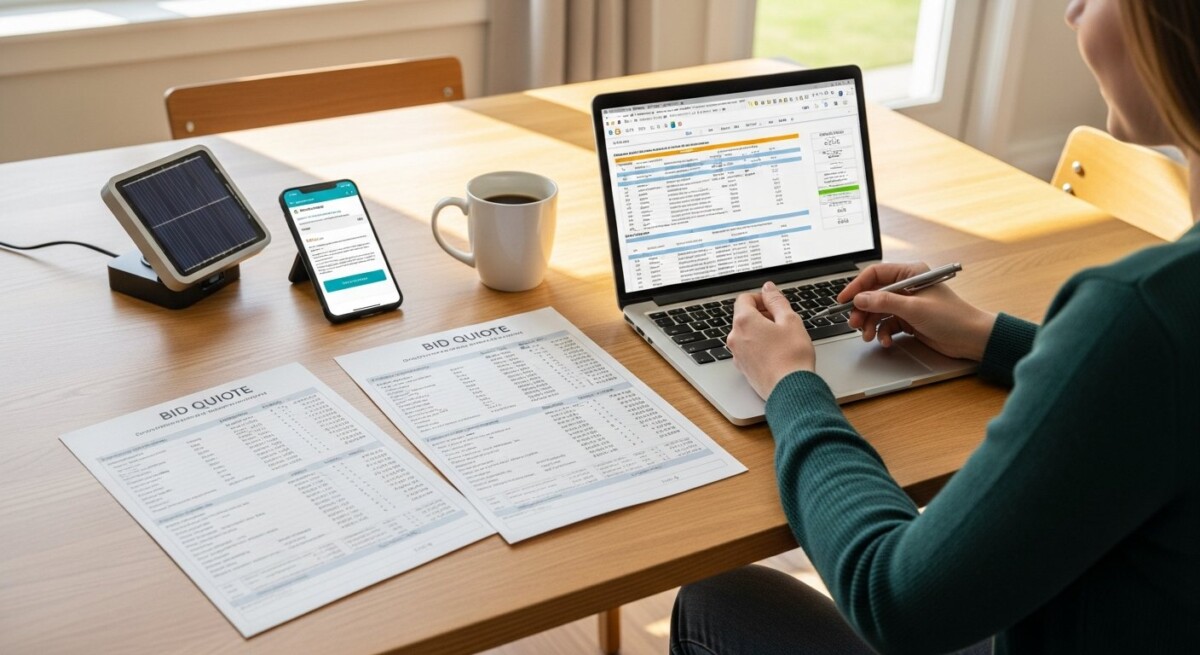
Once you submit your solar quote request form, you will typically receive between three and seven proposals within a few business days. This is the moment where many homeowners feel tempted to pick the lowest price. However, the cheapest option is not always the best value. To make an informed comparison, focus on four critical dimensions: equipment quality, installer reputation, warranty coverage, and total cost per watt.
Equipment quality matters because solar panels and inverters have different degradation rates and efficiency levels. A premium panel from a tier-one manufacturer might cost slightly more upfront but produce more energy over 25 years than a budget panel. Similarly, microinverters or power optimizers can improve performance on partially shaded roofs compared to a traditional string inverter. Your quotes should clearly list the brand, model, and wattage of the panels and inverters proposed. If a quote is vague about equipment, ask for specifics before comparing prices.
Installer reputation is equally important. A low price from a company with a history of poor customer service or shoddy workmanship can become a nightmare when something goes wrong. Check online reviews on platforms like the Better Business Bureau, Google, and Solar Reviews. Look for patterns in complaints about communication, timeline delays, or post-installation support. A reputable installer will also have proper licensing and insurance, which they should provide upon request.
Warranty coverage is the third pillar of a strong proposal. Most solar panels come with a 25-year performance warranty, but the workmanship warranty from the installer can vary from 2 years to 25 years. A longer workmanship warranty signals that the installer stands behind their labor. Also check the inverter warranty, which is typically 10 to 25 years depending on the technology. If a quote offers a 25-year comprehensive warranty that covers both equipment and labor, that is a strong indicator of quality.
Finally, calculate the total cost per watt. Divide the gross system cost (before incentives) by the total system size in watts. For example, an $18,000 system that is 6,000 watts (6 kW) costs $3.00 per watt. The national average in 2025 is roughly $2.80 to $3.20 per watt before the federal tax credit. If a quote comes in above $3.50 per watt, ask why. It may include premium equipment, a high-quality battery, or complex installation conditions. If it comes in below $2.50 per watt, be cautious. Extremely low prices often indicate substandard components or an installer cutting corners on labor or permits.
Common Mistakes Homeowners Make With Solar Quote Forms
Even with the best intentions, homeowners frequently make errors when filling out their solar quote request form. These mistakes can lead to inaccurate quotes, wasted time, or missed savings opportunities. Being aware of these pitfalls helps you avoid them.
One common mistake is providing an estimated electric bill instead of an actual one. If you guess your monthly usage, installers will size the system based on that guess. If your guess is too high, you may end up with an oversized system that costs more than necessary. If it is too low, you might not offset enough of your usage. Always upload a PDF of your actual bill or enter the exact kWh numbers from your last 12 months of statements.
Another error is ignoring the roof condition. If your roof is nearing the end of its lifespan (over 15 years old for asphalt shingles), you should replace it before installing solar. Removing and reinstalling panels for a roof replacement later adds thousands of dollars in labor. Some homeowners skip this step and then face unexpected costs down the road. Include your roof’s age and condition honestly in the form so installers can advise you on the best approach.
A third mistake is submitting the same form multiple times with slight variations. This can duplicate your request and cause confusion. Instead, submit one complete form and wait for responses. If you do not hear back within a week, follow up with the platform’s customer service rather than resubmitting. Duplicate entries can flag your request as spam or overwhelm installers with redundant leads.
Finally, do not ignore the fine print on financing. Some solar loans include dealer fees that inflate the total system cost by 15 to 30 percent. These fees are often hidden in the interest rate or added to the principal. When comparing quotes, ask each installer for a cash price and a financed price side by side. This transparency allows you to see exactly how much the financing costs. In our article on how many solar quotes you should request for best savings, we discuss why getting at least three to five proposals is the sweet spot for uncovering these pricing differences.
How to Use the Form to Maximize Your Solar Incentives
The federal solar Investment Tax Credit (ITC) currently allows you to deduct 30 percent of your system cost from your federal taxes. Many states and utilities also offer additional rebates, performance-based incentives, or net metering credits. A properly filled-out solar quote request form helps you capture these incentives by ensuring that installers include them in their calculations.
When you submit your form, the platform typically asks for your zip code and utility company. This information allows the system to match you with installers who are familiar with your local incentive landscape. For example, if you live in California, your quotes will likely include calculations based on Net Energy Metering 3.0 (NEM 3.0), which changes how credits are valued. If you live in New York, your quotes may factor in the NY-Sun incentive program. Each installer will apply these incentives differently, so comparing them helps you choose the one that maximizes your after-incentive savings.
You can also use the form to ask specific questions about incentives. Most forms have a notes or comments section. Use it to ask whether the installer handles the ITC paperwork, whether they offer any manufacturer rebates, and whether they have experience with your local utility’s net metering application. Installers who proactively manage these details provide a smoother experience and often help you claim credits you might have missed.
Timing matters as well. Some incentives have annual funding caps and are distributed on a first-come, first-served basis. Submitting your solar quote request form early in the year gives you a better chance of securing these limited funds. Waiting until late fall or winter may mean that popular rebates have already been exhausted. If you are serious about going solar, start the quote process at least three to six months before you want the system installed.
Understanding the Fine Print: Fees and Disclosures
Every solar quote request form and the resulting proposals come with terms that you need to read carefully. The most important disclosure is whether the service is free and carries no obligation. Reputable platforms like FreeSolarPowerQuotes are clear that you are under no obligation to purchase anything. You are simply requesting information and competitive bids. If a platform charges a fee to submit a form or requires a deposit before providing quotes, consider that a red flag.
Another disclosure to look for is how your personal data is handled. The form collects your contact information, energy usage, and property details. Legitimate platforms have a privacy policy that explains how they use and share this data. They should not sell your information to third parties without your consent. If the privacy policy is vague or nonexistent, choose a different platform. You can also check the site’s CCPA compliance (if you are a California resident) to see your opt-out options.
Finally, understand that the installers who contact you may offer slightly different terms than what was quoted on the initial call. Always ask for a written proposal that matches the verbal offer. Compare the written proposal against the terms you expected from the quote request form. If there are discrepancies, ask for an explanation before signing any contract. The form is the starting point for a conversation, not the final word on pricing.
Making the Final Decision: When to Say Yes
After you have received and compared your quotes, the decision comes down to a combination of price, trust, and timing. The solar quote request form has done its job by giving you a set of options. Now you need to choose the installer that offers the best overall value for your specific situation.
A good rule of thumb is to narrow your list to the top three proposals based on cost per watt, warranty, and installer reviews. Then schedule a phone call or in-home consultation with each of those three. Pay attention to how they communicate. Do they answer your questions clearly? Do they pressure you to sign immediately? Do they offer to walk you through the incentive paperwork? The installer who provides the most transparent and educational experience is often the one who will deliver a smooth installation.
Do not rush. A quality solar installation is a 25-year investment. Taking an extra week to compare proposals or ask follow-up questions is far better than signing a contract you regret. If an installer tells you that a limited-time discount expires tomorrow, that is a classic high-pressure sales tactic. Walk away. A reputable company will let you take the time you need to make an informed decision.
Once you have chosen an installer, confirm the timeline. Most installations take 4 to 8 weeks from contract signing to activation, depending on permitting and utility approval. Ask for a written schedule that includes key milestones: site survey, engineering, permit submission, installation date, and final inspection. Having this timeline in writing protects you if delays occur.
Using a solar quote request form is the smartest way to start your solar journey. It saves you time, money, and stress by putting competitive offers in front of you without the pressure of a single sales pitch. When you combine a well-prepared form with careful evaluation of the proposals you receive, you position yourself to make a confident, cost-effective decision that will power your home for decades.