
Monocrystalline Solar Panels: Top Efficiency Guide
Discover why monocrystalline solar panels deliver the highest efficiency, longest lifespan, and best long-term savings for your home.

By Benjamin Taylor
Learn more about Solar Panel Installation and Repair for guides, costs, and what to expect.
Compare Solar Panel Installation and Repair Pros Near You

Enter your ZIP code to compare top-rated local professionals and request free quotes.
When you start shopping for solar panels, one term appears again and again: monocrystalline. These panels are the most popular choice for American homes, and for good reason. They pack the highest efficiency into the smallest space, they last for decades, and they perform better in low light than most alternatives. If you want to maximize the energy produced from every square foot of your roof, monocrystalline solar panels are likely the right call. This guide breaks down how they work, what they cost, how they compare to other types, and how to decide if they fit your home and budget.
What Are Monocrystalline Solar Panels?
Monocrystalline solar panels are made from a single, continuous crystal structure of silicon. To create them, manufacturers grow a cylindrical ingot of pure silicon, then slice it into thin wafers. Because the entire wafer is one crystal, electrons have a clear, uninterrupted path to move, which makes the panel highly efficient at converting sunlight into electricity.
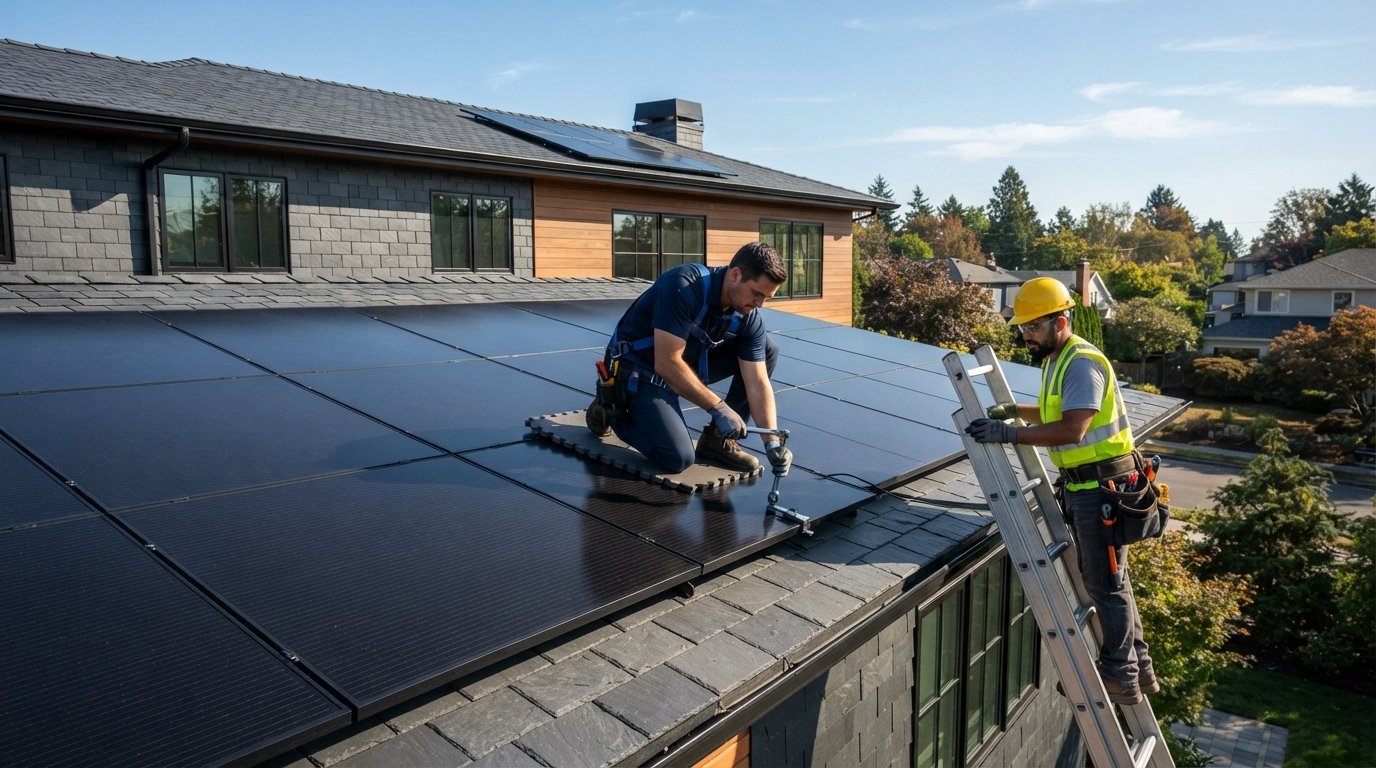
The most obvious visual cue is the color. These panels have a uniform black or very dark blue appearance, with rounded corners on the cells. That look comes from the high-purity silicon and the anti-reflective coating. Many homeowners choose them specifically because they blend better with dark roofs than the speckled blue of polycrystalline panels.
Another key feature is their temperature coefficient. Solar panels lose efficiency as they heat up, but monocrystalline panels lose less than other types. In hot climates like Phoenix or Houston, that difference can mean more kilowatt-hours produced over the life of the system.
Monocrystalline vs. Polycrystalline vs. Thin-Film
To understand why monocrystalline dominates the residential market, it helps to see how it stacks up against the two other main categories: polycrystalline and thin-film.
Efficiency and Space
Monocrystalline panels typically offer efficiency ratings between 18% and 22%. Polycrystalline panels usually land between 15% and 17%. Thin-film panels are lower still, often below 12%. If you have limited roof space, monocrystalline is the clear winner because you need fewer panels to hit your target output. For example, a 6 kW system might need only 15 monocrystalline panels, but 18 polycrystalline panels or 25 thin-film panels to produce the same energy.
Lifespan and Degradation
Most monocrystalline panels come with a 25-year performance warranty, and many will still produce at 85% to 92% of their original output after 25 years. Polycrystalline panels degrade slightly faster, and thin-film panels degrade faster still, often losing 1% to 2% per year. Over a 30-year ownership period, that difference can be substantial.
Aesthetics
Monocrystalline panels are sleeker, with a uniform black finish and no visible silver speckles. Polycrystalline panels have a blue, fragmented look, and thin-film panels are either dark and uniform or have a textured appearance depending on the type. For curb appeal, monocrystalline wins.
Cost
Monocrystalline panels are the most expensive of the three. Polycrystalline panels are cheaper, but they require more roof area and produce less power over time. Thin-film is the least expensive, but its low efficiency and faster degradation usually make it a poor value for residential rooftops. You can get a detailed comparison of the top models in our guide to the most efficient solar panels.
Here is a quick reference table for the three types:
- Monocrystalline: 18-22% efficiency, 25-30 year lifespan, premium cost, black uniform look.
- Polycrystalline: 15-17% efficiency, 20-25 year lifespan, moderate cost, blue speckled look.
- Thin-Film: 10-12% efficiency, 15-20 year lifespan, lowest cost, flexible and lightweight.
For most homeowners, the extra upfront cost of monocrystalline pays off through higher energy production and lower degradation. If you plan to stay in your home for more than 10 years, the math strongly favors monocrystalline.
Key Benefits of Choosing Monocrystalline Panels
Beyond raw efficiency, monocrystalline panels offer several practical advantages that matter for daily use and long-term ownership.
First, they perform better in low-light conditions. On cloudy days, early mornings, and late afternoons, monocrystalline panels still generate meaningful power. Polycrystalline and thin-film lose more output when light is diffuse. If you live in a region with frequent overcast skies, this can add up to hundreds of extra kilowatt-hours per year.
Second, they are more tolerant of heat. The temperature coefficient for monocrystalline panels is typically around -0.3% per degree Celsius, while polycrystalline is closer to -0.4%. In a hot climate, that means a monocrystalline system might produce 2% to 3% more power on a 95-degree afternoon. Over 25 years, that is a significant boost.
Third, they take up less roof space. Because each panel produces more power, you can install a smaller array. That reduces the visual impact, leaves room for future expansion, and can lower installation costs if your roofer charges per panel.
Fourth, they have a longer useful life. Most monocrystalline panels are rated for 25 years, but many will continue producing at a usable level for 30 to 40 years. The degradation rate is slower, so your system stays closer to its rated output for longer.
How Much Do Monocrystalline Panels Cost?
The price of monocrystalline panels has dropped dramatically over the past decade. In 2010, a typical home solar system cost around $40,000 before incentives. Today, the same size system might cost $15,000 to $25,000 before the federal tax credit. The panels themselves account for about 25% to 30% of the total cost.
Per watt, monocrystalline panels now run between $0.70 and $1.50 for the hardware alone. A complete installed system, including inverters, racking, wiring, and labor, usually costs $2.50 to $3.50 per watt. For a 6 kW system, that means $15,000 to $21,000 before incentives.
After the 30% federal Investment Tax Credit (which remains in effect through 2032), the net cost drops to $10,500 to $14,700. Many states and utilities add extra rebates, and some offer performance-based incentives. You can estimate your specific costs with a solar calculator, but the key takeaway is that monocrystalline panels are no longer a luxury item. They are the mainstream choice for most U.S. homes.
How Long Do They Last?
Monocrystalline panels are built to withstand hail, wind, and snow. Most carry a 25-year power output warranty, and the physical structure is often warranted for 25 years as well. Degradation is gradual: in the first year, a panel might lose 2% to 3% of its output, then less than 0.5% per year after that. After 25 years, a typical monocrystalline panel still produces about 88% of its rated power.
Real-world performance matches these numbers. Many systems installed in the 1990s are still running at 80% to 90% of original capacity. With no moving parts, the main risks are electrical failures in the junction box or microcracks from extreme weather, but reputable manufacturers back their products with robust warranties.
If you plan to live in your home for more than 10 years, monocrystalline panels are a long-term asset. They can also boost your home's resale value, as buyers often pay a premium for homes with existing solar systems, especially if the panels are paid off.
Are Monocrystalline Panels Worth It for Your Home?
The honest answer is that it depends on your situation. Monocrystalline panels make the most sense if you have limited roof space, high electricity rates, or a hot climate. They also make sense if you want to maximize your return on investment, because the higher efficiency means you generate more power per dollar spent over time.
If your roof is very large and you have plenty of south-facing exposure, you could save money with polycrystalline panels. But in most residential settings, the difference in cost is small, and the long-term production advantage of monocrystalline wins out. For example, a 6 kW monocrystalline system might cost $1,000 more upfront than a polycrystalline system, but it will produce 5% to 10% more energy each year, which could be $100 to $200 in annual savings. Over 25 years, that is $2,500 to $5,000 in your pocket.
Thin-film panels are rarely worth it for rooftops. They are better suited for large commercial installations where space is less constrained. For homes, monocrystalline is the recommended option for most buyers, especially if you want to avoid surprise performance shortfalls.
If you are considering a lease or power purchase agreement, the choice of panel is less critical because the leasing company owns the system. However, you still want to ensure the installer uses quality monocrystalline panels, since the system's output directly affects your savings. You can learn more about the pros and cons of leasing in our guide to solar leasing.
How to Install Monocrystalline Panels
Installation is a job for licensed professionals, but understanding the process helps you evaluate quotes and monitor quality. Here are the standard steps:
- Site assessment: An installer evaluates your roof's size, angle, shade, and structural integrity. They also review your electricity usage to size the system correctly.
- System design: The installer designs the array, choosing the exact number of panels, the inverter type (string, microinverter, or optimizer), and the racking system.
- Permitting: Your local government may require a building permit and an electrical permit. The installer handles this, but it can take a few weeks.
- Installation: Crews mount the racking, attach the panels, run wiring to the inverter, and connect to your main electrical panel. This usually takes one to three days.
- Inspection and interconnection: A local inspector verifies the work, then your utility company approves the connection to the grid. After that, you can turn the system on.
Proper wiring is critical for safety and performance. A poorly installed system can underperform or create fire risks. We have a detailed guide on how solar panels are wired if you want to understand the technical side.
Most installers offer a workmanship warranty for 5 to 10 years, which covers any installation errors. Always verify that your installer is licensed and insured, and check for certifications like NABCEP.
Choosing the Right Monocrystalline Panel
Not all monocrystalline panels are equal. When comparing models, look at these key specs:
- Efficiency: Higher is better, but above 21% the gains are marginal. A 22% panel is excellent, but 20% is already very good.
- Wattage: Panels range from 350W to 500W. Higher wattage means fewer panels needed, which can reduce installation cost.
- Temperature coefficient: Lower (closer to zero) is better. Aim for -0.35% per degree Celsius or lower.
- Degradation rate: Look for 0.25% per year or less. Some premium panels offer 0.25% degradation and a 30-year warranty.
- Warranty: At least 25 years on power output and 15 years on product. Longer is better.
Brand matters, but the differences between reputable brands are small. What matters more is the installer's workmanship and the system design. A well-installed system with mid-tier panels will outperform a poorly installed system with premium panels.
Before signing a contract, get at least three quotes from different installers. Compare the total cost, the equipment specifications, and the warranty terms. Avoid the cheapest option if it uses unknown panel brands or a vague warranty. The best deal is the one that offers solid equipment, a strong warranty, and a professional installation at a fair price.
The Bottom Line on Monocrystalline Panels
Monocrystalline solar panels are the gold standard for residential solar. They offer the highest efficiency, the longest lifespan, and the best performance in real-world conditions. The upfront cost is slightly higher than other types, but the extra energy production over 25 years usually pays for itself and then some.
If you are ready to explore solar for your home, the smartest next step is to compare quotes from vetted local installers. A professional can assess your roof, calculate your potential savings, and give you a precise price for a monocrystalline system. Getting multiple quotes is the best way to ensure you get a fair deal and a system that meets your needs.
Solar is a major investment, but with monocrystalline panels, it is one of the most reliable home improvements you can make. The technology is mature, the warranties are strong, and the financial benefits are proven. Whether you want to lower your electric bill, increase your home value, or reduce your carbon footprint, monocrystalline panels are a smart, durable choice.