
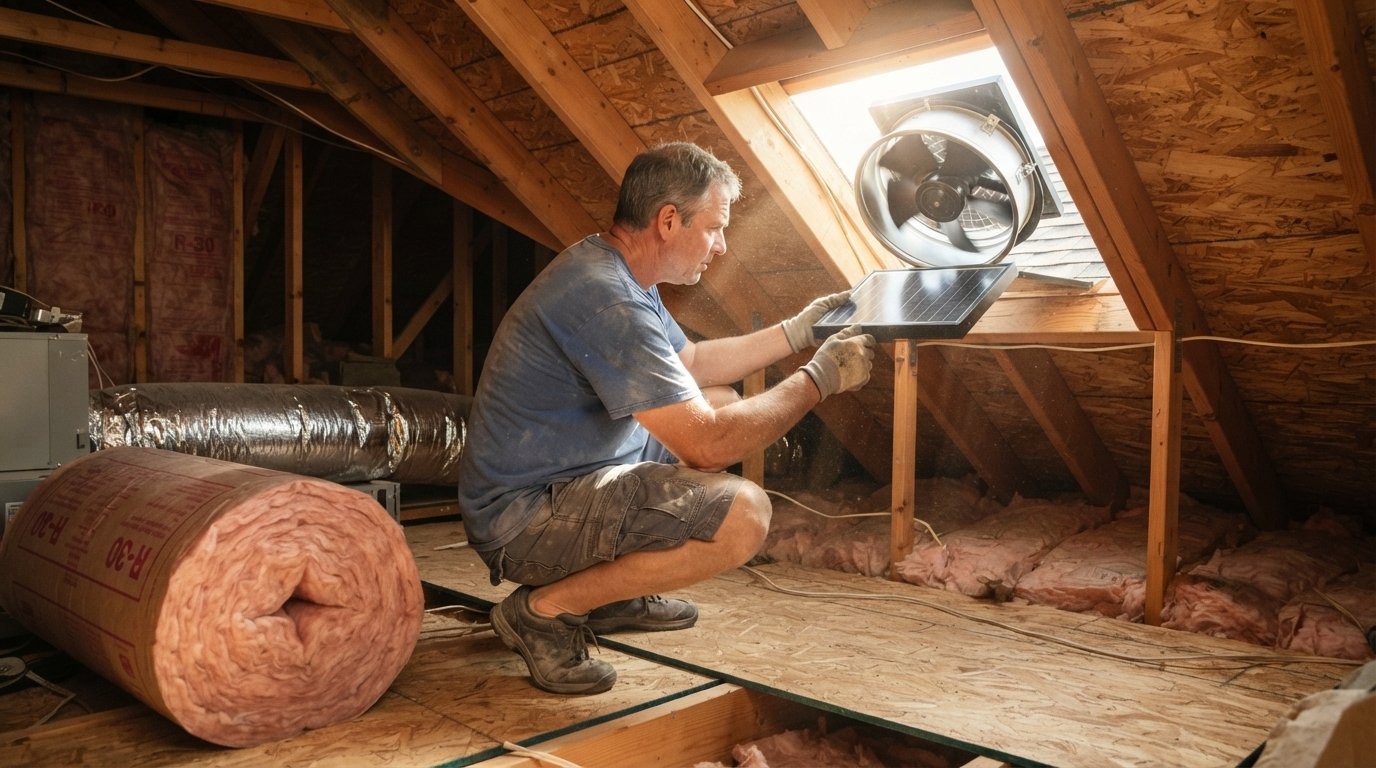
Solar Plus Attic Fan and Ventilation Cooling Savings
Cut summer cooling costs with solar plus attic fan and ventilation cooling savings. Call (833)-793-7166 for a free solar quote.

Learn more about Weatherization for guides, costs, and what to expect.
Compare Weatherization Pros Near You

Enter your ZIP code to compare top-rated local professionals and request free quotes.
Your air conditioner is working overtime, and the culprit might be right above your head. In most American homes, the attic acts as a solar oven, trapping heat that radiates down through the ceiling and forces your cooling system to run longer and harder. Pairing a solar attic fan with smart ventilation upgrades can cut that hidden cooling load, and when you combine those savings with a solar energy system, the financial case becomes even stronger. This guide breaks down how attic heat drives summer bills, how to compare ventilation options, and how to size a fan so it complements your solar production instead of wasting it.
How Attic Heat Gain Drives Summer Cooling Costs
On a sunny 95 degree day, attic air temperatures can climb past 140 degrees, and the roof sheathing itself can exceed 160 degrees. That heat does not stay in the attic. It conducts through the ceiling assembly, radiates from hot ducts, and leaks into living spaces through gaps around light fixtures, wiring penetrations, and attic access panels. The result is a measurable increase in the sensible cooling load your air conditioner must handle, often adding 10 to 20 percent to summer cooling costs in homes with poor attic insulation or leaky ducts.
The effect compounds when ductwork runs through the attic. A typical attic duct system loses cooling capacity as the hot surrounding air warms the ducts before conditioned air reaches the rooms. Sealing and insulating ducts is always the first priority, but reducing attic temperature itself lowers the temperature differential that drives that heat transfer. In humid climates, attic ventilation also helps remove moisture that can degrade insulation performance and encourage mold growth.
Homeowners often notice the symptom without identifying the cause: rooms feel stuffy in late afternoon, the air conditioner runs continuously from noon to sunset, and upstairs bedrooms never quite reach the thermostat setting. Before adding panels or upgrading HVAC equipment, it is worth understanding how much of that load comes from the attic. A free solar savings estimator can help you model how efficiency upgrades and solar production interact to change your overall energy picture.
Solar Attic Fans, Powered Vents, and Passive Ridge Vents Compared
Ventilation strategies fall into three broad categories, and each has a distinct role in a whole-home cooling plan. Understanding the tradeoffs helps you avoid spending money on equipment that does not match your climate, roof design, or energy goals.
- Solar attic fans: A roof-mounted fan runs on a small photovoltaic panel, so it moves hot air without drawing grid electricity. These are ideal for sunny climates and homes where running new electrical circuits to the attic is expensive or impractical. They operate most when the sun is strongest, which aligns with peak attic heat.
- Powered vents (line-voltage): Traditional electric attic fans and powered vents move more air than most solar fans, but they consume household electricity and require wiring, a thermostat or humidistat, and ongoing maintenance. In a solar home, their runtime can be shifted to daytime hours when production is high, but they still add to the load calculation.
- Passive ridge vents and soffit vents: These rely on natural buoyancy and wind to move air. They cost little to install, have no moving parts, and work silently. However, their airflow is modest and depends on roof geometry, wind exposure, and proper intake area at the soffits. They are a baseline requirement, not a complete solution in hot climates.
The strongest approach is usually layered: ensure adequate passive intake and exhaust first, then add a solar attic fan sized to the attic volume. In mixed and hot climates, solar fans offer the best balance of daytime airflow and zero grid draw. In cooler climates, passive ventilation alone may be sufficient. Homeowners in Florida, Texas, Arizona, and similar hot zones typically see the fastest payback from active ventilation paired with air sealing and insulation upgrades.
Load Calculations: Sizing an Attic Fan Without Wasting Solar Production
Sizing an attic fan is not guesswork. The goal is to achieve roughly 4 to 6 air changes per hour in the attic space, depending on climate and roof complexity. The basic formula multiplies attic square footage by the desired air changes, then converts that to cubic feet per minute (CFM). For example, a 1,500 square foot attic targeting 5 air changes per hour needs about 125 CFM of continuous airflow, but real-world sizing typically accounts for fan efficiency, static pressure, and thermostat cycling, landing most homes in the 300 to 700 CFM range for solar fans.
Oversizing is a common mistake. A fan that moves too much air can depressurize the attic and pull conditioned air from the house through ceiling leaks, which increases cooling costs instead of reducing them. It can also draw moisture from bathrooms and kitchens into the attic, creating condensation problems. Balanced ventilation requires adequate soffit intake area, usually at least one square foot of net free vent area per 150 square feet of attic floor space when using an active fan.
From a solar perspective, a solar attic fan does not add to your home's electrical load, so it does not require additional panel capacity. That is a key advantage. If you install a line-voltage fan instead, you need to account for its wattage in your solar production estimate. A 300 watt fan running six hours a day consumes about 1.8 kWh daily, which is small but not zero. The cleaner approach is to let the fan run on its own dedicated solar panel, keeping your home solar system dedicated to larger loads like HVAC, appliances, and electric vehicle charging.
Interactions With HVAC Sizing and Duct Sealing Priorities
Attic ventilation reduces the temperature surrounding your ductwork and ceiling, but it does not fix air leaks, insufficient insulation, or oversized HVAC equipment. The correct sequence of upgrades matters. Before adding ventilation, seal attic air leaks, weatherstrip the attic access, and insulate the ceiling to current recommended R-values. These steps reduce the heat that enters the living space and protect the ventilation investment.
Duct sealing is equally important. Leaky ducts in a hot attic lose a significant percentage of cooling capacity, and no fan can recover that loss. Sealing ducts and insulating them to at least R-8 reduces the temperature differential and lets ventilation do its job on the attic air itself. Once those fundamentals are in place, a solar attic fan can lower attic temperature by 20 to 40 degrees, which reduces the heat radiating through the ceiling and extends the life of roofing materials.
HVAC sizing should be evaluated after efficiency upgrades, not before. A contractor who sizes a new air conditioner based on the pre-upgrade load may recommend equipment that is larger than necessary once ventilation and sealing are complete. Right-sizing the HVAC system improves humidity control, reduces cycling, and lowers energy use. When you request solar quotes through a service like NewSolarQuotes, you can also ask about efficiency audits that identify whether attic ventilation or HVAC replacement should come first in your overall plan.
When Ventilation Upgrades Beat Adding More Panels
Solar panels reduce the cost of the electricity you consume, but they do not reduce the amount of electricity you need. If your attic is driving a large cooling load, adding panels to cover that load costs more than reducing the load itself. A solar attic fan typically costs a fraction of adding several panels and can deliver a comparable or better return in hot climates, especially when paired with air sealing and insulation.
Consider a simple decision framework. If your attic temperature routinely exceeds 130 degrees, your ducts run through the attic, and your summer bills spike in the afternoon, ventilation and sealing upgrades should come first. If your attic is already well sealed, insulated, and passively vented, and your remaining load is driven by appliances or electric vehicles, then adding solar capacity makes more sense. Many homeowners do both, but sequencing the efficiency work first ensures the solar system is sized to the post-upgrade load, which improves the return on investment.
It also helps to verify local incentives and utility programs. Some states and utilities offer rebates for attic insulation and ventilation upgrades, and the federal tax credit for solar continues to make the renewable portion of the project attractive. Always confirm current program details with official sources, because incentive terms can change.
Practical Next Steps for Homeowners
Start with a home energy audit or a walkthrough with a qualified contractor. Measure attic temperatures at midday, inspect soffit and ridge vent area, and check for duct leaks and insulation gaps. Then decide whether a solar attic fan, a line-voltage fan, or passive improvements fit your climate and budget. Finally, size your solar system after the efficiency upgrades are complete so you are not paying to generate electricity for a load you could have eliminated.
Combining solar with attic ventilation is not about chasing two separate rebates. It is about reducing the cooling load first, then producing clean electricity for what remains. That sequence delivers the strongest cooling savings, the best solar value, and a more comfortable home from the first hot afternoon. For a personalized estimate of how much you could save, connect with a trusted local provider and review your options before the next heat wave arrives.