
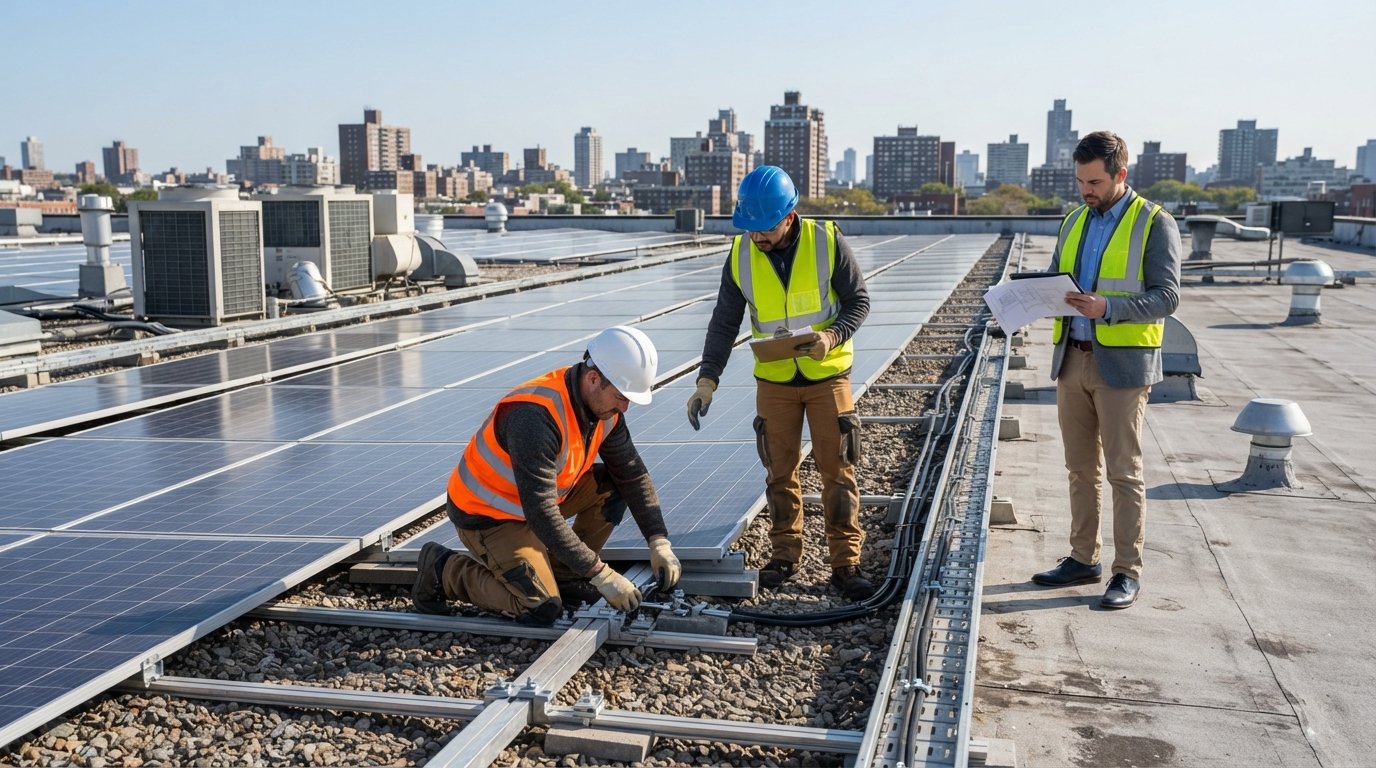
Vetting Solar Installers for Commercial Projects: Business Checklist
Use this vetting solar installers for commercial projects business checklist to avoid costly mistakes. Call 8337937166 for free quotes today.

By Benjamin Taylor
Learn more about Solar Panel Installation and Repair for guides, costs, and what to expect.
Compare Solar Panel Installation and Repair Pros Near You

Enter your ZIP code to compare top-rated local professionals and request free quotes.
Choosing the wrong solar installer for a commercial project can cost your business six figures in lost incentives, roof damage, and underperforming assets. Commercial solar is not a residential job scaled up. It involves three-phase power, demand charges, complex interconnection studies, and tax structures that demand an installer with proven commercial experience. This vetting solar installers for commercial projects business checklist walks you through the exact due diligence steps that protect your capital and your operations.
Why Commercial Solar Vetting Differs From Residential
Residential solar installers often sell on monthly payment savings and curb appeal. Commercial projects live or die on kilowatt-hour economics, demand charge reduction, and depreciation schedules. A commercial installer must understand your utility rate structure, your load profile, and how solar production overlaps with your peak demand windows. They also need to coordinate with your facilities team, your CPA, and sometimes your landlord or REIT.
Most importantly, commercial solar systems are frequently larger than 100 kilowatts, which triggers different permitting, interconnection, and incentive rules. An installer who only does 8-kilowatt rooftop jobs may lack the engineering depth to handle a 500-kilowatt carport or ground mount. Your checklist must screen for that depth before you sign anything.
Start With Licensing, Insurance, and Financial Stability
Before you evaluate proposals, confirm the installer can legally and financially perform the work. Licensing requirements vary by state, but commercial electrical work almost always requires a master electrician or licensed electrical contractor on staff. Ask for the license number and verify it with your state licensing board. Do not accept a subcontractor arrangement where the licensed party is three layers removed from your project.
Insurance is equally critical. A commercial project exposes the installer to liability far beyond a residential roof. Request certificates for general liability, workers compensation, and commercial auto. General liability limits should typically be at least $2 million per occurrence for commercial work. If the installer cannot produce a certificate naming your business as an additional insured, that is a red flag.
Financial stability matters because solar projects can take six to twelve months from contract to commissioning. An installer who goes bankrupt mid-project leaves you with a half-finished array and no warranty. Ask for proof of bonding capacity, recent financial references, and whether they have ever filed for bankruptcy. You can also check lien history through your county recorder or a service like LevelSet.
- Active electrical contractor license with commercial endorsements
- General liability insurance of at least $2 million per occurrence
- Workers compensation coverage for all field staff
- Bonding capacity sufficient for your project size
- No unresolved liens or bankruptcy filings in the last five years
Evaluate Commercial Project Experience, Not Just Years in Business
A company that has been installing solar for fifteen years but only on houses is not a commercial installer. Ask for a project portfolio that includes systems within 20 percent of your size and in a similar utility territory. If your project is a 300-kilowatt rooftop system on a warehouse, you want to see at least three comparable installations with references you can call.
When you call those references, ask specific questions. Did the installer hit the promised production numbers? How did they handle utility interconnection delays? Did they complete the project on schedule and on budget? Were there any change orders that increased the price by more than 10 percent? A good installer will welcome these calls because they know their references are strong.
Also ask about the installer's experience with your specific mounting type. Rooftop ballasted systems, carports, ground mounts, and canopy structures each have different engineering and permitting challenges. An installer who has only done flush-mount residential roofs may struggle with the wind loading and structural calculations required for a commercial carport.
For a broader framework on comparing installer quality and value, see this guide on how to vet solar installers for the best value, which covers residential and commercial angles.
Check Engineering and Design Capabilities
Commercial solar design is not a one-size-fits-all process. The installer should have in-house or contracted professional engineers who can stamp structural and electrical drawings. Ask whether the structural analysis accounts for your roof's existing condition, including age, membrane type, and load capacity. A proper design also includes a shade study, production modeling in tools like PVsyst or Helioscope, and a single-line electrical diagram that your utility will accept.
Demand charge management is another differentiator. Many commercial electric rates include demand charges based on your highest 15-minute usage interval. A smart installer will design the solar array and possibly battery storage to shave those peaks, not just maximize total kilowatt-hours. If the installer cannot explain how their design reduces your demand charges, they may not understand commercial rate structures.
Ask for the production model assumptions. What weather data did they use? What degradation rate did they assume? What soiling and mismatch losses did they apply? A credible commercial proposal will show these assumptions and provide a guaranteed production number, sometimes called a performance guarantee. If the installer refuses to guarantee production, you are taking on all the performance risk.
Review Financial and Contractual Terms Carefully
Commercial solar contracts are complex. They should clearly state the scope of work, the total price, the payment schedule, and the timeline. Watch for escalation clauses that allow the installer to raise the price if material costs increase. Some escalation is reasonable, but unlimited escalation is not. Ask for a fixed price or a cap on any adjustments.
Warranties are another critical area. You want a workmanship warranty of at least five years, preferably ten. Equipment warranties come from manufacturers, but the installer should handle warranty claims on your behalf. Ask how long the installer has been in business and whether they will likely be around to honor a ten-year workmanship warranty. If they are a small startup, consider whether the warranty is worth the paper it is printed on.
Payment schedules should be tied to milestones, not just dates. A typical commercial schedule might be 20 percent at contract signing, 30 percent at equipment delivery, 30 percent at mechanical completion, and 20 percent at commissioning. Never pay more than 50 percent before equipment arrives on site. Also confirm that the installer will provide lien waivers from subcontractors and suppliers as payments are made.
Verify Utility Interconnection and Permitting Expertise
Interconnection is often the longest and most unpredictable part of a commercial solar project. Your installer should have a track record of successfully navigating your utility's interconnection process. Ask how many projects they have completed with your specific utility and whether they have ever had an application rejected or delayed beyond the standard timeline.
Permitting is similar. Commercial solar permits often require structural, electrical, and fire department approvals. The installer should handle all of this as part of the contract. Ask whether their fee includes permit costs and whether they have a dedicated permitting coordinator. If they expect you to pull the permits, that is a sign they lack commercial experience.
For businesses exploring renewable energy options beyond solar, including hydropower and wind, independent educational resources like NewSolarQuotes can provide additional context. However, for most commercial properties, solar remains the most practical and cost-effective renewable investment.
Assess Safety Record and Workforce Qualifications
Commercial solar installation involves working at heights, handling high-voltage DC electricity, and operating heavy equipment. Safety should be a core competency, not an afterthought. Ask for the installer's OSHA 300 logs or experience modification rate (EMR). An EMR below 1.0 indicates a better-than-average safety record. An EMR above 1.2 suggests a higher risk of workplace incidents, which can lead to project delays and liability for your business.
Workforce qualifications matter too. Ask whether the installers on your project are employees or subcontractors. Employee crews generally receive more consistent training and supervision. If subcontractors are used, ask how the installer vets them and whether they carry their own insurance. Also confirm that all electrical work will be performed by licensed electricians, not general laborers.
Finally, ask about continuing education. The solar industry evolves quickly, with new rapid shutdown requirements, updated NEC codes, and changing utility rules. An installer who invests in ongoing training for their team is more likely to deliver a code-compliant, safe installation.
Request and Compare Multiple Bids
Never accept the first commercial solar quote you receive. Obtain at least three bids from installers who meet your vetting criteria. When comparing bids, normalize the assumptions. Ask each installer to use the same utility rate schedule, the same production modeling tool, and the same equipment tier. Otherwise, you may be comparing apples to oranges.
Look beyond the bottom-line price. A lower price may mean cheaper equipment, fewer safety measures, or a shorter warranty. A higher price may include better engineering, stronger guarantees, or more comprehensive service. The goal is not the cheapest system, but the best value over the 25-year life of the asset.
If you need help finding pre-screened commercial installers in your area, FreeSolarPowerQuotes can connect you with reputable providers for free, no-obligation quotes. Their service is designed to simplify the process and help you compare options side by side.
Final Steps Before You Sign
Once you have narrowed your list to two or three installers, do a final round of due diligence. Check online reviews on Google, Yelp, and the Better Business Bureau. Look for patterns in complaints, not just star ratings. A single bad review may be an outlier, but multiple complaints about the same issue (such as poor communication or delayed timelines) are a warning sign.
Ask for a copy of the contract at least a week before signing. Read it carefully, especially the fine print about termination, dispute resolution, and warranty transfers if you sell the building. Consider having your attorney review the contract, particularly if the project is large or complex.
Finally, trust your gut. If an installer is evasive, pressures you to sign quickly, or cannot answer basic technical questions, walk away. There are plenty of qualified commercial solar installers who will earn your business through transparency and competence. A thorough vetting process protects your investment and ensures your commercial solar project delivers the financial and environmental returns you expect.