
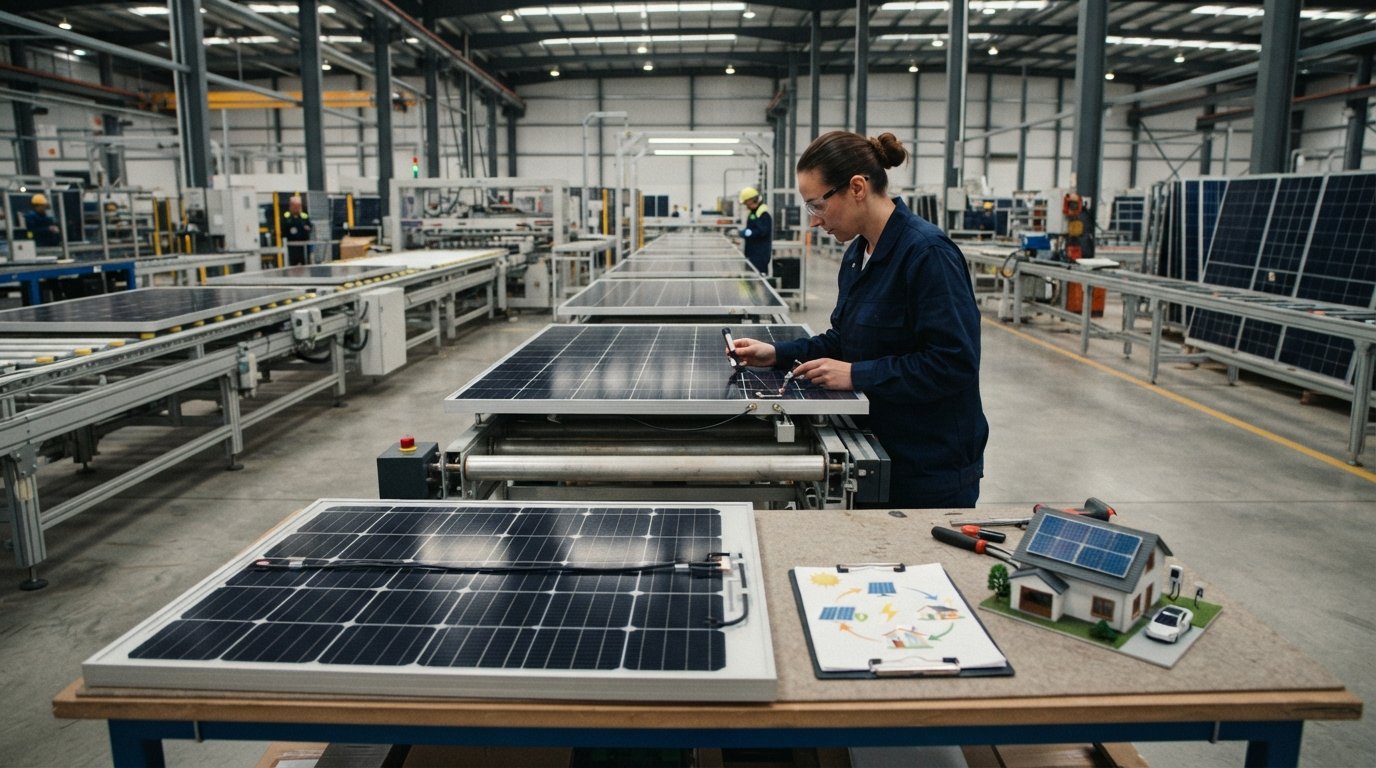
Solar Panel Carbon Debt: Manufacturing Impact and Payback
Solar panels carry a small carbon debt that is typically repaid within 1 to 3 years. Call (833)-793-7166 to explore your options.

Learn more about Solar Panel Installation and Repair for guides, costs, and what to expect.
Compare Solar Panel Installation and Repair Pros Near You

Enter your ZIP code to compare top-rated local professionals and request free quotes.
Every solar panel begins its life as a net carbon emitter. The mining, refining, manufacturing, and transport of a typical residential solar module generate more greenhouse gas emissions than the panel will avoid in its first one to two years of operation. That gap between the carbon spent to build a panel and the carbon saved by using it is called carbon debt, and understanding how long it takes to pay back is essential for anyone who cares about the true environmental footprint of their energy choices. The good news: solar panels reliably repay that debt many times over, but the timeline depends on where you live, how the panels are made, and what happens to them at end of life. This article breaks down the full lifecycle picture so you can evaluate solar on facts, not assumptions.
What Carbon Debt Means for Solar Panels
Carbon debt is the total greenhouse gas emissions released during the production and delivery of a solar panel, expressed in carbon dioxide equivalent (CO2e). It includes everything from quartz mining and silicon purification to cell fabrication, module assembly, and shipping. A panel that generates 400 watts of power for 25 years will offset far more carbon than it took to build, but only after it has operated long enough to clear that initial debt. The energy payback time (EPBT) is the number of years a panel must run to generate the same amount of energy that was consumed in its manufacture. Carbon payback time is the same concept expressed in emissions rather than energy.
Most modern monocrystalline silicon panels have an energy payback time between 1 and 2 years when installed in a sunny location, according to lifecycle assessments published by research institutions and industry groups. Carbon payback time is similar, often 1 to 3 years depending on the local electricity mix. After that point, every kilowatt-hour the panel produces displaces grid electricity that would otherwise come from fossil fuels, creating a net carbon benefit for the remaining 25 to 30 years of the system's life. The key takeaway is that solar is not zero-carbon from day one, but it becomes strongly carbon-negative over its lifetime.
It is also important to distinguish between the panel itself and the balance of system components. Inverters, racking, wiring, and batteries add to the upfront carbon footprint, though their contribution is usually smaller than the modules. For a typical residential installation, the modules account for roughly 60 to 80 percent of the total embodied carbon, with the rest coming from supporting hardware and installation. When you evaluate quotes from installers, asking about the equipment's country of origin and manufacturing standards can give you a sense of the embedded carbon you are purchasing.
Manufacturing Emissions: Where the Carbon Comes From
The solar manufacturing supply chain is energy-intensive, and the carbon intensity of the electricity used in production varies widely by region. Polysilicon production, which involves purifying metallurgical-grade silicon to 99.9999 percent purity, is the most energy-hungry step. It typically takes place in regions with relatively cheap electricity, and if that electricity comes from coal, the embedded carbon of the final panel rises substantially. Cell manufacturing and module assembly are less energy-intensive but still contribute. A panel made in a factory powered by hydroelectricity or renewables will have a significantly lower carbon footprint than one made in a coal-heavy grid.
Transportation also matters. Most solar modules installed in the United States are imported from Asia, primarily China, Vietnam, Malaysia, and Thailand. Ocean freight adds a small but nonzero amount of emissions per panel. Domestic manufacturing is expanding, and panels made in the US with a cleaner grid mix can have a lower carbon debt, though the difference is often modest compared to the total lifecycle emissions. The Inflation Reduction Act's domestic content incentives have accelerated US module assembly, but upstream polysilicon and wafer production remain concentrated overseas.
Raw material extraction is another piece of the puzzle. Silicon is abundant, but silver, copper, aluminum, and glass all require mining and refining. Silver paste used in cell metallization is a small fraction of total mass but has a high carbon intensity per kilogram. Aluminum frames and mounting structures are energy-intensive to produce, though they are highly recyclable. Glass production for module front covers also consumes significant energy. These material impacts are factored into lifecycle assessments, and they are one reason why recycling at end of life is so important.
For homeowners comparing quotes, the manufacturing origin is not always transparent. A reputable installer should be able to tell you the brand and model of the panels they propose, and you can look up manufacturer sustainability reports to see whether they publish third-party-verified environmental product declarations. This level of diligence is not necessary for everyone, but it is valuable if minimizing your carbon footprint is a primary motivation.
Energy Payback Timelines in Different Regions
Geography plays a decisive role in how quickly a solar panel repays its carbon debt. A panel installed in Arizona or Florida receives far more sunlight per year than one in the Pacific Northwest or the Northeast. Higher irradiation means more annual kilowatt-hours per installed watt, which shortens both energy and carbon payback. In sunny states, carbon payback can be under 2 years for a well-designed system. In cloudier regions, it may stretch to 3 or 4 years. Even at the high end, this is a small fraction of the system's expected 25 to 30-year lifespan.
The local grid mix also matters. If your utility generates most of its electricity from coal, each solar kilowatt-hour displaces a relatively carbon-heavy source, so the carbon benefit per kilowatt-hour is larger. Conversely, in a grid dominated by hydroelectric or nuclear power, the displaced electricity is already low-carbon, so the marginal carbon benefit of solar is smaller. This does not mean solar is less worthwhile in clean-grid states; it simply means the carbon payback calculation is different. In practice, most US grids still rely on natural gas and coal for marginal generation, so solar typically displaces fossil fuels during sunny hours.
Battery storage changes the equation. Adding a home battery increases the system's embodied carbon but allows solar energy to be used at night, displacing additional grid electricity. The carbon payback of the combined system is longer than solar alone, but still well within the system's lifetime. For most homeowners, the decision to add a battery is driven by resilience and time-of-use rate arbitrage rather than carbon accounting, but it is worth noting that batteries do carry a manufacturing footprint that should be considered.
To estimate your own carbon payback, you can use tools that combine your local solar irradiation, the carbon intensity of your utility's generation mix, and the embodied carbon of the proposed equipment. Many installers now include lifetime carbon offset estimates in their proposals, though these should be treated as rough estimates rather than precise measurements. If you want a more rigorous analysis, look for lifecycle assessment studies specific to the panel model you are considering.
Raw Material Extraction and Supply Chain Considerations
The solar supply chain has faced scrutiny over labor practices and environmental standards in polysilicon production, particularly in the Xinjiang region of China. Concerns about forced labor have led to trade restrictions and traceability requirements for panels entering the US market. For consumers, this means that some panels may be subject to import documentation requirements, and manufacturers are increasingly investing in supply chain transparency. The environmental impact of raw material extraction is also a factor: mining quartz, silver, and copper has local ecological effects, though these are typically small relative to the climate benefits of displacing fossil fuels.
Recycling and material recovery are improving. Glass, aluminum, copper, and silver can all be recovered from end-of-life panels, reducing the need for virgin materials. Silicon recovery is technically feasible but less economically common. As recycling infrastructure scales, the embodied carbon of new panels can be reduced by using recycled content, closing the loop on material flows. For now, the recycling rate for solar panels in the US is low, but policies and industry programs are beginning to change that.
Consumers who want to minimize supply chain impacts can look for manufacturers with published environmental product declarations, science-based targets for emissions reduction, and participation in take-back or recycling programs. The Solar Energy Industries Association maintains resources on responsible sourcing, and third-party certifications such as NSF/ANSI 457 provide a framework for evaluating sustainability claims. These tools are not perfect, but they offer a starting point for comparing manufacturers.
End-of-Life Recycling and US Capacity
Solar panels have a long life, but they do eventually reach end of life, either through degradation, damage, or replacement with higher-efficiency models. The first generation of utility-scale and residential systems is now reaching retirement age, and the volume of end-of-life panels is expected to grow substantially over the next decade. Without proper recycling, panels could end up in landfills, where they would lose valuable materials and pose a long-term waste management challenge. The good news is that solar panels are highly recyclable in principle: glass, aluminum, copper, and silver can be separated and recovered, and some processes can recover silicon and other materials.
US recycling capacity is still limited but expanding. Several dedicated solar recycling facilities have opened in recent years, and industry groups are working to develop standardized processes and collection networks. The cost of recycling is currently higher than landfill disposal in many areas, which is a barrier to widespread adoption. However, policies such as extended producer responsibility (EPR) laws, which require manufacturers to fund take-back and recycling, are gaining traction at the state level. Washington and California have led the way, and other states are considering similar legislation.
For homeowners, the practical takeaway is to ask your installer about end-of-life plans. Some manufacturers offer take-back programs, and some installers partner with recyclers. When the time comes to replace or remove a system, choosing a responsible recycler ensures that the materials are recovered and the environmental benefits of solar are maximized. Proper disposal also prevents hazardous substances, such as small amounts of lead or cadmium in some panel types, from entering the environment.
It is also worth noting that recycling reduces the carbon debt of future panels. By recovering aluminum, glass, and silicon, manufacturers can lower the embodied energy of new products. As recycling infrastructure matures, the lifecycle carbon footprint of solar will continue to improve, strengthening the case for solar as a cornerstone of a low-carbon energy system.
Lifecycle Emissions Compared with Grid Electricity
To put solar's carbon debt in perspective, consider the lifecycle emissions of different electricity sources. Coal-fired power plants emit roughly 1,000 grams of CO2e per kilowatt-hour over their lifecycle, including mining and transport. Natural gas combined-cycle plants emit around 400 to 500 grams. Solar photovoltaics, by contrast, emit roughly 20 to 50 grams of CO2e per kilowatt-hour over their lifecycle, depending on manufacturing location and technology. Wind power is in a similar range, and nuclear is lower still. These figures are based on lifecycle assessments that account for manufacturing, installation, operation, and decommissioning.
The comparison is stark: even accounting for manufacturing, solar is an order of magnitude cleaner than coal and significantly cleaner than natural gas. The carbon debt is real but quickly repaid, after which solar produces electricity with zero ongoing emissions. Over a 25-year horizon, a typical residential solar system will avoid tens of thousands of pounds of CO2 compared to grid electricity, depending on the local grid mix and system size. This is why solar is considered a key tool for decarbonization.
It is important to use accurate comparisons. Some critics of solar point to the energy intensity of manufacturing and suggest that panels never pay back their carbon debt, but this claim is not supported by the evidence. Numerous peer-reviewed studies and industry lifecycle assessments confirm payback times of a few years at most. The variation comes from assumptions about irradiation, manufacturing efficiency, and grid mix, but the overall conclusion is robust: solar pays back its carbon debt many times over.
For homeowners who want to maximize their climate benefit, the strategy is straightforward: install a right-sized system, keep it well maintained to ensure optimal performance, and plan for responsible end-of-life recycling. If you are considering solar and want to compare quotes from vetted installers, NewSolarQuotes offers an independent educational resource and a free quote service that can help you evaluate options without pressure. Understanding the full lifecycle impact empowers you to make a decision that aligns with both your financial and environmental goals.
Solar panel manufacturing does carry an environmental cost, but it is a cost that is paid back quickly and then some. The carbon debt is a temporary liability, not a permanent flaw. As manufacturing becomes cleaner, recycling improves, and grids get greener, the lifecycle case for solar only gets stronger. For homeowners motivated by sustainability, the most important step is to ensure that the system is designed, installed, and eventually recycled responsibly, so that the environmental benefits are fully realized. If you are ready to explore your options, gathering quotes from multiple installers is a smart first move, and you can start by understanding solar panel failure risks and protection to make a more informed decision.