
Powering Critical Loads With Solar Battery During Outage
Configure a solar battery to keep essentials running during blackouts. Call (833)-793-7166 for a free backup sizing quote and protect your critical loads.

Learn more about Solar Panel Installation and Repair for guides, costs, and what to expect.
Compare Solar Panel Installation and Repair Pros Near You

Enter your ZIP code to compare top-rated local professionals and request free quotes.
When the grid goes down, the difference between a minor inconvenience and a major disruption often comes down to which circuits keep running. A solar plus battery system can keep your refrigerator cold, your well pump pressurized, and your medical devices operational, but only if it is designed to handle those specific loads. Powering critical loads with solar battery during an outage is not automatic: it requires deliberate planning around load panels, transfer switches, inverter capabilities, and surge management. This guide walks through the technical and practical decisions that determine whether your backup system carries you through a blackout or trips the first time your air conditioner tries to start.
How Critical Loads Panels and Automatic Transfer Switches Work Together
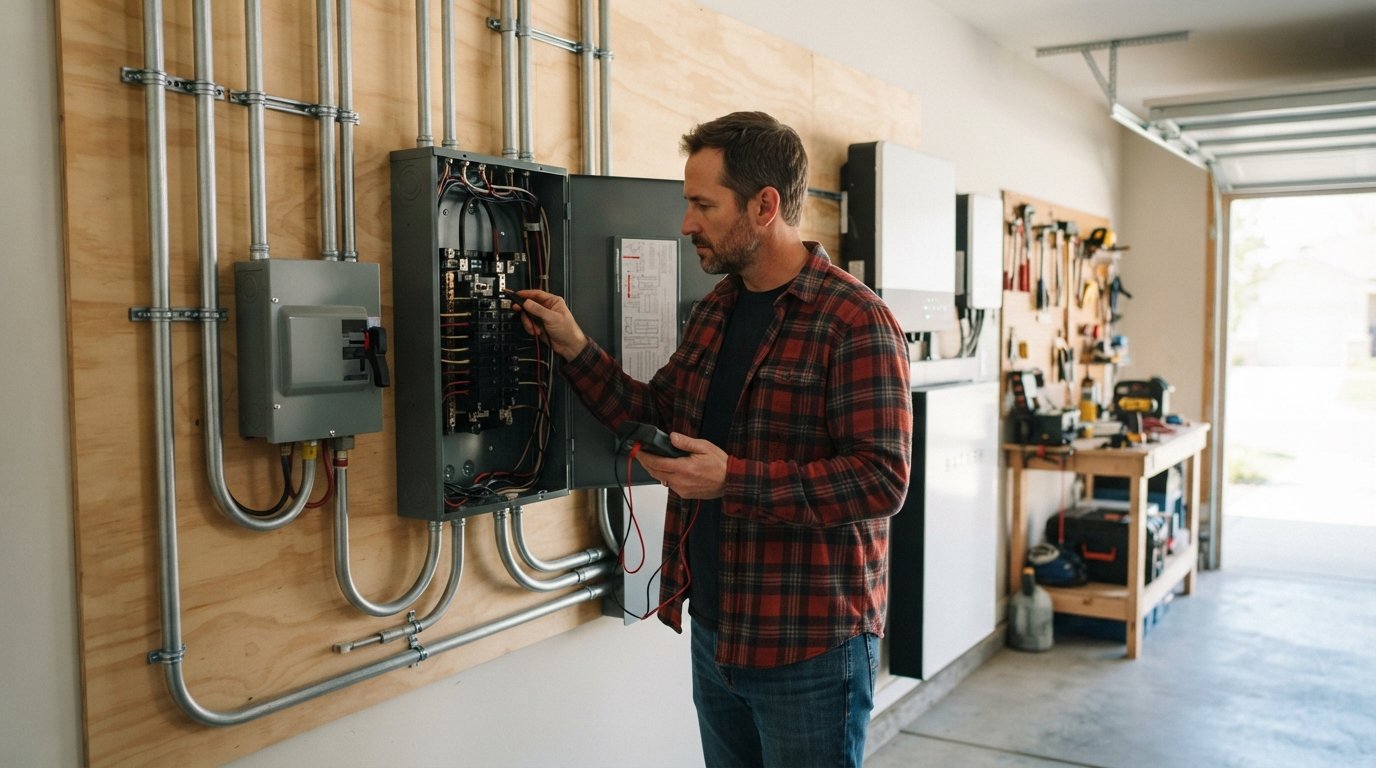
A critical loads panel (sometimes called a backup loads panel or subpanel) is a dedicated electrical panel that receives power from both the grid and your battery system. During normal operation, the main panel feeds the critical loads panel through the grid. When an outage occurs, an automatic transfer switch (ATS) disconnects your home from the utility lines and reconnects the critical loads panel to your battery and solar inverter. This isolation is essential: it prevents your system from backfeeding power onto lines that utility crews may be servicing, a hazard known as islanding.
The ATS must be rated for the full current of the circuits it manages, and it must switch quickly enough to avoid disrupting sensitive electronics. Most modern transfer switches complete the transition in under a second, though some sensitive medical equipment may require an uninterruptible power supply (UPS) on the device itself. The critical loads panel then becomes the sole distribution point for backup power, which means every circuit you want powered during an outage must be moved from the main panel to this subpanel during installation.
This relocation is the step most homeowners underestimate. An electrician must physically re-route each backed-up circuit, which can add several hours of labor and material cost to the project. The payoff is clarity: after the work is done, you know exactly which outlets, appliances, and systems will remain live when the grid fails. If you are considering adding a battery to an existing solar array, our guide on adding a battery to solar later explains how retrofits handle critical loads panels and transfer switch integration.
Sizing Backup Capacity for Refrigeration, Well Pump, and Medical Equipment
Sizing a battery for whole-home backup is straightforward arithmetic: add up the running watts of every appliance and multiply by the hours you expect to be off-grid. Sizing for critical loads is more nuanced because the goal is not comfort but continuity. Start by listing the loads you cannot live without for 12 to 24 hours. Typical entries include a refrigerator (150 to 250 running watts, but with a 3x surge at compressor startup), a well pump (500 to 1,500 running watts, with a 2x to 3x surge), a furnace blower (300 to 800 watts), medical devices (100 to 400 watts), and a few LED lights and phone chargers (under 200 watts total).
Once you have the running watts, multiply by the hours you need backup and add a 20 percent buffer for inverter efficiency losses and battery degradation over time. For example, a refrigerator that runs 8 hours per day at 200 watts consumes 1.6 kWh daily. A well pump that runs 1 hour at 1,000 watts consumes 1 kWh. Medical equipment running continuously at 150 watts consumes 3.6 kWh. That totals roughly 6.2 kWh, plus a 20 percent buffer, for a requirement of about 7.5 kWh of usable battery capacity. Most residential batteries offer 10 to 13.5 kWh of usable capacity, so a single unit can typically cover these essentials for a day or more.
Medical equipment deserves special attention. If a device is life-sustaining, the battery system should be sized to cover at least 48 hours of operation, and the device should have its own battery backup or UPS as a second layer of protection. Some homeowners also add a dedicated critical loads panel circuit for medical devices so that other loads cannot drain the battery below the medical reserve. Always consult the device manufacturer for startup and running wattage, and consider a load-shedding strategy that automatically disconnects non-essential circuits when battery state of charge drops below a set threshold.
- Refrigeration: 150 to 250 running watts, 3x surge at compressor start, roughly 1.5 to 2 kWh per day.
- Well pump: 500 to 1,500 running watts, 2x to 3x surge, roughly 1 to 2 kWh per day depending on usage.
- Medical equipment: 100 to 400 watts continuous, 2.4 to 9.6 kWh per day, often requires UPS backup.
- Furnace blower: 300 to 800 watts, 1 to 3 kWh per day in heating season.
- Lights and communications: under 200 watts total, roughly 1 to 2 kWh per day.
These figures are starting points, not final answers. A licensed electrician or solar designer should perform a load calculation using actual nameplate data and your household usage patterns. If you are unsure which loads to prioritize, a free solar quote from a vetted installer can include a backup sizing assessment tailored to your home.
The Grid-Forming Inverter Role in Outage Ride-Through
Not all solar inverters can operate during an outage. Standard grid-tied string inverters are designed to shut down when the grid fails, a safety requirement that prevents islanding. To power critical loads with solar battery during an outage, you need a grid-forming inverter, sometimes called a bidirectional or hybrid inverter, that can establish its own voltage and frequency reference. This capability allows the inverter to act as the grid for your home, coordinating battery discharge, solar production, and load management without any utility signal.
Grid-forming inverters also manage the transition between grid-tied and off-grid modes. When the ATS disconnects from the utility, the inverter detects the loss of grid voltage and switches to voltage-source mode within milliseconds. During this transition, the inverter must match the phase and frequency of the loads it is serving, or sensitive electronics may reboot. High-quality hybrid inverters, such as those from SolarEdge, Enphase, and Tesla, handle this seamlessly, but budget inverters may exhibit a brief flicker or dropout.
Another critical function of the grid-forming inverter is frequency-shift power control. When the battery is full and solar production exceeds the critical loads, the inverter raises the frequency slightly to signal the solar inverters to curtail production. Without this feature, excess solar energy could overcharge the battery or cause the system to shut down. If you are comparing inverter technologies, our article on string versus microinverters explains how each type interacts with battery backup, though grid-forming capability is typically a function of the battery inverter rather than the solar inverter itself.
Startup Surge Loads That Trip Undersized Backup Systems
The most common reason a backup system fails during an outage is not average power draw but startup surge. Motors in refrigerators, well pumps, air conditioners, and furnaces draw two to five times their running wattage for a few seconds when they start. A battery inverter rated for 5 kW continuous might handle a 4 kW running load, but if a well pump with a 3x surge starts while the refrigerator compressor is also running, the combined surge could exceed 10 kW and trip the inverter offline.
To avoid this, size the inverter for the largest surge plus the running wattage of all other simultaneous loads. Alternatively, use soft-start devices on motors, which reduce inrush current by 30 to 70 percent. Soft starters are especially valuable for well pumps and air conditioners. Load-shedding controls can also help: the inverter or a smart panel can temporarily disconnect non-essential circuits when a surge occurs, then reconnect them after the motor starts.
Another strategy is to sequence loads manually. During an outage, avoid running the microwave and the well pump at the same time, and wait a few minutes after the refrigerator cycles off before starting the furnace. These behavioral adjustments are simple but effective. For homeowners with large surge loads, a battery system with a high surge rating (for example, 7 kW continuous and 10 kW peak for 10 seconds) provides more headroom than a budget unit rated at 5 kW continuous and 6 kW peak.
If your system does trip, the inverter usually restarts automatically after a short delay. However, repeated trips indicate that the backup system is undersized for your critical loads. In that case, adding a second battery or a soft starter is often cheaper than replacing the inverter. A qualified installer can measure actual surge currents with a clamp meter and recommend the right fix. For broader home resilience, including plumbing and electrical repairs that may be needed after a storm, platforms like Repairmen connect homeowners with vetted local professionals for emergency repairs and maintenance.
Designing a Resilient Backup Strategy
Powering critical loads with solar battery during an outage is ultimately a design exercise: match the battery capacity to your essential loads, choose a grid-forming inverter with adequate surge ratings, and install a critical loads panel that isolates the circuits you need. The best time to make these decisions is before the outage, ideally during the initial solar installation when labor costs for panel relocation are lowest. If you already have solar and are considering storage, a retrofit is feasible but may require upgrading the inverter and adding a transfer switch.
Start by listing your must-have loads, then work with a licensed electrician or solar designer to calculate running watts, surge watts, and daily energy consumption. Use that data to select a battery with at least 20 percent more usable capacity than your calculation, and verify that the inverter can handle the largest surge plus simultaneous running loads. Finally, test the system by simulating an outage: turn off the main breaker and confirm that the critical loads panel stays energized and that no sensitive equipment reboots. A annual test, combined with software updates and battery health checks, keeps your backup system ready when you need it most.