
Solar Panel Bird Proofing Cost and Installer Options for 2026
Solar panel bird proofing cost and installer options explained. Call 8337937166 for free quotes and protect your solar investment today.

By Liam Parker
Learn more about Solar Panel Installation and Repair for guides, costs, and what to expect.
Compare Solar Panel Installation and Repair Pros Near You

Enter your ZIP code to compare top-rated local professionals and request free quotes.
Birds may look harmless from a distance, but when they decide to nest under your solar panels, the damage can be expensive and frustrating. The gap between a rooftop and a solar array creates a perfect, warm, and protected shelter that pigeons, sparrows, and other birds find irresistible. Once they move in, the problems multiply quickly: droppings corrode wiring and mounting hardware, nesting materials block airflow and reduce energy production, and the constant activity can void your panel warranty. The good news is that bird proofing is one of the most affordable solar add-ons available, and it pays for itself by protecting your system and your home. This guide breaks down what bird proofing actually costs, which installer options make sense for different budgets, and how to choose a provider you can trust.
Why Bird Proofing Matters More Than Most Homeowners Realize
Solar panels are designed to last 25 years or more, but that lifespan assumes the space beneath them stays clear. When birds nest under an array, they create a cycle of damage that is easy to miss until it becomes serious. The most common issue is droppings, which are acidic and can eat through the protective coating on wiring, junction boxes, and roof shingles. Over time, that corrosion leads to electrical faults, ground faults, and even fire risk. Nesting materials like twigs, leaves, and feathers also block the airflow that keeps panels cool, which means your system runs hotter and produces less electricity.
There is another layer of cost that many homeowners do not consider: roof damage. Birds often build nests near roof vents, valleys, and flashing, and the accumulated debris can trap moisture against the roof deck. That moisture leads to rot, mold, and expensive repairs that have nothing to do with your solar equipment. In some cases, insurance companies have started asking about pest exclusion during claims, and a documented bird proofing installation can help demonstrate that you maintained the property responsibly.
The financial case for bird proofing is straightforward. A typical installation costs a fraction of what you would pay to repair corroded wiring or replace damaged roof sections. It also protects the performance of your system, which is the whole point of going solar in the first place. If you are still evaluating your overall solar investment, our solar panel replacement cost guide explains how panel-level failures can affect long-term savings.
What Solar Panel Bird Proofing Actually Involves
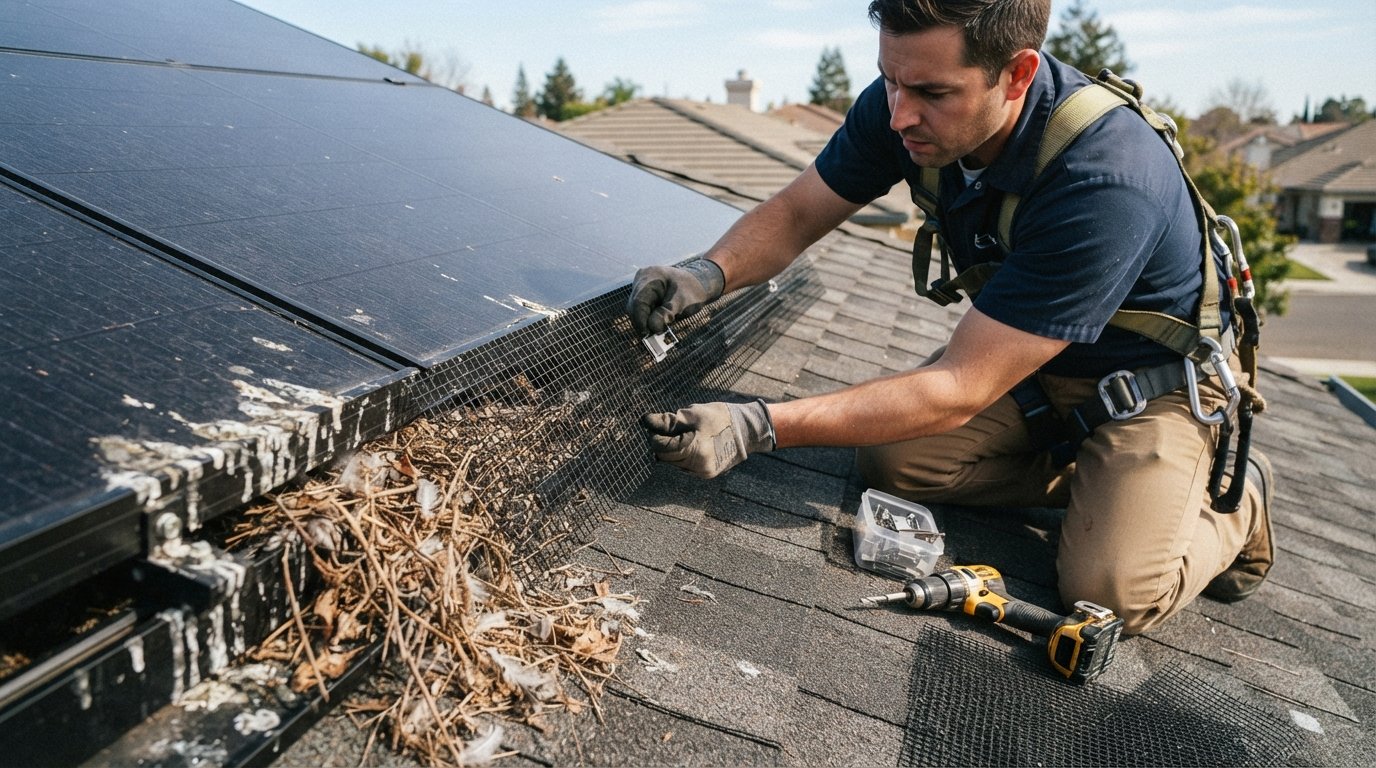
Bird proofing is not a single product. It is a system of barriers and exclusion materials that seal the gap between the panel edge and the roof surface. The most common solution is a coated steel mesh that is cut to fit around the perimeter of the array. The mesh is attached with clips that do not penetrate the roof or the panel frame, so there is no risk of voiding warranties. Installers typically use stainless steel or PVC-coated galvanized mesh because it resists rust and UV degradation for a decade or more.
Beyond mesh, some installers use rigid plastic or metal skirts that snap onto the panel frame. These skirts look cleaner and can be more durable, but they cost more and may not fit every panel profile. Another option is a wire-based exclusion system that uses tensioned wires to create a physical barrier. This approach is less common but can work well on arrays with irregular shapes or tight clearances.
A proper installation also includes sealing small gaps at the ends of the array, around conduit penetrations, and at the roofline. If those gaps are left open, birds will simply find another way in. Reputable installers will inspect the entire array, identify every potential entry point, and close them all. They will also remove any existing nests and clean the area before installing the barrier, which is important for both hygiene and safety.
Solar Panel Bird Proofing Cost Breakdown
The cost of bird proofing depends on the size of your array, the complexity of your roof, and the type of barrier you choose. For a typical residential system with 20 to 30 panels, most homeowners pay between $500 and $1,200 for a complete installation. That range covers materials, labor, and cleanup. Smaller arrays with easy roof access can cost as little as $300 to $500, while larger or more complex installations can reach $1,500 or more.
Here is a practical breakdown of what drives the price:
- Array size: Most installers charge per linear foot of perimeter, typically $8 to $15 per foot. A 30-panel array might have 120 to 150 linear feet of perimeter, which puts the material and labor cost in the $900 to $1,500 range.
- Roof pitch and height: Steep roofs and multi-story homes require more safety equipment and time, which adds $100 to $300 to the project.
- Barrier material: Coated steel mesh is the most affordable and widely used option. Rigid skirts and custom-fabricated metal barriers cost 20 to 40 percent more.
- Existing nest removal: If birds have already moved in, the installer must remove nests, clean droppings, and sometimes replace damaged wiring or insulation. This can add $200 to $500 or more.
- Travel and access: Remote locations or homes with limited parking can increase labor costs, though most local installers include travel within a standard service radius.
It is worth noting that bird proofing is rarely covered by solar panel warranties. Manufacturers cover defects in materials and workmanship, not pest damage. That means the cost comes out of your pocket either way, but proactive proofing is almost always cheaper than reactive repairs. If you are comparing quotes for a new solar installation, ask whether bird proofing can be bundled into the project. Many installers offer a discount when it is added at the same time as the main installation because they are already on the roof with the necessary equipment.
Installer Options: Who Should You Hire?
There are three main paths for getting bird proofing installed, and each has trade-offs in cost, convenience, and quality. The right choice depends on your budget, your timeline, and how comfortable you are managing the project yourself.
Solar installers and solar maintenance companies are often the best option for quality and warranty protection. These companies already understand rooftop solar systems, and they can inspect the array for damage while they are up there. Many offer bird proofing as a standard add-on service, and some will bundle it with panel cleaning or annual maintenance. The downside is that solar companies tend to be busier and may charge a premium for small jobs. Expect to pay $800 to $1,500 for a full installation, but you get the peace of mind that comes with licensed, insured professionals who know how to work around electrical components.
Pest control and wildlife exclusion specialists are another strong option, especially if birds have already caused damage. These companies are experts at excluding animals from structures, and they often have access to commercial-grade materials that are not available at retail stores. They may also offer warranties on their work and can handle related issues like rodent exclusion or attic vent sealing. Pricing is usually competitive with solar installers, ranging from $600 to $1,300 for a typical home. The main limitation is that not all pest control companies are familiar with solar arrays, so you should ask about their experience with rooftop solar before hiring.
General handymen and roofing contractors can sometimes handle bird proofing at a lower cost, but the quality varies widely. A skilled handyman can install mesh and clips effectively, but they may not know how to avoid damaging panel frames or wiring. Roofing contractors are a good fit if the bird proofing is part of a larger roof repair or replacement project. For standalone bird proofing, it is usually worth paying a bit more for a specialist who has done the work many times before.
If you are not sure where to start, a free quote service can connect you with vetted local providers who have experience with solar bird proofing. That approach saves time and helps you compare pricing without calling dozens of companies individually. For broader context on solar services and industry insights, SolarEnergy.ai is a useful resource for homeowners researching solar options.
How to Vet a Bird Proofing Installer
Not every installer who claims to offer bird proofing does the job correctly. Poorly installed mesh can sag, tear, or create new gaps that let birds back in. It can also trap debris against the roof, which defeats the purpose of the barrier. Before you hire anyone, ask a few direct questions that separate professionals from amateurs.
Start by asking how they attach the mesh to the panel frame. The correct answer involves clips or fasteners that do not penetrate the panel or the roof. If an installer proposes drilling into the panel frame or using adhesive alone, walk away. Next, ask about the material they use. Stainless steel or PVC-coated galvanized mesh is the standard for durability. Bare galvanized mesh will rust over time, and plastic mesh can become brittle in harsh sunlight.
You should also ask whether they remove existing nests and clean the area before installation. A proper job includes clearing out debris, checking for damage, and sealing all entry points. Finally, ask about warranty and follow-up. A reputable installer will stand behind their work for at least one to two years and will come back if birds find a way through. Get everything in writing, including the scope of work, materials, and warranty terms.
It is also smart to check licensing and insurance. In most states, anyone working on your roof should carry liability insurance and workers compensation coverage. If they do not, you could be held responsible for injuries that happen on your property. A quick call to your state licensing board or a look at online reviews can confirm whether a company is legitimate.
DIY vs Professional Installation: What Makes Sense?
Some homeowners consider DIY bird proofing to save money, and it is technically possible to buy mesh and clips online for $150 to $300. However, the installation itself is more challenging than it looks. You need to work safely on a roof, cut and shape mesh around panel edges, and secure it without damaging the solar equipment. If you make a mistake, you can void your panel warranty or create a new entry point for birds.
Professional installation is almost always worth the added cost for a few reasons. First, professionals have the right tools and safety equipment, which reduces the risk of falls and injuries. Second, they know how to work around live electrical components without causing damage. Third, they can identify and fix underlying issues, such as loose flashing or damaged wiring, that you might miss. Finally, a professional installation typically comes with a warranty, so if something goes wrong, you have recourse.
There is one scenario where DIY might make sense: if you have a small, ground-mounted array that is easy to access and you are comfortable with basic tools. Even then, you should research the correct materials and methods carefully. For rooftop systems, the risk of damage and injury is simply too high for most homeowners to justify the savings.
Long-Term Savings and Maintenance Tips
Bird proofing is a one-time investment that delivers ongoing returns. By keeping birds out, you protect your system from corrosion, reduce the need for cleaning, and maintain peak energy production. You also avoid the hassle of dealing with nests, droppings, and the health risks that come with them. Over the life of your solar system, those savings can easily reach thousands of dollars.
To get the most out of your bird proofing, schedule a visual inspection once a year. Look for sagging mesh, loose clips, or new gaps that might have opened up. If you notice birds gathering near the array, act quickly before they establish a nest. A quick repair is almost always cheaper than a full reinstallation. You should also keep trees trimmed back from the roof, since overhanging branches give birds easy access to the panels.
Finally, consider combining bird proofing with a panel cleaning service. Clean panels produce more electricity, and the cleaning crew can check the mesh while they are on the roof. Many solar maintenance companies offer both services together at a discounted rate. That kind of preventive care keeps your system running efficiently and protects your investment for decades.
Bird proofing may not be the most glamorous part of going solar, but it is one of the smartest. For a few hundred dollars, you can avoid thousands in potential repairs and keep your energy production on track. Whether you hire a solar specialist, a pest control expert, or a trusted handyman, the key is to choose someone who understands both birds and solar equipment. Do that, and your panels will stay clean, cool, and productive for years to come.