
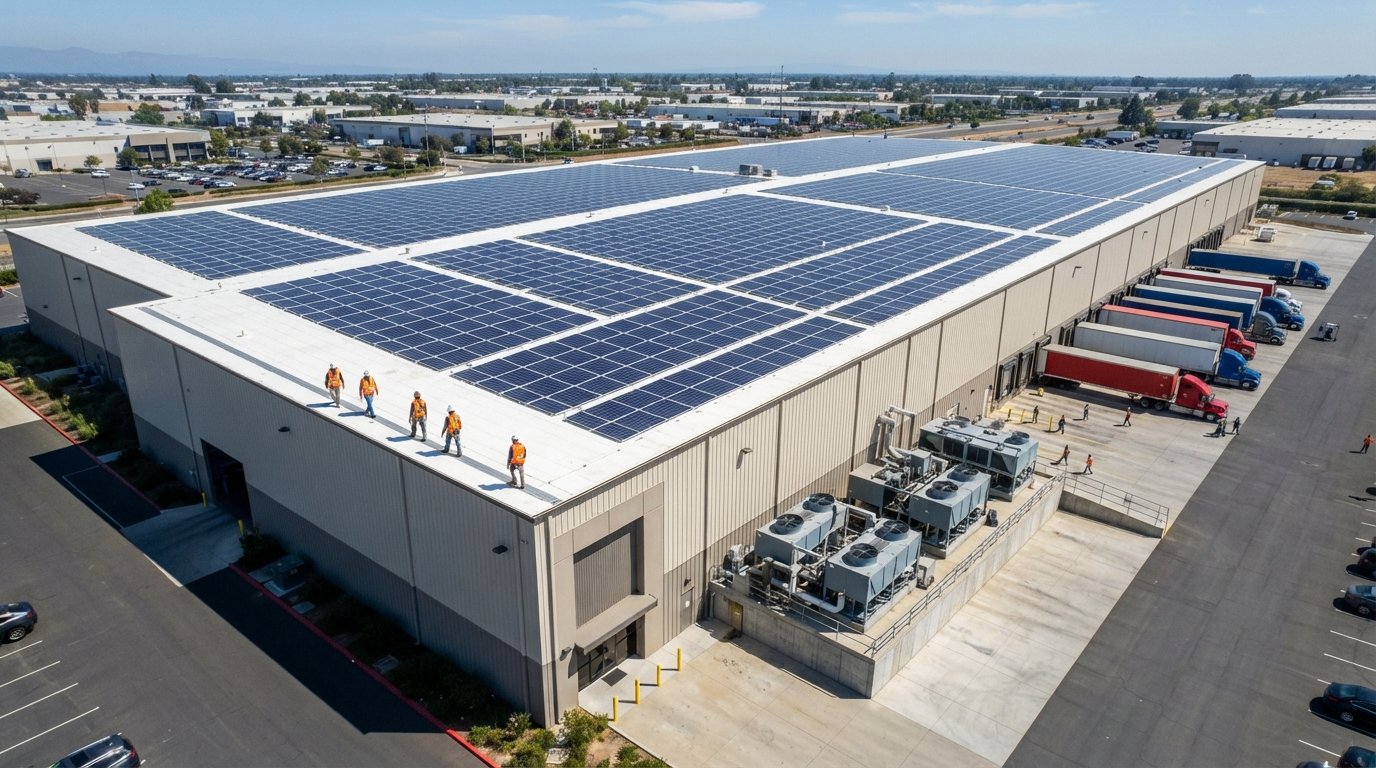
Solar Plus Warehouse Refrigeration Load Offset for Cold Storage
Offset cold storage refrigeration loads with solar. Call (833)-793-7166 to compare free commercial solar quotes and cut demand charges.

Learn more about Solar Panel Installation and Repair for guides, costs, and what to expect.
Compare Solar Panel Installation and Repair Pros Near You

Enter your ZIP code to compare top-rated local professionals and request free quotes.
Cold storage warehouses are energy-intensive by design. Refrigeration compressors, evaporator fans, and defrost cycles run around the clock, creating a baseload demand that never truly sleeps. For operators watching demand charges climb and utility rates shift, solar plus warehouse refrigeration load offset for cold storage offers a way to shrink operating costs while stabilizing long-term energy budgets. The challenge is not whether solar can help, but how to size and design a system that matches the unique load profile of a refrigerated facility.
This article breaks down how solar interacts with continuous refrigeration loads, demand charges, resilience planning, and commercial incentives. Whether you manage a distribution center, a food processing plant, or a third-party logistics warehouse, understanding these mechanics helps you ask smarter questions and evaluate proposals with confidence.
Why Refrigeration and Cold Storage Run High Baseload Demand
Unlike office buildings or retail spaces that peak during business hours and idle at night, cold storage facilities maintain temperature setpoints 24 hours a day, 7 days a week. A typical refrigerated warehouse may consume 40 to 60 percent of its total electricity through refrigeration alone, and that consumption is remarkably flat across the clock. Compressors cycle to hold temperature, evaporator fans move air continuously, and periodic defrost cycles add short bursts of high demand.
The result is a load profile that looks less like a hill and more like a plateau. Utilities price this pattern in two ways: volumetric energy charges (cents per kWh) and demand charges (dollars per kW of peak demand). Because refrigeration equipment often sets the facility peak, cold storage operators pay demand charges based on compressor startup and simultaneous load events, not just total consumption. Solar can address both components, but the strategy differs for each.
Understanding your load shape is the first step. A facility that runs a 300 kW refrigeration baseload plus 100 kW of lighting and office load has a very different solar sizing equation than a daytime-only operation. The goal is to offset the portion of that baseload that solar production can realistically cover, while accounting for the fact that solar produces only during daylight hours.
Sizing Solar Around 24-Hour Loads Versus Daytime Operations
The central tension in cold storage solar design is temporal mismatch. Solar panels generate electricity when the sun shines, but refrigeration loads persist through the night. A system sized to offset 100 percent of annual kWh consumption will overproduce during the day and leave the facility drawing grid power after sunset. That is not necessarily a problem, but it changes the economics.
There are three common sizing approaches for refrigerated warehouses:
- Daytime load offset: Size the array to match average daytime facility load, maximizing self-consumption and minimizing export to the grid. This approach often delivers the best simple payback because every kWh produced is used on site.
- Annual energy offset: Size the array to produce roughly the same annual kWh as the facility consumes. This works well when net metering or export compensation is favorable, but it may result in low-value exports if the utility pays wholesale rates.
- Demand-focused sizing: Size the array to clip peak demand charges during sunny hours, often paired with battery storage or load controls to shave peaks that occur outside solar production windows.
For most cold storage operators, a hybrid approach works best: size solar to cover the daytime refrigeration baseload plus other facility loads, then evaluate battery storage or generator integration for night-time resilience and demand management. A professional solar quote should include a load analysis, not just a roof measurement. If you are relocating a facility or expanding, resources like Moving.Homes relocation guides can help you plan the move while keeping energy infrastructure decisions on track.
It is also worth noting that refrigeration efficiency upgrades, such as variable frequency drives, floating head pressure controls, and LED lighting, reduce the load before solar is sized. Efficiency first, then solar, then storage is a sound sequence for maximizing return on investment.
Demand Charges and How Solar Shifts Peak kW Billing
Demand charges are often the largest controllable cost in a cold storage utility bill. A facility with a 500 kW peak demand and a $15 per kW demand charge pays $7,500 per month before a single kWh is consumed. Solar can reduce demand charges, but only if production coincides with the facility peak.
In many refrigerated warehouses, the peak demand occurs during the hottest part of the day when compressors work hardest. That aligns well with solar production. A well-designed system can shave 20 to 40 percent off peak demand during sunny hours, depending on array size and load shape. However, if the facility peak occurs at night or during a defrost cycle after sunset, solar alone will not reduce that demand component.
This is where battery storage or intelligent load controls enter the picture. A battery can discharge during peak demand events, and advanced controls can stagger compressor startups to avoid simultaneous inrush. Some utilities also offer demand response programs that pay facilities to reduce load during grid emergencies, and solar plus storage can help meet those commitments without compromising temperature integrity.
Operators should request interval data from their utility and share it with solar designers. A proposal that ignores demand charges is incomplete for a cold storage facility. The right design will model both energy and demand savings, and it will be transparent about assumptions regarding utility rate structures.
Battery or Generator Pairing for Refrigeration Resilience
Refrigeration failure is not just an inconvenience; it is a product loss event. A power outage that lasts more than a few hours can compromise inventory, trigger insurance claims, and damage customer relationships. Solar alone does not provide backup power unless it is paired with battery storage and the appropriate controls.
For cold storage facilities, resilience planning typically involves one of three configurations:
- Solar plus battery storage: The battery provides seamless backup for critical refrigeration circuits and can also perform demand charge management and time-of-use arbitrage. This is the most flexible option but requires careful sizing to cover the desired outage duration.
- Solar plus generator: The generator provides long-duration backup, while solar reduces fuel consumption and emissions during extended outages. This is common in facilities that already have generator infrastructure.
- Solar plus battery plus generator: A layered approach that uses the battery for short outages and demand management, the generator for extended outages, and solar for everyday cost offset. This offers the highest resilience but also the highest capital cost.
The right choice depends on your risk tolerance, utility reliability, and insurance requirements. Some insurers offer premium discounts for facilities with documented backup power and temperature monitoring. It is worth having a conversation with your insurer early in the design process, because resilience investments can sometimes be justified partly through insurance savings.
Battery sizing for refrigeration resilience is not the same as whole-facility backup. Most operators prioritize critical circuits: compressor controls, monitoring systems, and enough refrigeration capacity to maintain safe temperatures for a defined period. A solar designer experienced with commercial cold storage can help model these scenarios and size the battery accordingly.
Incentive and Depreciation Treatment for Commercial Cold Storage Solar
Commercial solar projects benefit from a range of federal and state incentives that can dramatically improve payback. For cold storage facilities, the investment tax credit (ITC) and accelerated depreciation are often the largest value drivers. The federal ITC has historically covered a percentage of system costs, and commercial projects may also qualify for bonus depreciation or Modified Accelerated Cost Recovery System (MACRS) treatment. Because incentive rules and percentages change, always verify current details with a tax professional and official sources before finalizing a project budget.
State and utility incentives vary widely. Some states offer rebates, renewable energy credit (REC) markets, or property tax exemptions for commercial solar. Utilities may offer demand response payments or clean energy programs that stack with solar. A comprehensive incentive analysis should be part of every commercial solar proposal, and it should distinguish between tax credits, taxable grants, and utility programs, because each has different tax implications.
For cold storage specifically, there may be additional opportunities through energy efficiency programs. Refrigeration upgrades and controls sometimes qualify for separate incentives, and bundling efficiency measures with solar can improve overall project economics. It is also worth exploring whether your facility qualifies for rural energy programs or manufacturing tax incentives, depending on its location and operations.
FreeSolarPowerQuotes connects business owners with reputable third-party solar providers who can prepare detailed proposals, including incentive analysis and financing options. The service is free and carries no obligation, making it a practical starting point for operators who want to compare quotes without pressure.
Design and Operational Considerations for Cold Storage Solar
Rooftop solar on a refrigerated warehouse presents unique design considerations. Roof structure, membrane condition, and available area all influence system size. Many cold storage roofs are large and flat, which is ideal for solar, but the roof may also host condensers, vents, and other equipment that create shading and access constraints. A structural review is essential before mounting solar, especially on older buildings.
Ground-mounted solar or carport structures may be viable alternatives if roof space is limited or if roof warranty concerns arise. Carports offer the added benefit of shading parking areas, which can improve customer and employee comfort. For facilities with adjacent land, ground-mount systems can be sized more flexibly and may simplify maintenance access.
Operationally, solar requires minimal attention, but monitoring is important. A production dashboard helps operators verify that the system is performing as expected and identify underperformance early. Most commercial solar providers offer monitoring and maintenance packages, and some include performance guarantees. It is worth asking about these details during the quote process.
Finally, consider how solar interacts with your existing electrical infrastructure. Interconnection studies, switchgear upgrades, and utility coordination can add time and cost to a project. An experienced commercial solar installer will manage these steps, but operators should plan for them in their project timeline.
Frequently Asked Questions
Can solar fully offset refrigeration load in a cold storage warehouse?
Solar can offset a significant portion of annual energy consumption, but it cannot fully offset nighttime refrigeration load without battery storage or another firm power source. Most facilities target 40 to 70 percent solar offset, depending on roof space, budget, and utility rate structure. The goal is to maximize self-consumption and demand reduction, not necessarily to reach 100 percent.
How does solar affect demand charges for refrigerated facilities?
Solar reduces demand charges when production coincides with facility peak demand. Because refrigeration peaks often occur during hot daytime hours, solar can shave peak kW and lower monthly demand charges. For peaks that occur outside solar hours, battery storage or load controls are needed.
What incentives are available for commercial cold storage solar?
Commercial solar projects may qualify for the federal investment tax credit, accelerated depreciation, state and utility rebates, and renewable energy credits. Incentive availability and amounts change, so verify current programs with a tax professional and official sources. Some energy efficiency programs also cover refrigeration upgrades that complement solar.
Is battery storage necessary for refrigeration resilience?
Battery storage is not always necessary, but it is the most direct way to provide backup power for critical refrigeration circuits during outages. Facilities with generators may pair solar with existing backup systems. The right approach depends on outage risk, insurance requirements, and budget.
How do I get quotes for a cold storage solar project?
Start by gathering 12 months of utility interval data and a roof or site plan. Then request quotes from multiple commercial solar providers. FreeSolarPowerQuotes can connect you with pre-screened installers who understand commercial refrigeration loads and can prepare detailed proposals.
Solar plus warehouse refrigeration load offset for cold storage is a practical strategy for controlling energy costs in an industry where margins are tight and uptime is critical. By understanding load profiles, sizing solar to match daytime demand, planning for resilience, and taking advantage of commercial incentives, cold storage operators can build a business case that stands up to scrutiny. The next step is a conversation with a qualified commercial solar provider who can translate these principles into a concrete design and financial model.