
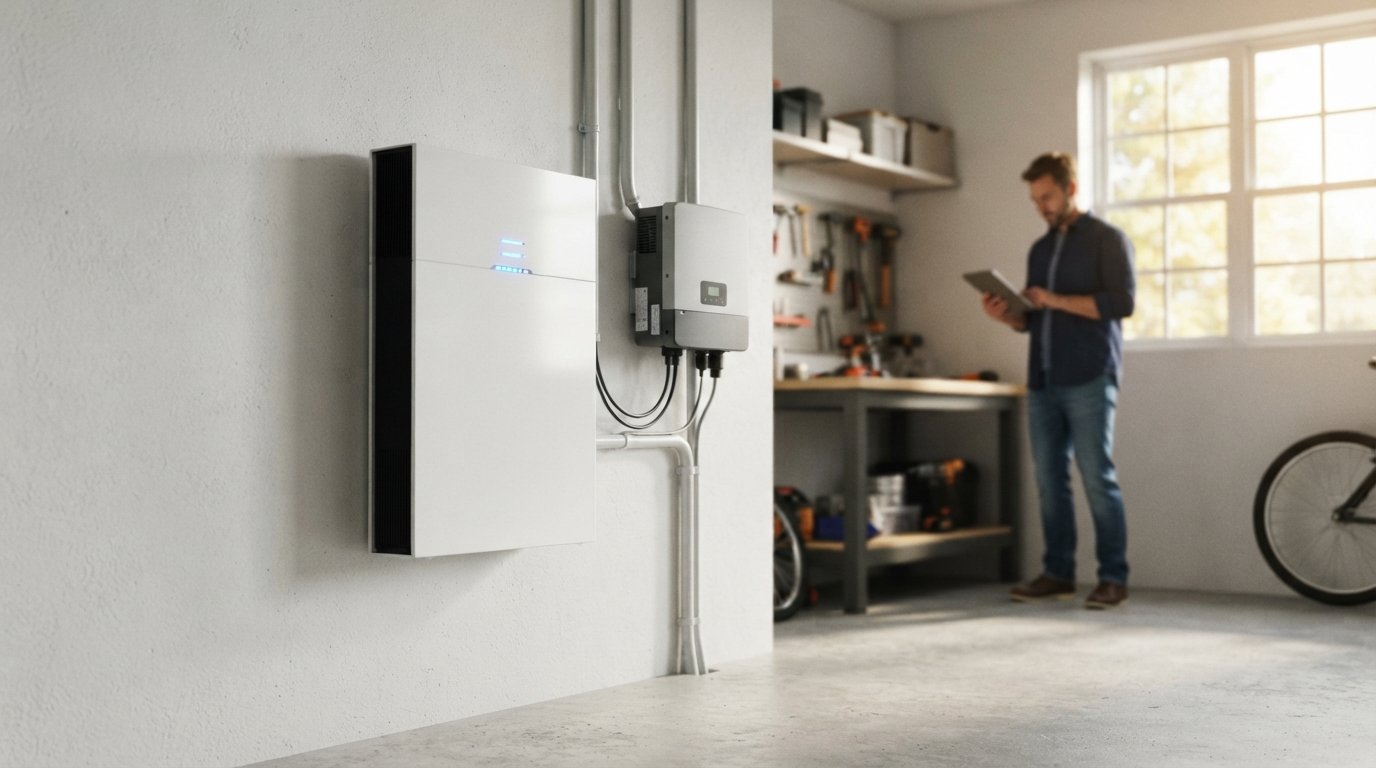
Solar Battery Round Trip Efficiency: What It Means for Savings
Solar battery round trip efficiency directly affects your savings and backup time. Call (833)-793-7166 to compare independent provider quotes with no obligation.

Learn more about Solar Panel Installation and Repair for guides, costs, and what to expect.
Compare Solar Panel Installation and Repair Pros Near You

Enter your ZIP code to compare independent local professionals and request free quotes.
When you buy a solar battery, you are not just paying for storage capacity. You are paying for every kilowatt-hour that actually makes it back out of the battery and into your home. The difference between what goes in and what comes out is called round trip efficiency, and it quietly shapes your savings, your backup duration, and even how long your battery lasts. Understanding this metric is one of the smartest moves a storage shopper can make, because it turns a confusing spec sheet into a clear picture of real-world value.
What Round Trip Efficiency Actually Measures
Round trip efficiency (RTE) is the percentage of energy you put into a battery that you can later draw back out. If you send 10 kWh into a battery and get 9 kWh back, the round trip efficiency is 90 percent. The missing 10 percent is lost as heat during charging and discharging, plus a small amount consumed by the battery management system and inverter electronics. This is not a flaw unique to solar batteries; it is physics. Every storage system, from a phone battery to a utility-scale lithium array, loses some energy in the round trip.
For homeowners, RTE matters because it directly reduces the value of every stored kilowatt-hour. If you charge a battery from solar and use that energy at night, you are effectively paying for more solar production than you can use. The lower the efficiency, the more solar capacity you need to cover the same evening load. That is why two batteries with identical nameplate capacity can deliver very different bill savings over a year.
Typical round trip efficiency for modern home solar batteries ranges from about 85 to 95 percent. Premium lithium iron phosphate (LFP) systems often land in the low 90s, while older chemistries or systems with less efficient inverters may sit closer to 85 percent. A few manufacturers advertise numbers above 95 percent, but those figures usually describe the battery cells alone, not the full system including the inverter. Always look for the system-level RTE, not the cell-level number.
AC Coupling vs. DC Coupling: Where the Losses Hide
The way a battery connects to your solar system has a big impact on round trip efficiency. In an AC-coupled setup, solar power is converted from DC to AC by the solar inverter, then back to DC by the battery inverter to charge the battery. When the battery discharges, the energy goes from DC to AC again. That is four conversions, and each one shaves off a few percentage points. AC coupling is common in retrofits because it lets you add storage to an existing solar system without replacing the inverter, but it typically delivers lower round trip efficiency, often in the mid-80s to low 90s.
DC-coupled systems charge the battery directly from the solar panels in DC form, avoiding two conversions. The battery then discharges through a single inverter to your home. This streamlined path usually pushes system RTE into the low to mid 90s. If you are designing a new solar plus storage system from scratch, DC coupling is generally the more efficient choice, though AC coupling still makes sense for many retrofit scenarios and for systems that need to work with multiple inverters.
The practical takeaway is simple: ask your installer whether the quoted efficiency is for the battery alone or for the full system, and ask how the battery will be coupled. A 95 percent cell efficiency can easily become 88 percent system efficiency once you account for inverter losses and coupling architecture. That gap translates into real dollars over a 10 to 15 year battery life.
How Efficiency Losses Affect Backup Duration and Daily Cycling
Round trip efficiency hits homeowners in two distinct ways: daily bill savings and backup resilience. On the daily cycling side, every stored kilowatt-hour that is lost to inefficiency is a kilowatt-hour you cannot use to offset grid electricity. If you are on a time-of-use rate plan and charge your battery from solar during the day to discharge during expensive evening hours, a 5 percent efficiency difference on a 13.5 kWh battery amounts to roughly 0.675 kWh per day. Over a year, that is about 246 kWh of lost usable energy. At a 30 cent per kWh evening rate, that is nearly $74 per year in foregone savings from a single efficiency percentage point gap. Scale that across a 10-year battery life and the difference between an 85 percent and a 93 percent system becomes significant.
Backup duration is affected even more directly. When the grid goes down, your battery's usable capacity is what keeps your lights on. A battery rated at 13.5 kWh with 90 percent round trip efficiency does not deliver 13.5 kWh to your home during an outage; it delivers closer to 12.15 kWh after accounting for discharge losses. If you are sizing a battery to carry critical loads for a certain number of hours, you need to build in that efficiency haircut. Otherwise, you may find your backup running out sooner than expected during a real outage.
Here is a simple framework for estimating usable backup energy:
- Start with the battery's nameplate capacity in kWh.
- Multiply by the depth of discharge (often 90 to 100 percent for modern lithium systems).
- Multiply by the system round trip efficiency (for example, 0.90 for 90 percent).
- The result is a realistic estimate of usable energy for backup planning.
Running this math before you buy prevents unpleasant surprises. It also helps you compare quotes fairly, because a larger battery with poor efficiency may deliver less usable energy than a smaller, more efficient one. For a deeper look at how storage interacts with bill savings, see our guide on solar battery storage to cut bills, which walks through the economics of daily cycling and backup value.
Temperature, Degradation, and Efficiency Over Time
Round trip efficiency is not a fixed number. It changes with temperature, state of charge, and the age of the battery. Lithium batteries are most efficient within a moderate temperature band, typically around 60 to 80 degrees Fahrenheit. In very cold conditions, internal resistance rises and efficiency drops. In extreme heat, the battery management system may throttle charging or discharging to protect the cells, which also reduces usable output. If your battery is installed in a garage or on an exterior wall in a climate with harsh summers or winters, expect real-world efficiency to be a few points below the laboratory rating.
Degradation is the other long-term factor. As a battery cycles, its internal resistance gradually increases and its capacity fades. Both effects tend to reduce round trip efficiency over time. A system that starts at 92 percent might drift into the high 80s after several years of heavy cycling. Most manufacturers warrant a certain percentage of retained capacity, but round trip efficiency is often not explicitly warranted. That makes it important to choose a battery with a robust management system and a track record of stable performance in your climate.
Temperature management is not just about efficiency; it is also about safety and longevity. A battery that runs hot will degrade faster and lose efficiency more quickly. If your installer proposes an outdoor location in a hot climate, ask about shading, ventilation, and whether the battery has active thermal management. Small installation decisions can protect your efficiency over the life of the system.
Comparing Efficiency Claims Across Battery Products
Battery spec sheets are not always apples to apples. Some manufacturers quote cell-level efficiency, some quote inverter efficiency, and some quote a full system number under ideal conditions. When you compare products, look for the system round trip efficiency and check the conditions under which it was measured. A claim of 96 percent that excludes inverter losses is not comparable to a claim of 90 percent that includes them.
It also helps to compare the full financial picture, not just the efficiency percentage. A slightly less efficient battery with a lower price per kWh may still deliver better overall value, especially if your utility rate structure rewards daily cycling. Conversely, a premium high-efficiency battery may be worth the extra cost if you are sizing for backup and every usable kilowatt-hour counts. The right choice depends on your goals: maximizing bill savings, maximizing backup duration, or both.
When you request quotes, ask each provider these questions:
- What is the system-level round trip efficiency, including the inverter?
- Is the battery AC-coupled or DC-coupled in this design?
- How does temperature affect efficiency in my climate?
- What efficiency degradation should I expect over 10 years?
Comparing answers side by side turns a confusing purchase into a transparent one. For broader context on how solar and storage fit together, you can explore independent resources such as SolarEnergy.ai, which offers educational guides and tools for homeowners evaluating solar savings and system design.
Turning Efficiency Into Savings: A Practical Checklist
Round trip efficiency is one of several factors that determine whether a battery pays off. To translate efficiency into expected savings, you need to combine it with your utility rate structure, your solar production profile, and your backup needs. A battery that cycles daily under time-of-use rates will generate more value per usable kWh than one that sits idle except during outages. Efficiency losses matter most when you are cycling frequently, because every cycle compounds the loss.
Use this checklist to evaluate a proposed system:
- Estimate daily usable energy by multiplying capacity by depth of discharge and system round trip efficiency.
- Compare that usable energy to your evening or peak-period load.
- Multiply by your rate difference (peak rate minus off-peak or solar cost) to estimate daily savings.
- Adjust for seasonal variation and expected efficiency degradation over time.
- Confirm the backup duration this usable energy provides for your critical loads.
This simple model will not replace a professional design, but it will help you spot unrealistic savings claims and ask better questions. It also helps you decide whether a higher-efficiency battery is worth the premium for your specific situation.
Finally, remember that efficiency is only one piece of the puzzle. Installation quality, warranty terms, and the track record of the provider matter just as much. FreeSolarPowerQuotes connects homeowners with independent third-party providers who can compare system designs and explain efficiency in plain language. There is no obligation, and the goal is to help you make an informed decision before you sign anything.
Round trip efficiency may not be the flashiest number on a battery spec sheet, but it is one of the most honest. It tells you how much of your solar investment actually reaches your home, and it shapes both your bill savings and your peace of mind during an outage. Ask about it, compare it carefully, and factor it into your math. Your future self, the one watching the meter spin backward, will thank you.