
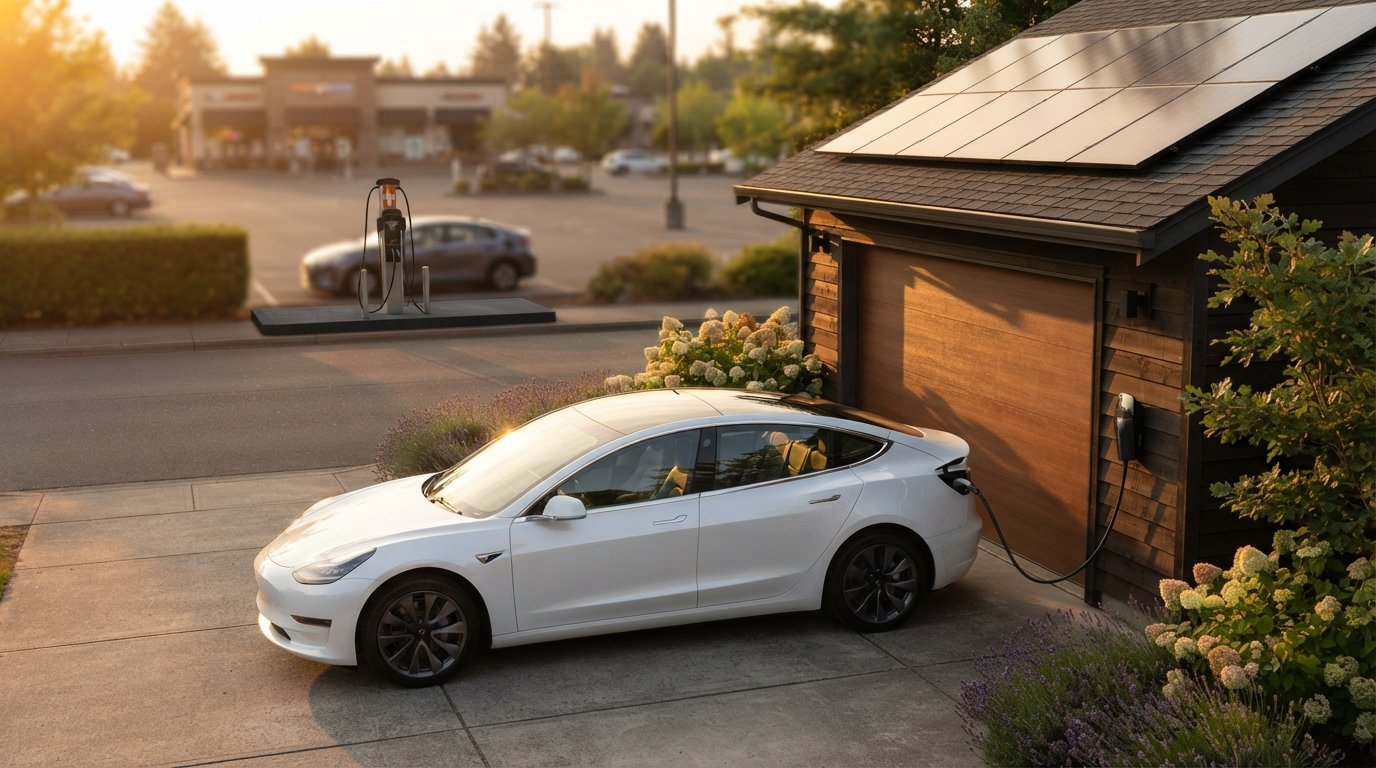
EV Charging With Solar vs Public Charging Costs
Compare electric vehicle charging with solar versus public charging costs, including per-mile math and payback. Call (833)-793-7166 for free solar quotes.

Learn more about Solar Panel Installation and Repair for guides, costs, and what to expect.
Compare Solar Panel Installation and Repair Pros Near You

Enter your ZIP code to compare top-rated local professionals and request free quotes.
Electric vehicle owners quickly learn that the cost of charging varies wildly depending on where the electrons come from. A driver who plugs into a public DC fast charger might pay three to four times more per mile than someone who charges at home with solar panels on the roof. That gap is not a rounding error: over five years, it can add up to thousands of dollars and reshape the entire payback math for a solar plus EV investment. This guide breaks down electric vehicle charging with solar versus public charging costs, using real numbers, practical examples, and a clear framework for deciding which path makes the most sense for your driving habits and your home.
The Two Charging Worlds: Level 2 Home Solar vs DC Fast Public Networks
Home charging and public charging are not just different prices. They are different technologies, different use cases, and different cost structures. At home, most EV owners install a Level 2 charger that runs on 240 volts and adds roughly 25 to 40 miles of range per hour. That speed is more than enough for overnight charging, which is how the vast majority of EV miles are actually logged. The electricity itself can come from the grid, from solar panels, or from a combination of both, and that choice is where the savings live.
Public charging splits into two tiers. Level 2 public chargers, often found in shopping centers and workplaces, are slower and usually priced per hour or per kilowatt-hour at rates that are higher than residential electricity but not dramatically so. DC fast chargers, the kind that add 100 to 200 miles in 20 to 40 minutes, are the convenience tier. They command premium pricing because the equipment is expensive, demand charges are high, and the business model depends on capturing drivers who need a quick top-up. For a typical EV owner, DC fast charging is a road-trip tool, not a daily habit, and treating it as a daily habit is the fastest way to erase the fuel savings that made the EV attractive in the first place.
The practical takeaway is that comparing solar home charging to public charging is really a comparison between a low, stable, largely fixed cost per mile and a high, variable, convenience-driven cost per mile. The rest of this article quantifies that gap and shows how to calculate it for your own situation.
Cost Per Mile: Solar Home Charging vs Public Fast Charging
To make an honest comparison, convert everything to cents per mile. The math is straightforward: take the price per kilowatt-hour, divide by the vehicle's efficiency in miles per kWh, and you have your cost per mile. A typical efficient EV gets about 3.5 to 4 miles per kWh. A larger electric truck or SUV might get 2 to 2.5 miles per kWh. Using 3.5 miles per kWh as a middle case keeps the comparison clean.
Here is how the numbers shake out across the main charging scenarios, using national average figures that readers should verify against their own utility rates and local public charging prices:
- Solar home charging: Excess solar production effectively costs the homeowner the amortized system price, often 4 to 8 cents per kWh after incentives. At 3.5 miles per kWh, that is roughly 1.1 to 2.3 cents per mile.
- Grid home charging: Residential rates average around 16 to 17 cents per kWh nationally, though they range from under 10 cents in parts of the South to over 30 cents in Hawaii and parts of California. At 3.5 miles per kWh, that is about 4.6 to 4.9 cents per mile.
- Public Level 2: Often priced at 20 to 30 cents per kWh, or a flat hourly rate. At 3.5 miles per kWh, that works out to roughly 5.7 to 8.6 cents per mile.
- DC fast charging: Commonly 40 to 60 cents per kWh, with some networks higher. At 3.5 miles per kWh, that is 11.4 to 17.1 cents per mile.
Put in annual terms, a driver covering 12,000 miles pays roughly $130 to $275 per year when charging from solar, versus $1,370 to $2,050 per year on DC fast charging. That is a spread of more than $1,000 per year in the middle of the range, and it grows for households with two EVs or higher annual mileage. Over a five-year ownership period, the difference can exceed $5,000, which is often more than the entire cost of a home Level 2 charger installation.
The comparison also matters for solar payback. When you add an EV to a household with solar, you are effectively increasing the self-consumption of your solar production, which raises the value of every panel on the roof. Instead of exporting excess power to the grid at a low net metering rate, you are using it to displace expensive gasoline or expensive public charging. That shift can shorten the solar payback period by a year or more in many cases.
Solar Offset Value and Time-of-Use Charging Windows
The headline savings from solar EV charging depend heavily on how well your charging schedule lines up with your solar production and your utility's rate design. Solar panels produce power in the middle of the day, but most EVs are parked at home overnight. Without a strategy to bridge that timing gap, a homeowner can end up exporting solar during the day at a low rate and buying grid power at night at a higher rate, which quietly erodes the savings.
There are three practical ways to close the gap. The first is to charge during the day whenever possible, which works well for remote workers, retirees, and households with flexible schedules. The second is to add a home battery so that midday solar production is stored and used for evening charging. The third, and often the most cost-effective, is to adopt a time-of-use rate that makes overnight charging cheap and shifts other loads away from peak hours.
Time-of-use rates vary by utility, but the pattern is common: peak hours in the late afternoon and early evening carry the highest prices, while overnight super-off-peak windows can be half or less of the standard rate. Pairing a TOU rate with scheduled overnight charging can bring grid charging costs down to 8 to 12 cents per kWh in many markets, which narrows but does not eliminate the advantage of solar. For homeowners with solar plus a battery, the combination of stored solar and off-peak grid power can push the effective charging cost below 5 cents per kWh for most of the year.
Net metering policy is the other variable. In states with full retail net metering, exported solar credits offset grid purchases at the retail rate, which makes the timing gap less painful. In states that have moved to lower export rates or avoided-cost compensation, self-consumption becomes far more valuable, and EV charging is one of the best ways to self-consume. Homeowners should check their current utility tariff and state policy before assuming a specific savings figure, because these rules change and vary significantly by region.
Installation Costs and Rebates for Home EV Chargers
A home Level 2 charger is the enabling infrastructure for low-cost solar EV charging, and its cost is modest relative to the savings it unlocks. Hardware typically runs $400 to $800 for a reputable unit, and installation adds $300 to $1,200 depending on the distance from the electrical panel, whether a subpanel or service upgrade is needed, and local labor rates. A straightforward install in a garage with a nearby panel often lands in the $800 to $1,500 range all-in, while complex installs with long conduit runs or panel upgrades can exceed $2,500.
Federal incentives have historically helped offset this cost. The 30 percent federal tax credit for EV charger installation (Alternative Fuel Vehicle Refueling Property Credit) has applied in eligible census tracts and to eligible equipment, though specific rules and expiration dates have shifted and readers should verify current eligibility with a tax professional or the IRS before relying on it. Many states, utilities, and local air quality districts also offer rebates of $250 to $1,000 for charger hardware or installation, and some utilities offer discounted overnight EV charging rates that stack with the equipment rebate. These programs are frequently updated, so the practical step is to check your utility's EV page and your state energy office before purchasing equipment.
For readers planning broader home upgrades alongside the charger, working with an experienced contractor can simplify the electrical work and any associated remodeling. Resources such as 180Remodel's home renovation services can help homeowners coordinate panel upgrades, garage improvements, and related projects with qualified professionals, which is often the difference between a clean, code-compliant install and a series of costly change orders. The same discipline applies to solar: getting multiple quotes and comparing equipment, warranties, and installation practices is the best way to protect the investment.
When Public Charging Still Makes Sense
Public charging is not the enemy of EV savings. It is a tool with a specific job, and the owners who save the most are the ones who use it selectively rather than habitually. The clearest case is long-distance travel: on a 500-mile road trip, DC fast charging is the only practical option, and the premium is simply part of the cost of the trip. Comparing that premium to the cost of gasoline for the same journey usually still favors the EV, even at 50 cents per kWh.
Apartment dwellers and renters without access to a dedicated parking spot are another group for whom public charging is often the primary option. For these drivers, the comparison shifts: public Level 2 charging at work or at a nearby garage can be reasonably affordable, and some employers offer free or subsidized charging as a benefit. In that situation, the question is not whether to install solar at home but whether the combination of workplace charging and occasional fast charging beats a gasoline car, which it usually does.
There are also strategic reasons to use public charging even when home solar is available. Some networks offer membership plans or off-peak pricing that can be competitive with residential rates, and destination charging at hotels and shopping centers can turn errands into free or low-cost top-ups. The key is to treat public charging as a supplement, not a substitute, and to avoid the trap of relying on fast charging for daily commuting when a home charger would pay for itself in well under two years.
Calculating Payback for a Solar Plus EV Charging Investment
The payback calculation for solar plus EV charging combines two investments that reinforce each other. The solar system produces power that offsets home consumption, and the EV charger converts that power into miles. To estimate payback, start with the annual miles driven, divide by the vehicle's miles per kWh to get annual kWh needs, and multiply by the cost per kWh you would otherwise pay. Then compare that annual figure to the net cost of the solar system and charger after incentives.
Here is a simple framework that captures the main variables without requiring a spreadsheet:
- Estimate annual EV electricity use: Annual miles divided by miles per kWh. For 12,000 miles at 3.5 miles per kWh, that is about 3,430 kWh per year.
- Value the solar offset: Multiply the kWh figure by your marginal electricity or public charging rate. At 17 cents per kWh grid rate, the annual value is about $583. At a 45 cents per kWh fast charging rate, it is about $1,544.
- Add the charger cost: Net charger and installation cost after rebates, often $500 to $1,500.
- Compare to the solar investment: A solar system sized to cover both home and EV load might cost $15,000 to $25,000 before the 30 percent federal tax credit, depending on region and size.
- Compute simple payback: Divide the net investment by the annual savings from solar production plus avoided charging costs. Many households land in the 6 to 10 year range, with EV charging often shaving a year or more off the solar-only payback.
Two cautions apply. First, incentive programs and rate structures change, so any payback estimate should be treated as a planning tool rather than a guarantee. Second, the value of solar EV charging depends on self-consumption, so a homeowner who exports most solar production and charges overnight at high rates will see a longer payback than one who charges during the day or uses a battery. The most reliable approach is to model the specific utility rate, net metering policy, and driving pattern before signing a contract. For readers who want to explore how solar performs in agricultural or commercial settings, our guide on solar for agricultural businesses reducing farm operating costs offers a parallel framework for larger operations.
Practical Steps to Maximize Savings
The gap between solar charging and public fast charging is large enough that a few deliberate choices can meaningfully improve the economics. The first is to size the solar system with the EV in mind rather than treating the car as an afterthought. A system designed for the home's existing load may not produce enough surplus to cover 3,000 to 4,500 kWh of annual driving, and adding panels later is usually more expensive than sizing correctly upfront. The second is to choose a charger with scheduling and energy management features, which allow charging to align with solar production or off-peak windows without manual intervention.
The third is to compare quotes from multiple solar and electrical contractors, because installation pricing varies widely for the same equipment. A homeowner who collects three or four quotes, checks licensing and warranties, and verifies incentive eligibility typically saves more than one who accepts the first proposal. The fourth is to revisit the charging strategy after the first year, using the utility's usage data to confirm that the actual cost per mile matches the plan. Small adjustments, such as shifting charging to a different window or adding a small battery, can improve results without a major new investment.
For most homeowners who drive an EV and have a suitable roof, the combination of solar and a Level 2 charger is one of the highest-return energy investments available. It reduces exposure to volatile public charging prices, turns the roof into a fuel source, and shortens the payback period for the solar system itself. Public charging remains essential for road trips and for drivers without home charging access, but as a daily strategy it is the most expensive way to power an EV. Homeowners who want to explore their options can request free, no-obligation quotes from vetted local providers and compare the numbers against their actual driving patterns before making a decision.
Learn more about Solar Panel Installation and Repair for guides, costs, and what to expect.
Compare Solar Panel Installation and Repair Pros Near You
Enter your ZIP code to compare top-rated local professionals and request free quotes.