
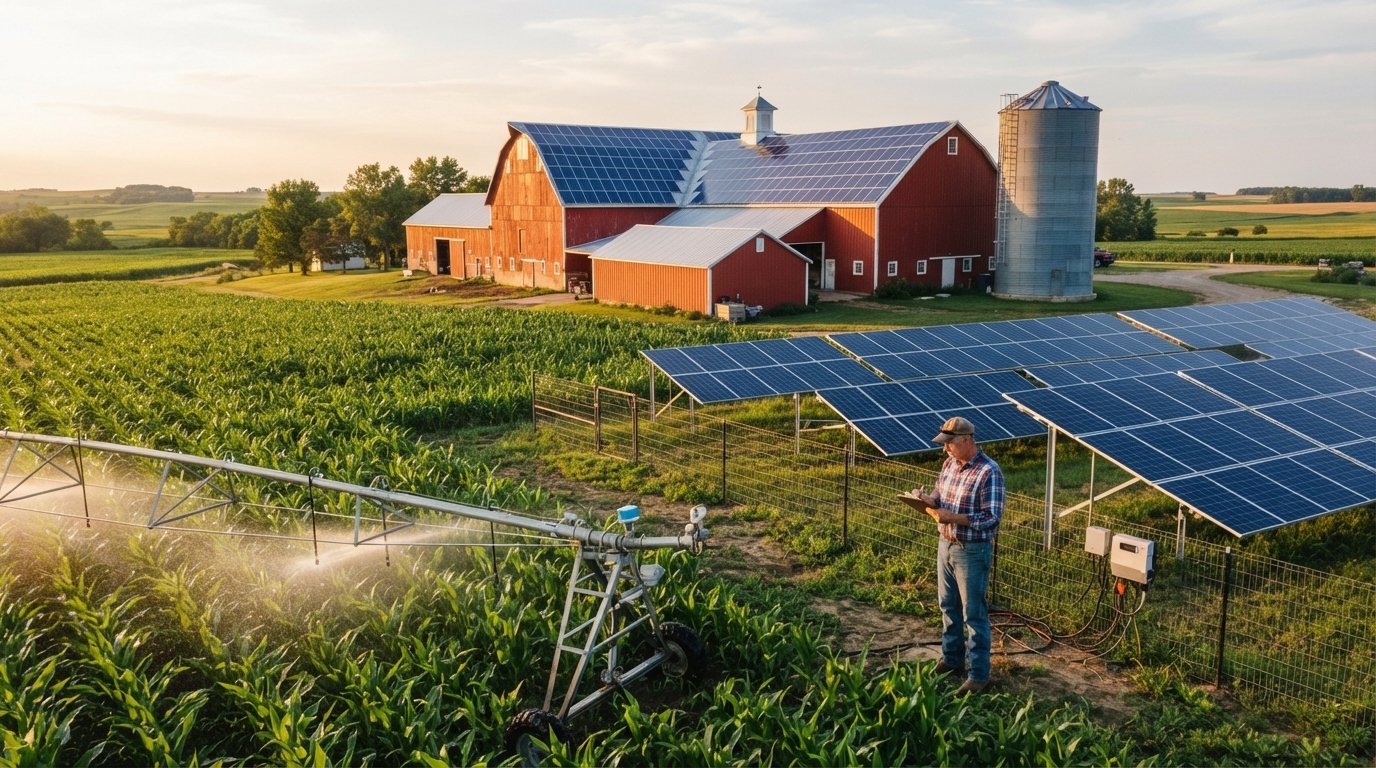
Solar for Agricultural Businesses Reducing Farm Operating Costs
Solar for agricultural businesses reducing farm operating costs can lock in predictable energy rates for decades. Call (833)-793-7166 to compare quotes.

By Leo Owens
Learn more about Solar Panel Installation and Repair for guides, costs, and what to expect.
Compare Solar Panel Installation and Repair Pros Near You

Enter your ZIP code to compare top-rated local professionals and request free quotes.
Farm margins are tight, and energy is one of the few line items you can permanently shrink. From irrigation pumps and grain dryers to climate-controlled barns and cold storage, agricultural operations consume enormous amounts of electricity, often at some of the highest commercial rates in the country. Solar for agricultural businesses reducing farm operating costs is not a niche experiment anymore: it is a mainstream financial strategy that thousands of farms, ranches, orchards, and greenhouses across the United States are using right now to stabilize their budgets and protect themselves from volatile utility pricing.
The core idea is simple. Instead of renting power from the grid every month forever, you own a generation asset that produces electricity for 25 to 35 years at a fixed cost. Once the system is paid off, your fuel is essentially free. This shift turns a recurring operating expense into a depreciating capital asset, and that difference shows up clearly on your profit and loss statement within the first year of operation.
This guide breaks down how agricultural solar actually works, what it costs, how the numbers pencil out, and what you should verify before signing anything. Whether you run a 50-acre row crop operation or a multi-site dairy, the fundamentals are the same.
Why Energy Is a Make-or-Break Cost for Modern Farms
Agriculture has become dramatically more energy-intensive over the past two decades. Precision irrigation systems, automated milking parlors, ventilation fans, refrigeration, and grain drying equipment all run on electricity, and many of them run during peak demand windows when utility rates are highest. For some operations, electricity is now the third-largest operating expense after labor and feed or fertilizer.
Utility rates have also climbed steadily. In many rural service territories, commercial and agricultural rates have increased faster than the general rate of inflation, and demand charges can spike unpredictably during summer irrigation season. A single hot week can add thousands of dollars to a monthly bill with no warning. That unpredictability makes budgeting nearly impossible, especially for operations with thin margins.
Solar addresses both problems at once: it lowers the total kilowatt-hours you purchase, and it shifts your exposure away from volatile utility pricing. A well-sized array with the right financing structure can lock in a predictable cost per kilowatt-hour for decades, which is exactly what a farm needs when planning multi-year capital investments.
How Solar Reduces Farm Operating Costs in Practice
The savings come from several places, and understanding each one helps you evaluate proposals more intelligently. The most obvious is direct bill reduction: every kilowatt-hour your array produces is one you do not buy from the utility. For a farm using 100,000 kWh per year, even a partial offset can eliminate thousands of dollars annually.
Beyond the raw offset, there are secondary savings that many owners overlook. Solar can reduce demand charges if it is paired with battery storage or a smart load controller, because the system can shave peak draw during high-cost intervals. It can also reduce exposure to future rate hikes, since the portion of your usage covered by solar is essentially immune to utility price increases. And in many states, excess generation can be credited through net metering or similar programs, turning your array into a modest revenue source during low-demand months.
Here is how the primary savings categories typically stack up for a mid-sized farm:
- Direct bill offset: 40 to 90 percent reduction in electricity purchases depending on system size and load profile.
- Demand charge management: Additional savings when solar is paired with storage or load scheduling.
- Rate hike insulation: Fixed cost per kWh for 25-plus years versus unpredictable utility escalation.
- Incentive capture: Federal tax credit and accelerated depreciation can cover 30 to 50 percent of system cost.
- Net metering or export credits: Extra value in states with favorable programs.
The exact mix depends on your utility, your state, and how your operation uses power. A dairy that runs refrigeration around the clock will see different savings than a row crop farm that runs irrigation pumps seasonally. This is why a custom analysis matters more than a generic calculator, though a good starting point is to use a free solar savings estimator to model your own usage before you talk to installers.
What Agricultural Solar Systems Actually Cost
Commercial and agricultural solar pricing is typically quoted on a dollars-per-watt basis before incentives. As of 2026, most farm-scale installations fall between $2.00 and $3.20 per watt installed, depending on system size, roof or ground mount configuration, interconnection requirements, and local labor costs. A 100 kW system, which is a common size for a mid-sized farm, would therefore land somewhere between $200,000 and $320,000 before any incentives.
That number sounds large, but the federal Investment Tax Credit currently covers 30 percent of the installed cost for eligible projects, and bonus depreciation under Section 168 of the tax code allows businesses to write off a substantial portion of the remaining basis in the first year. When you combine the ITC with depreciation, the effective net cost can drop by 40 to 50 percent, and sometimes more depending on your tax situation. Many agricultural operations also qualify for USDA Rural Energy for America Program (REAP) grants, which can cover an additional 25 percent of project costs.
Financing options matter just as much as sticker price. Solar loans let you own the system with little or no money down, and in many cases the loan payment is lower than the utility bill you were already paying, creating immediate positive cash flow. Leases and power purchase agreements (PPAs) offer similar cash-flow benefits but with different ownership and tax implications. For farms that cannot use the tax credit directly, a PPA or lease may be the better path.
One important note: incentive programs and tax rules change. Always confirm current details with a qualified tax professional and with official program sources before you commit to a project.
Matching System Size to Your Farm's Load Profile
Oversizing is one of the most common and expensive mistakes in agricultural solar. If you install more capacity than your operation can consume or export profitably, the excess generation may be credited at wholesale rates or not at all, which destroys your payback math. Undersizing, on the other hand, leaves savings on the table and forces you to keep buying expensive peak power from the utility.
The right size depends on three things: your annual kilowatt-hour consumption, your time-of-use profile, and your utility's net metering or export rules. A good installer will pull 12 months of utility data and model production hour by hour against your actual usage. If a proposal does not include that analysis, treat it as a red flag.
Ground-mounted arrays are often the best fit for farms because they avoid roof structural concerns, allow optimal tilt and orientation, and can be expanded later. Roof-mounted systems work well on large barns and shops with newer, structurally sound roofs, but you should confirm the roof has at least 15 to 20 years of remaining life before covering it with panels. Tracking systems, which follow the sun, can boost production by 15 to 25 percent but add cost and maintenance complexity, so they usually only make sense on high-value operations with limited land.
Incentives, Tax Treatment, and Financing Structures
The financial case for agricultural solar leans heavily on incentives, and the rules are specific enough that you should not rely on general advice. The 30 percent federal Investment Tax Credit is the biggest single lever, but eligibility depends on ownership structure and whether the system is purchased or financed through a lease or PPA. Bonus depreciation and MACRS depreciation schedules can add substantial value for owners who purchase outright.
State and utility programs vary widely. Some states offer additional rebates, production incentives, or property tax exemptions for renewable energy equipment. Net metering rules determine how much credit you receive for exported power, and in some territories agricultural customers fall under different tariffs than residential customers. USDA REAP grants are competitive but well worth pursuing for eligible rural small businesses and agricultural producers.
Before you sign anything, gather these documents and answers:
- Twelve months of utility bills showing kWh usage and demand charges.
- A written production estimate from the installer, ideally using PVWatts or equivalent modeling.
- A clear breakdown of gross cost, incentives, net cost, and financing terms.
- Confirmation of your utility's interconnection process and timeline.
- A written statement of who owns the renewable energy credits and tax credits.
Walking through these items with your accountant before signing is the single best way to avoid unpleasant surprises.
Operational and Maintenance Realities
Solar arrays are remarkably low-maintenance, but they are not maintenance-free. Panels need occasional cleaning in dusty or agricultural environments, especially if you are near unpaved roads or heavy pollen. Inverters typically need replacement once over a 25-year system life, which is a real cost to budget for. Mounting hardware should be inspected after severe weather, and any tracking systems need periodic mechanical service.
Most farms find that annual maintenance runs between 0.5 and 1.5 percent of installed cost, which is far lower than the maintenance burden of most other capital equipment on the property. Monitoring systems now let you check production from a phone, so underperformance is usually caught quickly. Many installers offer performance guarantees and extended warranties, which are worth reviewing carefully.
It is also worth thinking about resilience. Adding battery storage lets you keep critical loads running during outages, which matters for dairies, cold storage, and any operation where a multi-hour power loss translates into spoilage or animal welfare problems. Storage also enables more sophisticated demand charge management, which can improve the financial return in territories with high demand charges.
Choosing the Right Installer for Your Operation
Agricultural solar is not the same as residential solar. Farm systems are larger, often three-phase, frequently ground-mounted, and subject to different utility interconnection rules. Not every installer has experience in this space, and the difference between a good and a bad installation can be tens of thousands of dollars over the system's life.
Look for an installer with a documented track record on agricultural projects, references you can actually call, and a clear explanation of how they handle permitting, interconnection, and incentive paperwork. Ask how they size systems, what modeling tools they use, and what happens if production falls short of projections. A confident, transparent installer will welcome those questions.
If you are also considering a property change or relocation as part of a long-term plan, resources like Moving.Homes relocation guides can help you think through how a solar investment interacts with a future sale or transfer, since solar can increase property value and transferability varies by contract type. It is worth understanding those details before you commit.
The simplest way to start is to gather three or more quotes from installers who specialize in commercial and agricultural work. Comparing proposals side by side will quickly reveal which ones did real engineering and which ones are guessing. Independent platforms that connect farm owners with vetted providers can shorten that process considerably and reduce the risk of working with an inexperienced contractor.
The Long-Term Financial Picture
Over a 25-year horizon, a well-designed agricultural solar system typically produces a levelized cost of energy between 4 and 8 cents per kilowatt-hour, compared to utility rates that often exceed 12 to 18 cents and continue to rise. That gap is the entire financial argument in one sentence. The system pays for itself, then keeps paying you for another decade or more.
Payback periods for farm solar generally fall between 4 and 8 years after incentives, depending on your utility rates, system size, and how much of your production you consume on-site. After that, the electricity is essentially free, minus modest maintenance. For operations with high energy intensity, the savings can be reinvested into equipment, land, or labor, which compounds the benefit over time.
The environmental angle matters too. Farms are on the front lines of climate variability, and reducing reliance on fossil-fuel-generated electricity is both a practical and a values-driven choice for many owners. But the financial case stands on its own, and that is usually what convinces lenders and family partners to sign off.
Solar for agricultural businesses reducing farm operating costs is ultimately about control. You control your energy source, your cost per kilowatt-hour, and your exposure to utility rate hikes. In an industry where so many variables are outside your control, that is a rare and valuable position to be in.