
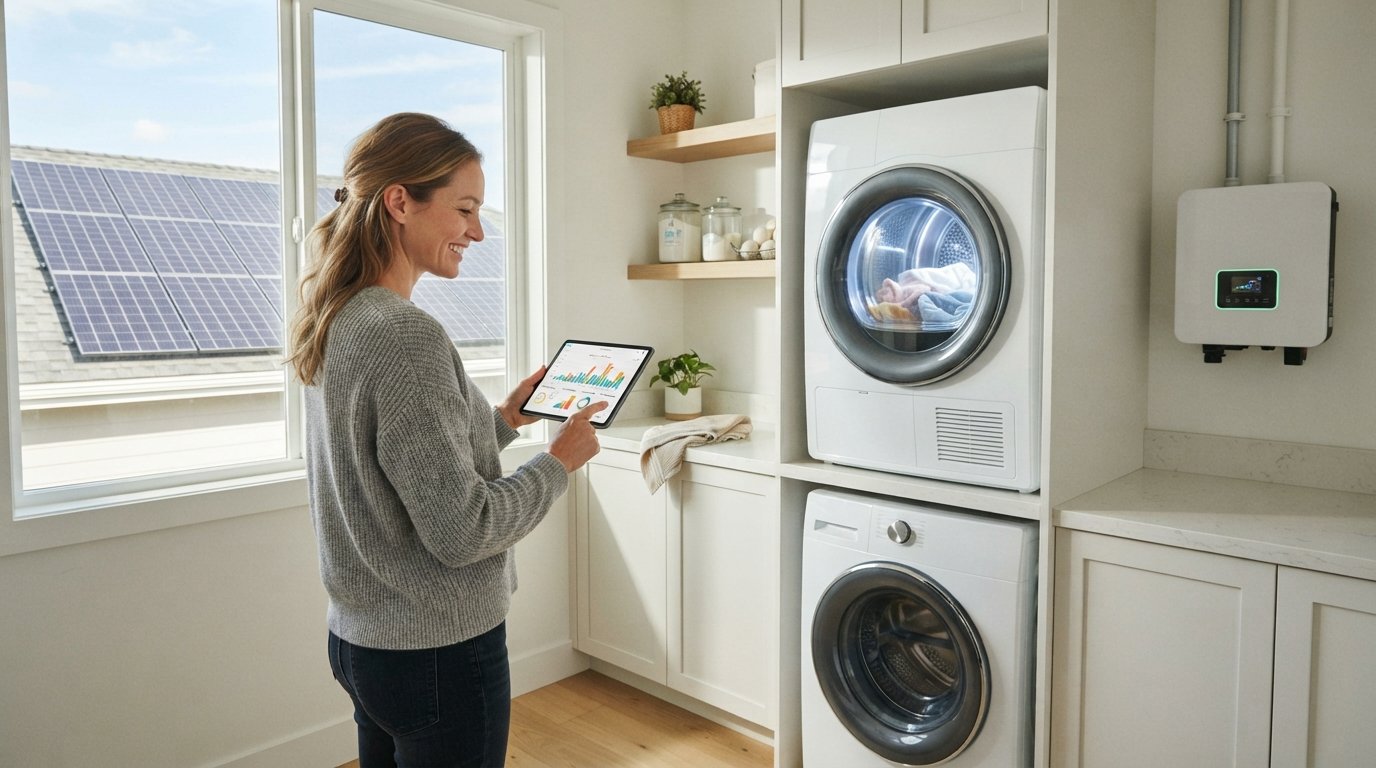
Solar Plus Heat Pump Clothes Dryer: Electrification Guide
Plan solar plus heat pump clothes dryer and appliance electrification with our guide. Call (833)-793-7166 for expert advice and free quotes.

Learn more about Solar Panel Installation and Repair for guides, costs, and what to expect.
Compare Solar Panel Installation and Repair Pros Near You

Enter your ZIP code to compare top-rated local professionals and request free quotes.
Electrifying your home appliances is one of the most effective ways to cut carbon emissions and reduce long-term energy costs, but it also transforms your home's electricity demand. A heat pump clothes dryer, induction cooktop, and heat pump water heater each add significant new loads that your solar system must accommodate. Planning for solar plus heat pump clothes dryer and appliance electrification together, rather than sequentially, ensures your renewable energy system is sized correctly, your electrical panel can handle the added circuits, and you maximize available incentives. This guide walks through load profiles, solar sizing, load shifting, panel capacity, and how to combine electrification with efficiency upgrades and government programs.
Understanding New Load Profiles from Heat Pump Dryers, Induction, and Water Heating
Heat pump dryers are far more efficient than conventional electric resistance dryers, using roughly 50 to 60 percent less energy per load. However, they still represent a new continuous load of about 1,000 to 1,500 watts during operation, and they run longer per cycle (often 90 to 120 minutes). Induction cooktops draw 1,800 to 3,600 watts per burner but only intermittently. Heat pump water heaters typically use 400 to 500 watts during compressor operation, with backup resistance elements that can draw 4,500 watts if recovery is fast. Together, these appliances can add 3 to 6 kWh per day to a typical household's consumption, depending on usage patterns.
These loads differ from traditional resistance appliances in both magnitude and timing. A conventional electric dryer might pull 5,000 watts for 45 minutes, while a heat pump dryer pulls 1,200 watts for two hours. The total energy may be similar or lower, but the load is spread over a longer window. That extended runtime can actually align better with solar production during daylight hours if you schedule drying during the day. Induction cooking is concentrated around meal times, which often coincide with solar production for lunch but not dinner. Heat pump water heaters can be scheduled to heat water during peak solar hours, storing hot water for evening use. Understanding these profiles is the first step in designing a solar plus electrification plan that minimizes grid reliance.
When you add multiple electric appliances, the aggregate load profile becomes more complex. A household that electrifies space heating, water heating, cooking, and laundry may see its annual electricity consumption rise by 6,000 to 10,000 kWh, depending on climate and home efficiency. That is a substantial increase that must be reflected in solar system sizing. If you install solar first and electrify later, you may undersize your system and lose the opportunity to maximize self-consumption. Conversely, electrifying without solar exposes you to higher utility bills, especially if your utility has tiered rates or time-of-use pricing. The integrated approach is almost always more cost-effective.
Sizing Solar for Electrification Step Changes
Sizing a solar system for a home that is electrifying requires forecasting future loads, not just current consumption. Start by inventorying the appliances you plan to convert and estimating their annual energy use. Use the ENERGY STAR appliance calculator or manufacturer specifications to get kWh per year for each appliance. Add those figures to your current annual consumption to get a projected total. Then, factor in climate and usage habits: a heat pump water heater in a cold garage may use more energy than one in a conditioned space; a heat pump dryer used daily will consume more than one used twice weekly.
Once you have a projected annual kWh figure, you can size the solar array to offset that consumption. A common rule of thumb in the United States is that 1 kW of solar capacity generates about 1,200 to 1,600 kWh per year, depending on location and panel orientation. For a household adding 8,000 kWh per year from electrification, you would need roughly 5 to 7 kW of additional solar capacity to offset that load fully. However, net metering policies vary widely: some utilities credit exported solar at the full retail rate, while others offer lower avoided-cost rates. In areas with weak net metering, you may want to size the system to maximize self-consumption rather than total production, which often means slightly smaller arrays paired with battery storage or load-shifting strategies.
It is also wise to plan for future electrification beyond your immediate projects. Many homeowners start with a heat pump dryer and induction range, then later add a heat pump water heater or electric vehicle charger. Leaving room for expansion in your solar design (extra roof space, a larger inverter, or a battery-ready configuration) avoids costly rework later. If you are unsure how much solar you need, our guide on solar plus heat pump water heater integration explains how to calculate loads and optimize system size for one of the largest electrification loads. The same principles apply to dryers and other appliances.
Load Shifting and Smart Appliance Scheduling with Solar
Load shifting is the practice of running appliances when solar production is highest, typically late morning to mid-afternoon. Heat pump dryers, with their long cycle times, are ideal candidates for daytime scheduling. Many models include delay-start timers, and some smart dryers can be integrated with home energy management systems that trigger operation when solar generation exceeds a threshold. Induction cooktops are less flexible, but lunchtime cooking or batch cooking during solar hours can absorb excess production. Heat pump water heaters are perhaps the most flexible: they store thermal energy in a tank, so you can heat water at noon and use it in the evening.
Smart appliance scheduling can be manual or automated. At the simplest level, you can set a timer on your dryer to start at 11 a.m. and run through the early afternoon. For more advanced control, consider a home energy management system (HEMS) that monitors solar production and automatically signals appliances to run when there is surplus power. Some utilities also offer demand response programs that pay you to shift loads away from peak times, which complements solar self-consumption. If you have a battery, you can store excess solar and use it in the evening, further reducing grid draw.
To make load shifting effective, you need to understand your household's baseline and flexible loads. A simple energy monitor can show when your solar system is exporting power, indicating surplus. You can then manually start the dryer or water heater during those windows. Over time, this habit becomes automatic and can significantly increase the share of solar energy you consume directly. For households with time-of-use rates, shifting loads to solar hours also avoids expensive peak-period electricity, compounding savings.
Panel Capacity and Circuit Planning for Added Electric Appliances
Adding electric appliances often requires electrical panel upgrades. A heat pump dryer typically requires a 30-amp 240-volt circuit, similar to a conventional dryer, but some models can run on a 20-amp circuit. Induction cooktops need a dedicated 240-volt circuit, usually 40 to 50 amps. Heat pump water heaters often require a 30-amp circuit, and if you add a heat pump for space heating, that may need a 30 to 60-amp circuit. If your panel is already near capacity, you may need a service upgrade to 200 amps or a subpanel. These costs should be factored into your electrification budget.
Before installing solar, it is smart to assess your panel's capacity and plan for future electric loads. A licensed electrician can perform a load calculation based on the National Electrical Code (NEC) to determine if your existing service can handle the added appliances. If an upgrade is needed, doing it at the same time as solar installation can save on labor costs and avoid duplicate permits. Some solar inverters and batteries can also provide backup power during outages, but only if the critical loads are on a dedicated backup panel. Planning circuits for backup power (e.g., keeping the heat pump water heater or dryer on backup) requires careful design.
When planning circuits, consider the physical space in your panel and the routing of new wires. Heat pump dryers and water heaters often need to be located near exterior walls for venting or condensate drainage, which may affect where circuits can be run. Induction cooktops require adequate clearance and ventilation. It is best to involve both your electrician and solar installer early in the planning process so that panel upgrades, circuit additions, and solar interconnection are coordinated. This integrated approach minimizes disruption and ensures your system is safe and code-compliant.
Combining Electrification with Incentives and Efficiency Upgrades
Electrification projects can qualify for a range of incentives, and combining them with solar amplifies the financial benefits. The federal Investment Tax Credit (ITC) covers 30 percent of the cost of solar and battery storage, and it may also apply to certain electrical panel upgrades when done as part of a solar installation. The Inflation Reduction Act also introduced electrification tax credits and rebates, including up to $8,000 for heat pump water heaters and up to $840 for heat pump dryers, subject to income limits and program availability. State and utility rebates may add further savings. Always verify current incentives with official sources, as programs change.
Efficiency upgrades should precede or accompany electrification to right-size your solar system. Weatherization, insulation, air sealing, and efficient appliances reduce overall load, meaning you can install a smaller solar array and still meet your needs. For example, upgrading to a heat pump dryer already reduces energy use compared to a resistance dryer, but adding a heat pump water heater and induction cooktop further improves efficiency. A home energy audit can identify the most cost-effective improvements. Many utilities offer free or discounted audits, and some provide rebates for efficiency upgrades.
Financing is another consideration. Solar loans, leases, and power purchase agreements (PPAs) can spread the cost of solar, while electrification rebates may be available at the point of sale or as tax credits. Some lenders offer green loans that bundle solar and efficiency improvements. When evaluating quotes, ask installers about bundling solar with panel upgrades and appliance circuits to capture economies of scale. FreeSolarPowerQuotes can connect you with reputable solar providers who can assess your electrification plans and design a system that accommodates future loads. Getting multiple quotes is essential to compare pricing and ensure your system is sized correctly.
Finally, consider the sequence of your projects. If you are planning a major renovation or move, coordinating electrification and solar with other work can reduce costs. For example, if you are moving to a new home, you might plan solar and appliance upgrades as part of the move-in process. Resources like Moving.Homes relocation checklists can help you organize the transition, but be sure to prioritize energy planning early so you can take advantage of incentives and net metering opportunities before you settle in.
Bringing It All Together
Integrating solar with heat pump dryers and other electric appliances is a strategic investment that pays off in lower energy bills, reduced emissions, and greater energy independence. By understanding load profiles, sizing your solar system for future electrification, shifting loads to solar hours, planning panel capacity, and stacking incentives with efficiency upgrades, you can maximize the return on your investment. Start with a home energy audit and a load calculation, then work with qualified solar and electrical professionals to design a system that grows with your electrification journey. The upfront planning effort ensures you avoid costly undersizing and take full advantage of the clean energy transition.
Learn more about Solar Panel Installation and Repair for guides, costs, and what to expect.
Compare Solar Panel Installation and Repair Pros Near You
Enter your ZIP code to compare top-rated local professionals and request free quotes.