
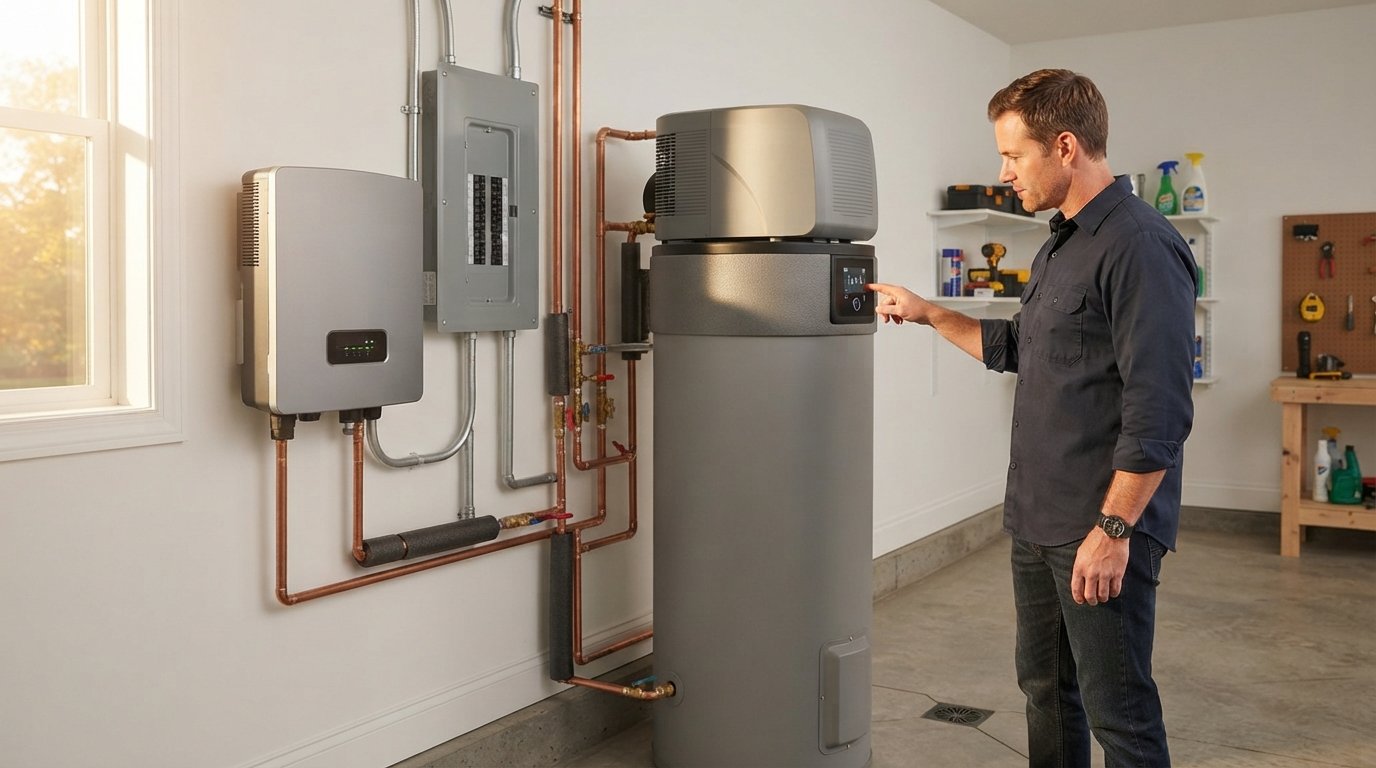
Solar Plus Heat Pump Water Heater Integration Guide for 2026
This solar plus heat pump water heater integration guide shows how to cut water heating costs with solar. Call (833)-793-7166 for expert help.

By Leo Owens
Learn more about Solar Panel Installation and Repair for guides, costs, and what to expect.
Compare Solar Panel Installation and Repair Pros Near You

Enter your ZIP code to compare top-rated local professionals and request free quotes.
Your water heater is likely the second-largest energy consumer in your home, right behind heating and cooling. If you have already gone solar, or you are planning to, pairing that photovoltaic array with a heat pump water heater can slash your overall energy bills and shrink your carbon footprint even further. But integrating the two systems properly requires more than just buying a new appliance and flipping a switch. This solar plus heat pump water heater integration guide walks you through the why, the how, and the what-to-watch-out-for so you can maximize savings and avoid costly mistakes.
Why Heat Pump Water Heaters Pair Perfectly with Solar
Heat pump water heaters (HPWHs) work like a refrigerator in reverse: they move heat from the surrounding air into the water tank instead of generating heat directly with electric resistance. That efficiency translates to two to three times less electricity than a standard electric tank, and dramatically less than a gas or propane unit. When you power that efficient appliance with solar electricity, you are essentially heating water with sunlight, which is as clean and cheap as it gets.
But the synergy goes deeper. Solar panels produce the most electricity during the middle of the day, while a typical water heater draws power in the morning and evening when people shower. By integrating a heat pump water heater with a solar system, you can shift heating cycles to sunny hours and use your solar energy directly instead of exporting it to the grid (often at a lower net metering rate). This is especially valuable in states where net metering has been reduced or replaced with time-of-use rates.
If you are also considering battery storage to capture excess solar and use it at night, our guide on solar plus battery storage explains how to size and configure that setup. But even without a battery, a well-scheduled HPWH can absorb surplus solar production and reduce your reliance on the grid.
Sizing Your Solar Array and Heat Pump Water Heater for Optimal Savings
Proper sizing is the foundation of a successful integration. You need to match the heat pump water heater's electrical load with your solar array's output, while accounting for your household's hot water usage and the heat pump's recovery rate. A typical HPWH draws between 400 and 700 watts when running in heat pump mode, and it runs for roughly two to four hours per day depending on household size. That means it needs about 1 to 3 kWh per day, which translates to a small fraction of a typical 6 kW solar system's daily production.
However, if you have a large family or high hot water demand, the HPWH may run longer or switch to backup resistance heating, which draws significantly more power. In that case, you will want to ensure your solar array has enough excess capacity to cover the additional load. A good rule of thumb is to add 1 to 2 kW of solar capacity for the water heater if you want to cover most of its energy use with solar. Your installer can perform a load calculation and use tools like the Solar Cost Calculator to model different scenarios.
When sizing, also consider the HPWH's tank size and first-hour rating (FHR). A 50-gallon HPWH with a 60-gallon FHR may be sufficient for a family of three, while a larger family might need an 80-gallon unit. The key is to avoid oversizing the tank (which increases standby losses) or undersizing it (which forces backup heating). Work with a qualified contractor to determine the right balance.
Scheduling Heating Cycles Around Solar Production
One of the most effective ways to maximize the benefit of solar plus heat pump water heater integration is to schedule the HPWH to run when your solar panels are producing. Most modern heat pump water heaters come with programmable timers or smart controls that let you set specific operating windows. Ideally, you want the unit to run during peak sun hours, typically between 10 a.m. and 3 p.m., when solar generation is highest.
If your utility offers time-of-use (TOU) rates, align the heating schedule with both solar production and off-peak electricity rates. Some advanced controllers can even monitor solar production and automatically divert excess energy to the water heater, a concept known as solar self-consumption optimization. This is particularly useful if you do not have a battery and want to avoid exporting power at low net metering rates.
Here are a few practical steps to set up an effective schedule:
- Identify your solar peak window: Use your inverter monitoring app or utility data to see when your system generates the most electricity.
- Set the HPWH timer: Program the heat pump to run during that 4- to 5-hour window, ensuring it has enough time to recover for evening use.
- Enable vacation mode or anti-legionella cycles: Schedule periodic high-temperature cycles (if recommended) during sunny periods to maintain hygiene without tapping the grid.
- Monitor and adjust: After a week or two, review your energy usage and fine-tune the schedule to avoid backup heating.
Keep in mind that HPWHs are slower to recover than conventional electric tanks, so you may need to adjust your schedule if your household uses a lot of hot water in the morning. Some homeowners set the HPWH to run late morning through mid-afternoon and then again briefly in early evening if needed, but the goal is to minimize grid draw.
Incentives for Solar and Heat Pump Water Heaters
Federal, state, and local incentives can significantly reduce the upfront cost of both solar and heat pump water heaters. The federal Investment Tax Credit (ITC) currently covers 30% of the cost of solar installation, and it may also apply to the electrical work needed to connect a HPWH if it is part of a solar-ready upgrade. Additionally, the Inflation Reduction Act introduced the High-Efficiency Electric Home Rebate Act (HEEHRA) and the Energy Efficient Home Improvement Credit (EEHIC), which can provide up to $1,750 for a heat pump water heater and up to $500 for related electrical panel upgrades.
Many states and utilities offer additional rebates for HPWHs, sometimes stacked with solar incentives. For example, some utilities provide $500 to $1,000 rebates for qualifying heat pump water heaters, and low-income households may qualify for higher rebates under HEEHRA. It is important to verify current incentives with your state energy office or a qualified tax professional, as programs and eligibility rules can change.
When planning your integration, consider the timing of your purchases to maximize incentives. For instance, installing the HPWH before or alongside your solar system may allow you to include the electrical upgrades in the solar tax credit calculation. Always consult with a tax advisor to confirm eligibility.
Installation Sequencing and Contractor Coordination
Integrating a solar plus heat pump water heater system requires careful coordination between your solar installer and a plumbing/HVAC contractor. The sequence of installation matters for both efficiency and cost. Ideally, you should install the heat pump water heater first (or simultaneously) so that the solar system can be sized to include its load from the start. If you already have solar, you will need to ensure your existing system has enough capacity or plan for an expansion.
Here are key steps to coordinate the project:
- Assess your electrical panel: HPWHs often require a dedicated 240V circuit, and your panel may need an upgrade. This is also a good time to evaluate whether your panel can accommodate future solar or battery additions.
- Choose a qualified contractor: Look for professionals who have experience with both solar and heat pump water heaters, or who are willing to coordinate with each other. You can find pre-vetted contractors through resources like PlanRemodel, which lists qualified home improvement professionals across the U.S.
- Plan the location: HPWHs need adequate space and airflow. Ensure the installation location is compatible with both the unit and any solar conduit runs.
- Schedule inspections: Both solar and plumbing installations require permits and inspections. Coordinate timelines to avoid delays.
- Commission and test: After installation, verify that the HPWH runs primarily during solar production hours and that the solar system monitors the added load correctly.
Communication is critical. Make sure your solar installer knows the HPWH's electrical specifications and expected run schedule, and that your plumber understands the solar production window. A well-coordinated installation will ensure the systems work together seamlessly from day one.
Maximizing ROI and Avoiding Common Pitfalls
The financial return on a solar plus heat pump water heater integration can be excellent, but it depends on proper sizing, scheduling, and incentive capture. To maximize ROI, focus on self-consumption: use as much solar electricity on-site as possible, rather than exporting it. This is especially important in areas with low net metering rates. A HPWH is a flexible load, so you can program it to absorb surplus solar that would otherwise be wasted.
Common pitfalls include undersizing the solar array, failing to account for the HPWH's backup heating element, and not coordinating incentives. Another mistake is installing the HPWH in a cold space (like a garage in northern climates), which reduces efficiency and may require a different model. Always follow the manufacturer's installation guidelines and consider a cold-climate HPWH if needed.
Finally, remember that this solar plus heat pump water heater integration guide is a starting point. Every home is different, so consult with qualified professionals to design a system that fits your specific needs. With careful planning, you can enjoy lower energy bills, greater comfort, and a smaller carbon footprint for years to come.
Ready to take the next step? Connect with reputable solar providers in your area to get free, no-obligation quotes and see how much you can save with a solar plus heat pump water heater system.