
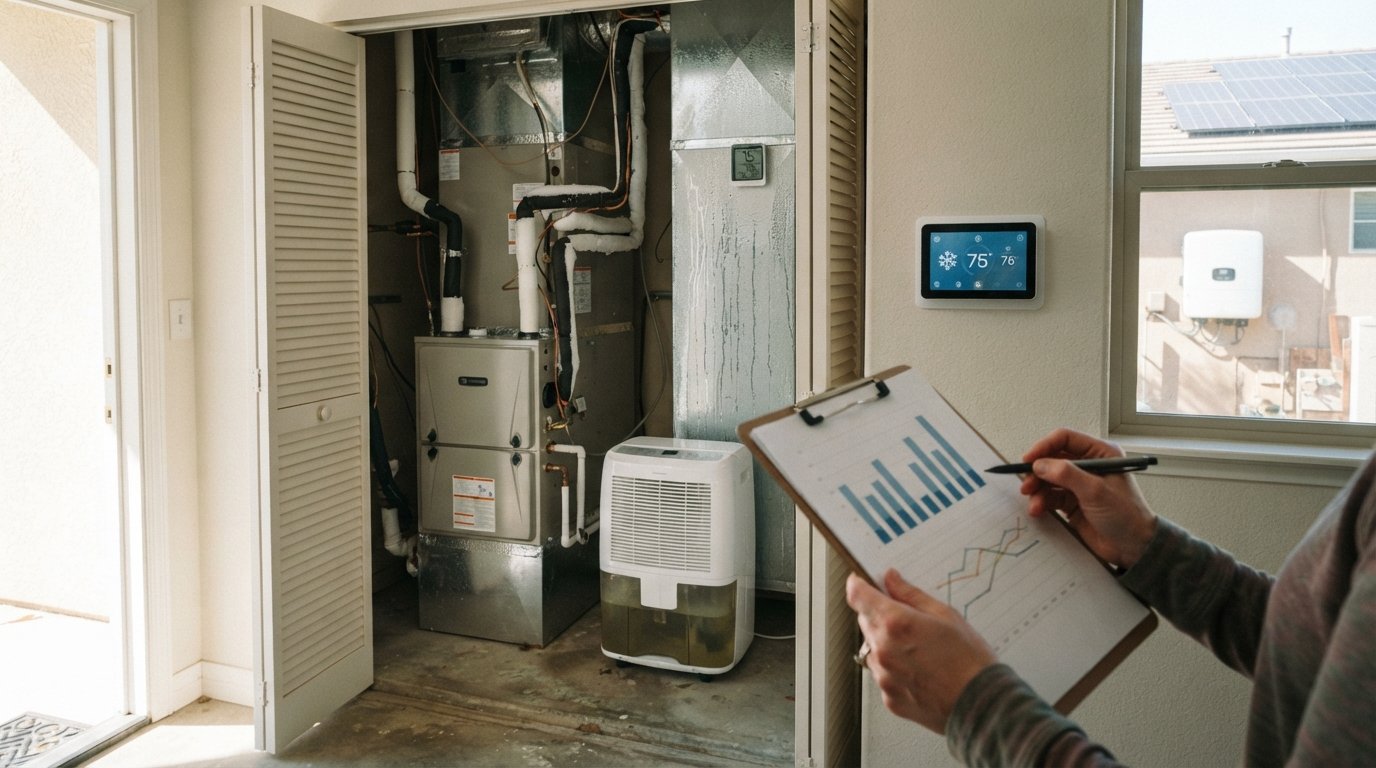
Solar Plus Dehumidifier and HVAC Load Planning for Humid Climates
Plan solar plus dehumidifier and HVAC loads for humid climates to avoid summer peak charges. Call (833)-793-7166 for expert help.

Learn more about Solar Panel Installation and Repair for guides, costs, and what to expect.
Compare Solar Panel Installation and Repair Pros Near You

Enter your ZIP code to compare top-rated local professionals and request free quotes.
If you live in a humid climate, you already know that your air conditioner is not just cooling the air, it is wringing water out of it. That moisture removal is a massive energy load, and it is the single biggest reason why a solar array sized on annual averages can fall short in July. Solar plus dehumidifier and HVAC load planning for humid climates is not a niche topic; it is the difference between a system that offsets your bill and one that leaves you buying peak power all summer. This guide walks through how to estimate that load honestly, how dehumidifiers fit into the picture, and how to design a solar plus storage system that keeps humidity under control without wrecking your return on investment.
Why Humid Climates Break Conventional Solar Sizing
Most solar sizing conversations start with a utility bill and an annual kilowatt hour total. That approach works fine in dry climates where heating and cooling loads are somewhat predictable. In humid regions like Houston, Florida, or the Carolinas, the annual number hides a brutal summer peak. Your air conditioner may run for 20 hours a day in August, and a standalone dehumidifier may add another 300 to 700 watts of continuous draw. If your solar array is sized to the annual average, you will be importing power during the exact hours when your utility charges the most.
Latent load is the technical term for the energy your HVAC system spends removing moisture rather than changing temperature. In a humid climate, latent load can represent 30 to 40 percent of your total cooling energy. That means a 3 ton air conditioner that draws 3,500 watts might spend over 1,000 watts of that just condensing water. A solar plus dehumidifier and HVAC load planning strategy has to account for this hidden work, because it does not show up as a temperature change on your thermostat but it absolutely shows up on your electric bill.
The practical consequence is that you cannot trust a generic online calculator that asks for your zip code and square footage. You need to look at hourly or at least monthly usage data, and you need to separate cooling from everything else. Many utilities now provide interval data downloads, and that is the single most valuable input for load planning in a humid climate.
How Dehumidifier and AC Runtime Shape Annual kWh Estimates
Air conditioners remove moisture as a byproduct of cooling, but they only do so when they are running. If your system is oversized, it will cool the house quickly and shut off before it has time to dehumidify properly. That is why many homeowners in humid climates run a standalone dehumidifier even when the AC is on: the AC keeps the temperature comfortable, and the dehumidifier keeps the air from feeling clammy. The problem is that this combination can be an energy hog if it is not planned for.
To estimate the annual kWh impact, you need to know the runtime hours and the wattage of each device. A typical whole home dehumidifier draws between 500 and 800 watts, while a portable unit might draw 300 to 500 watts. If a whole home unit runs 12 hours a day for six months of the year, that is roughly 1,300 to 1,700 kWh annually. That is a significant load, comparable to running a small window air conditioner. Your solar array has to cover that load, or you will be buying more grid power than you expected.
Here is a simple framework for estimating the combined load:
- Pull 12 months of hourly or daily usage data from your utility.
- Identify the summer months and calculate the average daily kWh for June through September.
- Subtract a baseline for non cooling loads (lighting, appliances, plug loads) using shoulder season data.
- Estimate dehumidifier runtime separately, either from a smart plug or from manufacturer specs and run hours.
- Add the dehumidifier kWh to the cooling kWh to get a true summer peak load.
Once you have that summer peak number, you can size your array to cover it rather than sizing to the annual average. That might mean a slightly larger system, but it also means you avoid the worst case scenario of buying expensive peak power all summer. If you are planning a move to a humid climate and need to coordinate a solar installation with your relocation, resources like Moving.Homes can help you plan the logistics of the transition while you line up local solar quotes.
Whole Home Versus Portable Dehumidifiers and Energy Use
The choice between a whole home dehumidifier and a portable unit has a direct impact on your solar load planning. Whole home units are typically integrated into your HVAC ductwork and run automatically based on humidity setpoints. They are more efficient at removing moisture per watt because they use larger coils and slower fans, and they can handle the entire house rather than one room. However, they draw more power when running and they run more often because they are managing the whole envelope.
Portable dehumidifiers are cheaper upfront and easier to install, but they are less efficient and often run continuously in a humid climate. A portable unit in a basement or a single room might draw 400 watts and run 24 hours a day during the summer, which adds up to nearly 300 kWh per month. That is a lot of solar capacity dedicated to one appliance. If you are sizing a system, a whole home unit is usually the better pairing with solar because it gives you more control over runtime and it can be scheduled to run during peak solar production hours.
There is also a maintenance angle. Portable units fill up quickly and shut off when the tank is full, which means they may not run as consistently as you expect. Whole home units drain to a condensate line and run unattended, so their energy use is more predictable. For solar planning, predictability matters as much as efficiency. You want to know how many kWh the device will consume so you can size the array and battery accordingly.
Sizing the Array for Summer Peaks Versus Annual Net Usage
There are two schools of thought on solar sizing in humid climates. The first is to size for annual net usage, meaning you generate as much energy over the course of a year as you consume. This is the most common approach and it works well if your utility offers generous net metering. The second is to size for summer peak load, meaning you generate enough power on the hottest, most humid days to cover your cooling and dehumidification without importing power.
In a humid climate, the annual net approach can leave you short in July and August because your consumption is front loaded into the summer. If your utility has time of use rates or demand charges, that shortfall is expensive. Sizing for the summer peak usually means adding 15 to 25 percent more panels than the annual calculation would suggest. That extra capacity also helps in winter, when solar production is lower but your cooling load is minimal.
The right choice depends on your rate structure and your tolerance for grid purchases. If you have full retail net metering, annual sizing is usually fine because you can bank credits in spring and fall. If you have avoided cost net metering or time of use rates, summer peak sizing is the safer bet. A solar plus dehumidifier and HVAC load planning approach should model both scenarios and show you the tradeoff between upfront cost and summer bill risk. When you request quotes through FreeSolarPowerQuotes, ask each installer to show you the summer peak calculation, not just the annual average.
Battery and Load Control for Evening Humidity Cycles
Humidity does not go away when the sun goes down. In fact, evening humidity cycles are often the most uncomfortable part of the day in places like Florida and the Gulf Coast. Your air conditioner and dehumidifier will run well into the night, and that is when solar production is zero. A battery can shift some of your midday solar production into the evening, but you need to size it correctly for the load.
A typical evening humidity cycle might require 2 to 4 kWh of cooling and dehumidification between 6 PM and midnight. A 10 kWh battery can cover that easily, but it will also be needed for other loads. The key is to use smart load control to prioritize the dehumidifier and AC during the evening, and to schedule heavy appliances like dishwashers and laundry for midday when solar is abundant. Many modern inverters and battery systems support this kind of scheduling, and it makes a meaningful difference in how much grid power you buy.
Load control can also help with the dehumidifier specifically. If you have a whole home unit, you can set it to run more aggressively during the day when solar is producing and pull back at night. That strategy uses your solar array as a dehumidification engine and reduces the battery capacity you need. It is a simple example of how solar plus dehumidifier and HVAC load planning for humid climates is really about scheduling and controls, not just panel count.
Efficiency Upgrades That Reduce Cooling Load Before Adding Panels
The cheapest solar panel is the one you do not need to buy. Before you size an array around a large cooling and dehumidification load, it is worth investing in efficiency upgrades that shrink that load. In a humid climate, the highest impact upgrades are usually air sealing, duct sealing, and attic insulation. A leaky duct system in a vented attic can lose 20 to 30 percent of your cooling energy before it reaches the living space, and it can also pull humid outdoor air into the ducts, which increases the latent load.
Here are the upgrades that typically deliver the best return before solar:
- Air sealing the building envelope to reduce humid air infiltration.
- Sealing and insulating ductwork, especially if ducts run through unconditioned space.
- Upgrading to a variable speed air handler or a dedicated dehumidification system.
- Adding attic insulation and radiant barriers to reduce heat gain.
- Installing a smart thermostat with humidity control to optimize runtime.
These upgrades reduce the size of the solar array you need, which lowers your upfront cost and improves your payback period. They also make your home more comfortable, which is the real goal. A solar plus dehumidifier and HVAC load planning process should always start with a home energy audit, because you cannot optimize a load you have not measured. Many utilities offer free or low cost audits, and the data you get from them is invaluable for sizing both the HVAC system and the solar array.
Putting It Together: A Planning Sequence for Humid Climates
The most reliable way to approach solar plus dehumidifier and HVAC load planning for humid climates is to follow a sequence that starts with measurement and ends with verification. First, gather at least 12 months of utility data and identify your summer peak demand. Second, get a home energy audit to find air sealing and duct leakage opportunities. Third, decide on your dehumidification strategy (whole home versus portable) and estimate its runtime and wattage. Fourth, size your HVAC system correctly, because an oversized system will short cycle and fail to dehumidify. Fifth, size your solar array to cover the summer peak load, not just the annual average. Sixth, add battery storage and load control to manage evening humidity cycles. Finally, monitor your system for the first year and adjust your settings based on actual performance.
This sequence matters because each step informs the next. If you skip the audit, you may oversize the array. If you skip the dehumidification estimate, you may undersize it. If you skip the load control, you may buy more battery than you need. The goal is not to build the biggest system, it is to build the right system for your climate and your home. FreeSolarPowerQuotes can connect you with installers who understand humid climate load planning and who will show you the math behind their recommendations. You can also call (833)-793-7166 to speak with a team member about your project and get matched with local providers.
Humid climates are unforgiving to poorly planned solar systems, but they are also where solar plus storage delivers some of its greatest value. When you get the load planning right, your system keeps the air dry, the lights on, and the utility bill low, even in the worst of August. That is a result worth planning for.