
Solar Panel Wind Load Ratings: What Homeowners Should Know
Solar panel wind load ratings what homeowners should know: ensure your system survives storms and passes inspection with the right engineering.

By Ethan Whitaker
Learn more about Solar Panel Installation and Repair for guides, costs, and what to expect.
Compare Solar Panel Installation and Repair Pros Near You

Enter your ZIP code to compare top-rated local professionals and request free quotes.
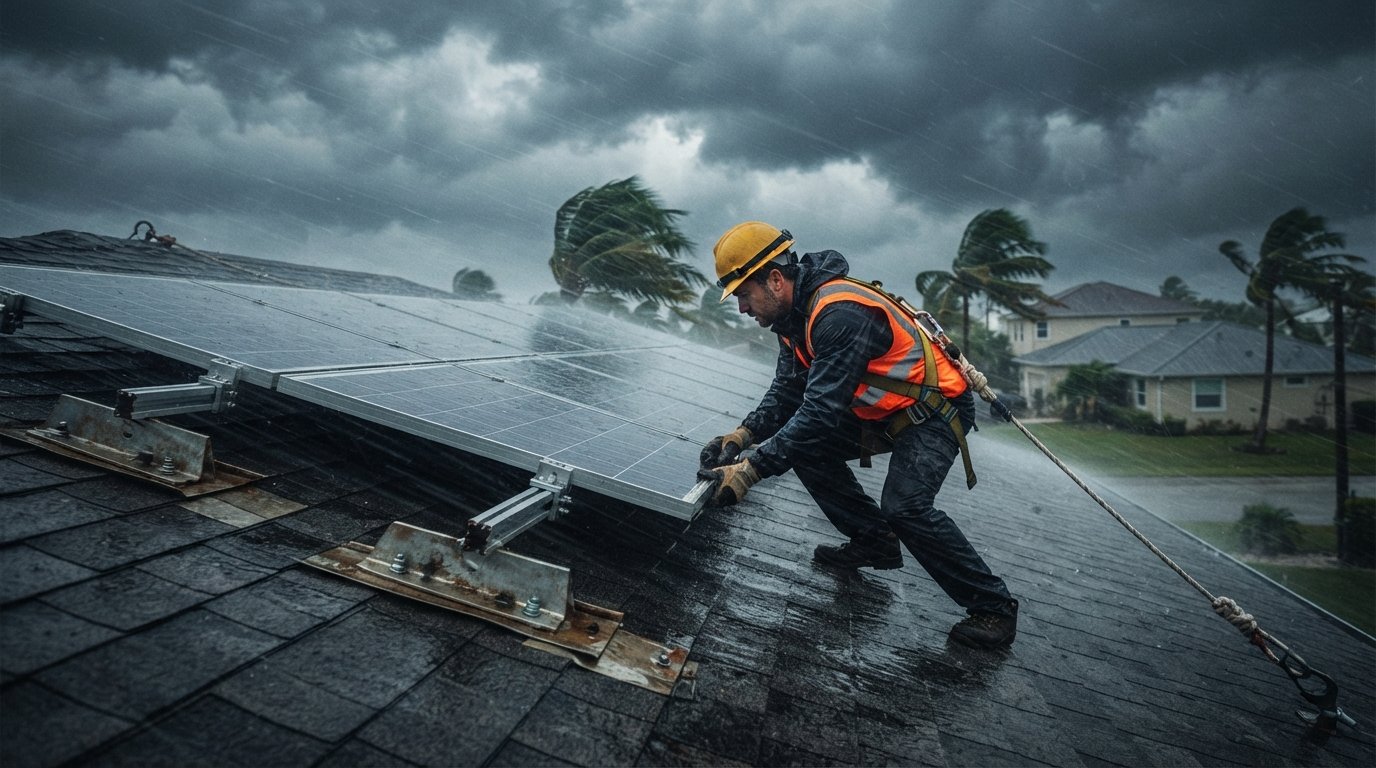
When you picture solar panels, you probably imagine them basking in the sun on a calm, clear day. But the reality is that your roof-mounted system has to survive everything Mother Nature throws at it, including powerful gusts, tropical storms, and even hurricanes. That is why understanding solar panel wind load ratings is not just a technical detail for engineers; it is a critical piece of information that can affect your home's safety, your insurance coverage, and the long-term performance of your investment.
Wind load ratings determine how much force a solar panel and its mounting system can withstand without failing. If your installer gets this wrong, you could face catastrophic damage during a storm, and your homeowner's insurance might not cover the repairs. This guide breaks down what wind load ratings mean, how they are calculated, and what you need to ask before signing any solar contract. We will also explain how to verify that your system meets local building codes and how to work with reputable providers to get a safe, durable installation.
What Exactly Is a Wind Load Rating?
A wind load rating is a measurement of the maximum wind speed and resulting pressure that a solar panel system can endure without structural failure. It is typically expressed in pounds per square foot (psf) or in miles per hour (mph) for the wind speed. The rating is not just about the panel itself; it also involves the mounting hardware, the roof attachment points, and the overall integrity of your roof structure. When wind hits a solar array, it creates both positive pressure (pushing down) and negative pressure (lifting up). The negative pressure, or uplift, is often the most dangerous because it can rip panels off the roof.
Building codes, such as the International Building Code (IBC) and the International Residential Code (IRC), set minimum wind load requirements based on your geographic location. These codes reference the American Society of Civil Engineers (ASCE) standard 7, which provides wind speed maps and formulas to calculate design loads. In the United States, coastal areas in Florida, Texas, and the Carolinas have much higher wind speed requirements than inland regions. For example, a home in Miami-Dade County might need to withstand winds of 170 mph, while a home in Phoenix might only need to handle 90 mph. Your solar installer must design the system to meet or exceed these local requirements.
It is also important to distinguish between the panel's own rating and the rating of the entire installed system. A solar panel might be tested to withstand a certain wind pressure, but if it is mounted on a roof with weak connections or inadequate spacing, the whole assembly could fail. Therefore, the wind load rating of your completed system is what truly matters, and it depends on a combination of factors including panel strength, mounting hardware, roof condition, and installation quality.
How Wind Load Ratings Are Calculated and Tested
Manufacturers test solar panels to determine their mechanical load rating, which is the maximum pressure they can handle. This testing is often done according to standards like IEC 61215 or UL 1703. In these tests, a panel is subjected to uniform pressure on both the front and back to simulate wind and snow loads. The result is a rating in pascals (Pa) or pounds per square foot. For instance, a panel might be rated for 5,400 Pa (about 113 psf) on the front and 2,400 Pa (about 50 psf) on the back. However, these are laboratory conditions, and real-world performance can vary due to installation angles, roof shape, and surrounding obstructions.
To determine the wind load on your specific roof, engineers use ASCE 7 formulas that consider basic wind speed, exposure category, height, and roof pitch. The basic wind speed comes from maps that divide the country into zones. Exposure category reflects the terrain around your home: urban areas with many buildings have lower exposure, while open fields or coastal areas have higher exposure. The height of your roof and its slope also affect the pressure coefficients. Your installer should perform these calculations or use software to ensure the mounting system is adequate.
Mounting hardware manufacturers provide their own engineering reports that specify how many attachments are needed per panel and the maximum spacing between them. These reports are based on testing and are often accepted by building departments as proof of compliance. As a homeowner, you should ask for these documents to verify that your system is designed for your local wind speeds. If an installer cannot provide them, that is a red flag.
Why Wind Load Ratings Matter for Homeowners
First and foremost, wind load ratings are about safety. A solar array that is not properly attached can become a projectile in a storm, endangering people and property. Even if no one is hurt, flying panels can cause significant damage to your roof, windows, and surrounding structures. Secondly, wind load ratings affect your insurance. Most homeowner's insurance policies cover damage from windstorms, but they may deny a claim if the solar system was not installed to code or if the damage resulted from poor workmanship. Insurers are increasingly asking for proof that the solar installation meets local wind load requirements.
Third, a system that is not rated for your area's wind speeds may not pass inspection, which means you could be forced to remove or retrofit it at your own expense. This can delay your project and add thousands of dollars in unexpected costs. Finally, wind load ratings impact the longevity of your investment. A system that is under-engineered may suffer subtle damage over time, such as loosened mounts or micro-cracks in panels, leading to reduced performance and premature failure. By ensuring your system is properly rated, you protect both your home and your financial return.
If you are considering solar, it is wise to get multiple quotes and compare not just price but also the wind load calculations and mounting hardware proposed. A reputable installer will be transparent about these details and happy to explain them. For a deeper dive into evaluating solar quotes, see our guide on understanding solar panel system quotes. It walks you through the questions to ask and the red flags to avoid.
Key Factors That Influence Your System's Wind Load Rating
Several variables determine how well your solar array will stand up to wind. Understanding these can help you have informed conversations with your installer and make better decisions.
- Geographic location: Basic wind speed maps assign higher speeds to coastal areas and lower speeds inland. Your exact address determines the minimum design requirement.
- Roof shape and pitch: Flat roofs and low-slope roofs experience different wind pressures than steep gable roofs. Corners and edges of the roof have higher uplift forces.
- Building height: Taller homes experience stronger winds at the roof level, increasing the load.
- Surroundings: Trees, neighboring buildings, and terrain can shield your roof or create turbulence that increases loads.
- Mounting system: The type of racking, the number of attachment points, and the quality of flashing and sealants all affect the system's ability to resist wind.
Additionally, the solar panels themselves have a mechanical load rating that must be considered. Some panels are stronger than others, but even the strongest panel will fail if the mounting is inadequate. It is the combination of panel, racking, and roof attachment that determines the overall wind resistance. Your installer should provide a structural analysis that shows how the system meets the required wind speed for your location.
Another factor is the age and condition of your roof. If your roof is old or has weak spots, it may not be able to support the additional load of solar panels, especially during high winds. In such cases, you may need to reinforce the roof or choose a different mounting method, such as a ground mount. A professional installer will assess your roof's structural integrity before proposing a design.
Building Codes and Standards You Should Know
In the United States, residential solar installations must comply with local building codes, which typically adopt the International Residential Code (IRC) or International Building Code (IBC). These codes reference ASCE 7 for wind loads. The latest edition, ASCE 7-22, provides updated wind speed maps and may require higher design loads in some areas. Your local building department will enforce these requirements during the permit process.
Some states and counties have additional wind-borne debris regions, particularly along the hurricane coastline. In these areas, solar panels and mounting systems may need to meet more stringent standards, such as impact resistance and enhanced attachment. For example, Florida's Building Code includes specific requirements for solar installations in the High-Velocity Hurricane Zone. Similarly, Texas has windstorm certification requirements in certain counties. It is crucial that your installer is familiar with local amendments and obtains all necessary permits.
To verify compliance, you can ask your installer for the engineering calculations, the mounting hardware's evaluation report (like an ICC-ES report), and the permit approval. You can also check with your local building department to confirm that the installation was inspected and passed. Do not rely solely on the installer's word; do your due diligence to ensure your system is code-compliant.
How to Ensure Your Solar Installation Meets Wind Load Requirements
Start by selecting a reputable, licensed solar installer with experience in your area. They should be familiar with local wind speeds and building codes. Ask for references from past customers and check online reviews. During the quote process, request that the installer provides a wind load calculation specific to your home. This calculation should show the design wind speed, the pressure coefficients, and the resulting loads on the panels and mounts.
Next, review the mounting hardware specifications. The manufacturer should have published load ratings and installation guidelines. Ensure that the installer follows these guidelines, including the recommended number of attachments and spacing. If the installer proposes a design that seems to have fewer attachments than recommended, question it. Sometimes, to save costs, installers might skimp on hardware, which can compromise safety.
Also, consider hiring a third-party structural engineer to review the plans if you are in a high-wind area or have a complex roof. This extra step can provide peace of mind and catch potential issues before installation. Finally, make sure all permits are pulled and inspections are passed. A valid permit means the local authority has reviewed the plans for code compliance, including wind loads.
When comparing quotes, do not automatically choose the lowest price. A cheap installation might cut corners on mounting hardware or skip engineering calculations. Instead, look for a balance of quality, experience, and transparency. A trustworthy installer will be happy to explain how they address wind loads and will provide documentation to back it up.
What Happens If Your System Is Under-Rated?
If your solar array is not properly rated for wind, the consequences can be severe. During a storm, panels could be ripped off, causing damage to your roof and potentially injuring someone. Even if the panels stay attached, the mounting system could fail, leading to leaks and structural damage. Your insurance company might deny a claim if they determine the installation was not up to code or was negligently installed. This could leave you with tens of thousands of dollars in repair bills.
Moreover, an under-rated system may not pass inspection, resulting in fines or a requirement to remove the system. If you try to sell your home, a non-compliant solar installation could be a liability that turns away buyers or lowers your property value. Therefore, it is far better to invest in a properly engineered system from the start. The slight additional cost for robust mounting and engineering is negligible compared to the potential losses.
If you suspect your existing system is under-rated, contact a licensed engineer or a reputable solar installer to assess it. They can recommend retrofits, such as adding more attachments or upgrading the racking. In some cases, you may need to remove and reinstall the system correctly. Addressing the issue proactively can save you from a disaster later.
Working With Solar Providers to Get It Right
At FreeSolarPowerQuotes, we understand that navigating wind load ratings and building codes can be overwhelming. That is why we connect you with pre-screened, reputable solar installers in your area who are experienced in local requirements. Our service is free and without obligation. You can request quotes from multiple providers and compare their approaches to wind load engineering. This allows you to make an informed decision and choose an installer who prioritizes safety and quality.
We also provide educational resources to help you ask the right questions. For instance, our guide on solar energy information and tools offers in-depth articles on installation best practices, financing, and incentives. By leveraging these resources, you can become a more savvy consumer and ensure your solar investment is protected.
Remember, a solar panel system is a long-term investment that should enhance your home's value and resilience. By insisting on proper wind load ratings, you are not only protecting your property but also contributing to the overall safety and sustainability of your community. Do not hesitate to ask questions and demand documentation. A professional installer will respect your diligence.
Ultimately, understanding solar panel wind load ratings empowers you to make better decisions. It ensures that your system is built to withstand the elements, that your insurance remains valid, and that your investment pays off for decades. As you embark on your solar journey, keep wind loads in mind, and choose a provider who shares your commitment to quality and safety.