
Solar Panel Hail Damage Insurance Claims: What Homeowners Should Know
Solar panel hail damage insurance claims what homeowners should know, plus how to document damage and decide between a claim and warranty repair. Call (833)-793-7166 for guidance.

By Caleb Morgan
Learn more about Solar Panel Installation and Repair for guides, costs, and what to expect.
Compare Solar Panel Installation and Repair Pros Near You

Enter your ZIP code to compare top-rated local professionals and request free quotes.
Hailstorms can turn a clear summer afternoon into a tense evening of wondering whether your rooftop solar investment just took a beating. For homeowners who have recently gone solar, the sight of golf-ball-sized ice pellets bouncing off photovoltaic panels is enough to trigger a wave of questions: Will my insurance cover this? How do I file a claim? What if the damage is only cosmetic? The answers are rarely as straightforward as they seem, because solar equipment sits at the intersection of home insurance, manufacturer warranties, and installer workmanship guarantees. Understanding how these pieces fit together before a storm hits can mean the difference between a smooth claim and months of frustration.
This guide walks through the practical realities of solar panel hail damage insurance claims, from how policies typically treat rooftop equipment to the documentation you need and the decision points that determine whether you file a claim or call your installer instead. The information here is educational, not legal or financial advice, and policy language varies by carrier and state, so always confirm details with your insurance agent and your solar contract before acting.
How Homeowner Policies Typically Treat Rooftop Solar Equipment
Most standard homeowners insurance policies (HO-3 and similar forms) cover solar panels as part of the dwelling structure, provided the system is permanently attached to the roof or ground-mounted and wired into the home. That is good news for most solar owners: hail damage to panels is generally treated the same way as hail damage to shingles, meaning it falls under the dwelling coverage portion of the policy rather than a separate rider. However, there are important caveats. Some carriers require the system to be listed on the policy or scheduled as an endorsement, and a few insurers exclude solar equipment unless it is specifically added. If you installed solar and never notified your insurer, your first call after a storm should be to verify that the system is actually covered.
Coverage also depends on who owns the equipment. If you purchased your system outright or financed it with a solar loan, you own the panels and they are typically covered under your homeowners policy. If you leased the system or signed a power purchase agreement (PPA), the third-party owner usually carries its own insurance on the equipment, and your policy may only cover damage to the roof beneath it. This distinction matters enormously during a claim, because filing under the wrong policy can delay repairs or lead to a denial. Check your contract to confirm ownership, and ask your agent how the system is listed on your policy declarations page.
Finally, note that many policies have separate deductibles for wind and hail claims, and some states allow percentage-based deductibles that can be substantially higher than a standard flat deductible. In hail-prone states like Texas, Colorado, and Oklahoma, a 1% or 2% hail deductible on a $400,000 dwelling policy means $4,000 to $8,000 out of pocket before insurance pays anything. That number directly affects whether filing a claim makes financial sense, so locate your deductible before you call the claims line.
Documenting Damage: Inspector Reports, Photos, and Production Data
The single biggest factor in a successful solar hail damage claim is documentation, and the best documentation starts before the storm. Keep a folder (digital or physical) with your original installation contract, the system's equipment specifications, proof of purchase, and a set of clear photos of the panels when they were new. Note the panel model, wattage, and serial numbers, because adjusters and manufacturers will ask for them. If your installer provided a commissioning report showing expected production, keep that too: it becomes your baseline for proving that output dropped after the storm.
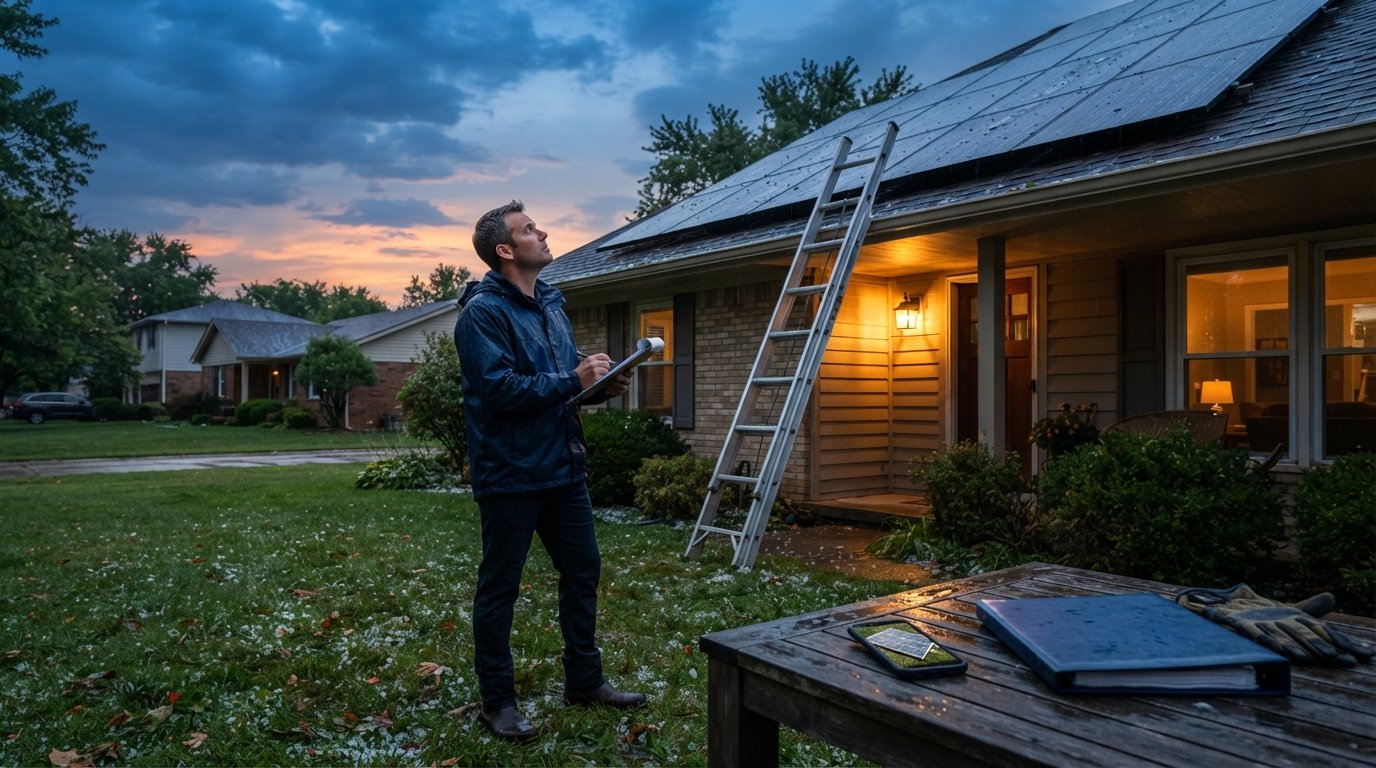
After a hail event, resist the urge to climb on the roof yourself. Instead, document from the ground with dated photos and video, capturing the panels, the roof surface, gutters, and any visible dents or cracked glass. Then request a professional inspection. Your solar installer can provide a service report that includes visual findings, electrical testing (such as insulation resistance or IV curve tracing), and a comparison of current production against your baseline. Many monitoring platforms also store historical production data, which is powerful evidence: a sudden 10% to 20% dip in output immediately following a storm is far more persuasive to an adjuster than a photo of a single cracked cell.
Here is a practical documentation checklist to work through after any hail event:
- Date-stamped photos and video of panels, roof, and surroundings taken from safe ground-level positions.
- A written inspection report from your installer or a certified solar inspector, including electrical test results.
- Production data exports from your monitoring app showing output before and after the storm.
- Copies of your insurance declarations page and your solar contract showing ownership and warranty terms.
- Receipts or estimates for any temporary measures, such as tarping or emergency electrical disconnection.
Keep in mind that cosmetic damage is a gray area. Microcracks in cells or scuffed glass may not be visible from the ground but can degrade performance over time. If your installer finds electrical anomalies without obvious physical damage, ask for that finding in writing, because it supports the argument that the system suffered functional damage rather than mere cosmetic wear. Adjusters are trained to distinguish between the two, and clear third-party documentation helps your case.
Choosing Between an Insurance Claim and Installer Warranty Repair
Not every hail-damaged panel should trigger an insurance claim. Solar panels are built to withstand significant impact, and most modern modules carry manufacturer warranties that cover defects and, in some cases, specific damage types for 10 to 25 years. Workmanship warranties from your installer typically cover installation-related issues for 5 to 10 years. If the damage is isolated to one or two panels and the cause is a manufacturing defect or installation flaw, the warranty path may be faster and cheaper than a claim, especially if your hail deductible is high.
The decision usually comes down to three factors: the cost of repair, your deductible, and the risk of future premium increases. If the estimated repair cost is at or below your deductible, filing a claim accomplishes nothing except putting a loss on your claims history. If the repair cost substantially exceeds the deductible, insurance becomes the rational choice. As a rule of thumb, many financial advisors suggest filing only when the damage exceeds your deductible by a comfortable margin, often two to three times the deductible amount, to justify the potential impact on future premiums.
Warranty repairs have their own limitations. Manufacturer warranties generally do not cover damage from acts of nature such as hail, wind, or lightning; they cover defects in materials and workmanship. Some premium panel brands offer enhanced hail coverage, but it is not standard. Your installer's workmanship warranty covers how the system was put together, not what the sky throws at it. Read both warranties carefully before assuming either will pay for hail damage, and if the damage is clearly storm-related, the insurance claim is usually the correct first step. For homeowners still planning a system, our guide on adding a battery to solar later explains how equipment changes can affect warranty and insurance considerations down the road.
How Deductibles and Roof Age Affect the Decision
Roof age is a factor many homeowners overlook, yet it can complicate a solar claim significantly. If your roof was already near the end of its service life when the hail hit, the adjuster may determine that some of the damage predates the storm or that the roof needed replacement anyway. In some cases, insurers will pay to remove and reinstall solar panels to facilitate a roof replacement, but only if the roof itself qualifies for coverage. If the roof is not covered due to age or wear, you may face the cost of detaching and reinstalling the array out of pocket, which can run into the thousands of dollars.
Deductibles interact with this in predictable ways. A high hail deductible combined with an older roof often tips the math toward paying for repairs directly rather than filing. Conversely, a newer roof and a modest deductible make a claim more attractive. Before filing, ask your installer for a detailed estimate that separates panel replacement, labor for detach and reset, electrical testing, and any roofing work. Then compare that total against your deductible and consider the long-term premium consequences. Some carriers offer claim forgiveness or waived surcharges for first claims, so ask your agent about your specific policy terms.
It also helps to understand how insurers evaluate solar claims in hail-prone regions. Many have developed specific inspection protocols for photovoltaic systems, and some will send a specialist adjuster rather than a generalist. If your carrier seems unfamiliar with solar, your installer's documentation becomes even more important. A clear report that ties production loss to storm damage gives the adjuster a defensible basis for approval.
Steps to Take Before Storm Season and After a Hail Event
Preparation is the cheapest insurance. Before storm season arrives, confirm with your agent that your solar system is listed on your policy and that you understand your wind and hail deductibles. Ask whether your carrier offers any discounts for impact-resistant panels or roof-mounted equipment, and update your home inventory with photos and serial numbers. If your system is leased, confirm in writing who insures the equipment and who is responsible for filing claims. A short annual review with your agent can prevent nasty surprises later.
When a hail event does occur, follow a calm, sequential process rather than rushing to file. This ordered approach keeps your claim credible and your options open:
- Wait until the storm passes and it is safe to inspect from the ground; never climb on a wet roof.
- Photograph and video the panels, roof, gutters, and any visible damage with date stamps.
- Check your monitoring app for production anomalies and export the data.
- Call your solar installer to schedule a professional inspection and written report.
- Contact your insurance agent to review coverage, deductibles, and whether filing makes sense.
- File the claim only after you have the inspection report and repair estimate in hand.
After filing, keep a log of every call, email, and visit, including names and dates. Adjusters are busy after widespread storms, and organized homeowners tend to get faster, fairer outcomes. If the initial offer seems low, you can request a re-inspection or provide supplemental documentation from your installer. Most policies also allow you to hire a public adjuster, though their fees typically run 10% to 15% of the settlement, so reserve that option for large or disputed claims.
For homeowners who are still shopping for solar or planning a roof replacement alongside installation, resources like PlanRemodel's contractor directory can help you find vetted roofing and home improvement professionals who understand how solar arrays interact with roofing systems. Coordinating roof work and solar installation properly reduces the chance of warranty disputes later and makes future insurance claims cleaner.
Common Pitfalls and How to Avoid Them
One frequent mistake is failing to notify the insurer about the solar installation in the first place. If the system was never added to the policy, the carrier may deny the claim or apply a coverage limit that falls far short of replacement cost. Another pitfall is accepting a quick settlement before your installer has completed electrical testing; hidden microcrack damage can reduce output for years, and a closed claim is hard to reopen. Always get the full technical picture before signing anything.
Homeowners also sometimes confuse cosmetic damage with functional damage, or vice versa. Scuffed glass with no electrical impact may not justify a claim, while invisible cell damage that shows up in production data very well might. Rely on your installer's testing, not visual impressions. Finally, be wary of door-to-door storm chasers who offer free roof inspections and pressure you to file immediately. Work with your existing installer and a licensed, local contractor you trust, and take the time to read every document before signing.
Solar panels are remarkably durable, and many systems emerge from hailstorms with nothing more than cosmetic marks. But when real damage occurs, the homeowners who fare best are those who documented their system from day one, understood their deductible and coverage, and followed a deliberate process instead of panicking. Review your policy annually, keep your documentation current, and know your installer's warranty terms. With those habits in place, a hail event becomes a manageable insurance matter rather than a financial shock, and your rooftop investment stays protected for the decades of clean energy ahead.