
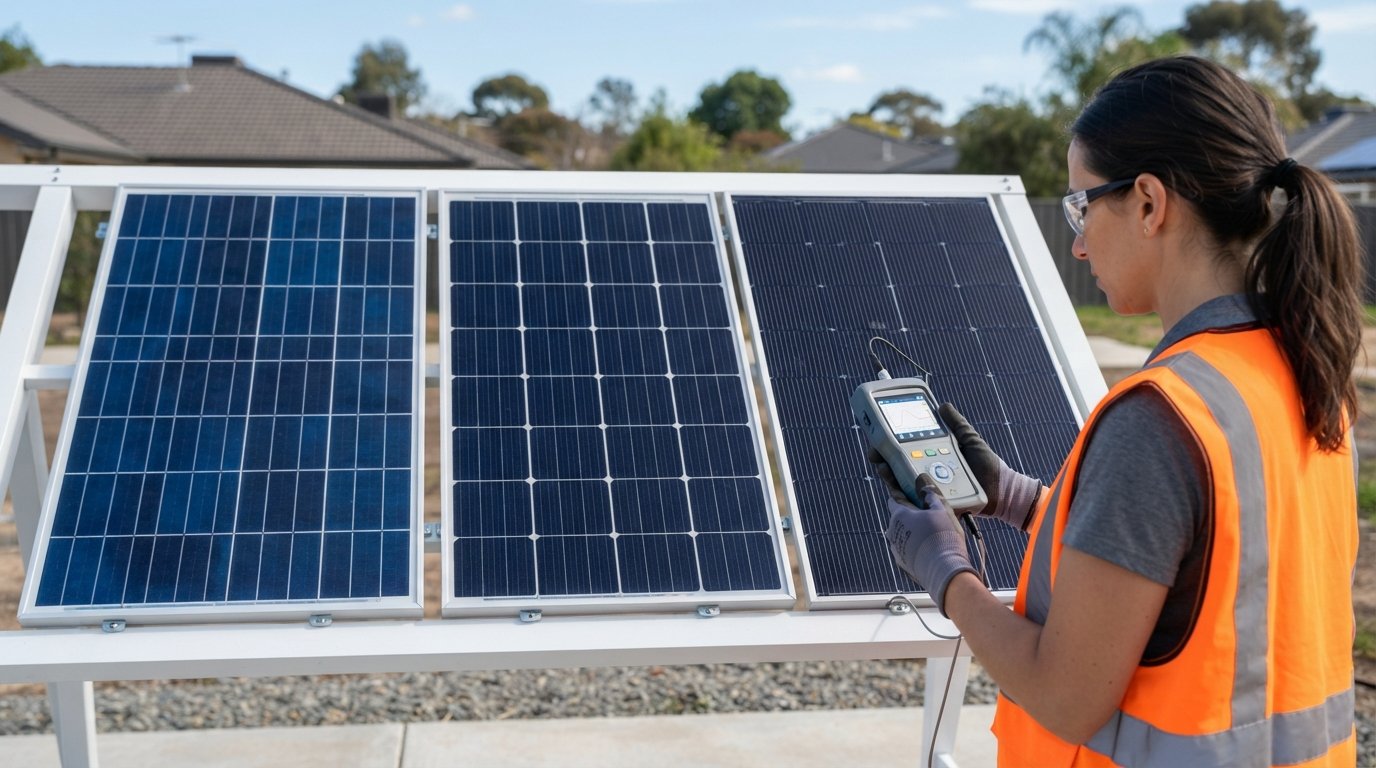
Solar Panel Efficiency: PERC vs TOPCon vs HJT (2026)
Compare solar panel efficiency PERC vs TOPCon vs HJT in 2026. See which technology maximizes roof space, cuts heat losses, and improves payback.

By Caleb Morgan
Learn more about Solar Panel Installation and Repair for guides, costs, and what to expect.
Compare Solar Panel Installation and Repair Pros Near You

Enter your ZIP code to compare top-rated local professionals and request free quotes.
Choosing the right solar panel technology can feel like comparing smartphones: every year brings a new acronym, a higher efficiency number, and a fresh round of marketing claims. In 2026, three names dominate the conversation among homeowners, installers, and even utility-scale developers: PERC, TOPCon, and HJT. Each represents a different way of squeezing more electricity from the same sunlight, and each comes with its own trade-offs in cost, durability, and real-world performance. Understanding how these technologies differ is not just an academic exercise. The panel type your installer proposes directly affects how much roof space you need, how much you pay per watt, and how quickly your system pays for itself.
This guide breaks down solar panel efficiency for PERC vs TOPCon vs HJT in plain language. You will learn what each acronym means, how their efficiencies compare, where they perform best, and what questions to ask before signing a contract. The goal is simple: help you make a confident, informed decision without drowning in semiconductor physics.
What Solar Panel Efficiency Actually Means for Your Roof
Efficiency is the percentage of sunlight hitting a panel that gets converted into usable electricity. A 20 percent efficient panel turns one-fifth of the sun's energy into power; a 23 percent panel turns nearly one-quarter. That difference sounds small, but it compounds quickly. On a roof with limited space, a higher-efficiency panel can mean the difference between covering 80 percent of your electricity bill and covering all of it.
Efficiency also influences balance-of-system costs. Fewer panels mean fewer mounts, less wiring, and lower labor hours. For homeowners in sunny states like Arizona, Texas, or Florida, the math often favors higher efficiency because the same roof area produces more kilowatt-hours over the year. For those with large, unshaded roofs, a slightly lower-efficiency panel at a lower price can deliver a better return on investment.
Three metrics matter most when comparing panels:
- Module efficiency: the panel's rated output under standard test conditions.
- Temperature coefficient: how much output drops as the panel heats up.
- Degradation rate: how much efficiency the panel loses each year.
PERC, TOPCon, and HJT differ on all three. PERC is the established workhorse, TOPCon is the fast-growing challenger, and HJT is the premium performer. The sections below unpack each technology, starting with the one most homeowners already own or have been quoted.
PERC: The Proven Baseline for Residential Solar
PERC stands for Passivated Emitter and Rear Contact. It is an evolution of the standard silicon solar cell that adds a passivation layer on the back side, which reflects unused light back into the cell and reduces electron recombination. The result is a modest but meaningful efficiency bump over older aluminum back surface field cells. Most panels installed on U.S. homes between 2018 and 2024 were PERC, and it remains the benchmark against which newer technologies are measured.
Typical PERC module efficiencies range from 19 percent to 21.5 percent. Premium PERC panels from tier-one manufacturers can reach 21.5 percent, but most commodity PERC sits closer to 20 percent. Temperature coefficients usually fall between -0.34 percent and -0.38 percent per degree Celsius, meaning output drops noticeably on hot roofs. Annual degradation is typically around 0.45 percent to 0.55 percent, with a 25-year power warranty guaranteeing roughly 84 to 87 percent of original output.
The great advantage of PERC is cost and supply chain maturity. It is manufactured at massive scale, widely available, and priced aggressively. For homeowners with ample roof space and a straightforward installation, PERC often delivers the lowest cost per watt and a payback period that is hard to beat. The technology is not going away, but it is increasingly relegated to budget and mid-tier product lines as TOPCon and HJT gain share.
When PERC Still Makes Sense
PERC is a strong choice when roof area is not a constraint, when the installed price per watt is significantly lower than alternatives, and when the installer offers a robust workmanship warranty. It is also common in ground-mounted arrays and commercial projects where land is plentiful. If a quote pairs PERC panels with a reputable installer and a competitive financing rate, the savings can outweigh the efficiency gap.
TOPCon: The New Mainstream Standard
TOPCon stands for Tunnel Oxide Passivated Contact. It adds an ultra-thin tunnel oxide layer and a doped polysilicon layer to the back of the cell, which dramatically reduces recombination losses and allows more electrons to reach the contacts. The architecture is compatible with existing PERC production lines, which is why manufacturers have been able to scale TOPCon quickly and keep prices close to PERC.
TOPCon module efficiencies typically range from 21.5 percent to 23.5 percent, with leading products approaching 24 percent. Temperature coefficients are better than PERC, often between -0.29 percent and -0.32 percent per degree Celsius. Annual degradation is lower, commonly 0.35 percent to 0.45 percent, and 30-year warranties are now standard for TOPCon products. In hot climates, the improved temperature coefficient can translate into several percentage points more annual energy yield than a comparable PERC panel.
For most U.S. homeowners shopping in 2026, TOPCon represents the sweet spot. It offers meaningfully higher efficiency than PERC, better heat performance, and longer warranties, all at a modest price premium. Many installers now default to TOPCon for residential projects because it future-proofs the system and maximizes production on constrained roofs. If you are comparing quotes, ask whether the proposed panels are TOPCon or PERC; the answer often explains a price difference of a few thousand dollars.
HJT: Premium Efficiency and Premium Price
HJT stands for Heterojunction Technology. It sandwiches a crystalline silicon wafer between thin layers of amorphous silicon, creating excellent passivation and very high open-circuit voltage. The result is the highest efficiency of the three mainstream technologies, with module efficiencies typically ranging from 22.5 percent to 24.5 percent and premium products exceeding 25 percent in laboratory settings.
HJT also boasts the best temperature coefficient of the group, often around -0.24 percent to -0.27 percent per degree Celsius, and very low degradation, sometimes as low as 0.25 percent per year. Those advantages make HJT particularly attractive in hot, sunny regions where heat derating is a major factor. The technology also performs well in low-light conditions, such as early morning, late afternoon, and cloudy days.
The trade-off is cost and manufacturing complexity. HJT requires specialized equipment and low-temperature processes, which limits the number of suppliers and keeps prices higher than TOPCon. For homeowners with limited roof space or a strong desire for maximum production per square foot, HJT can justify its premium. For others, the incremental gain may not offset the higher upfront cost. It is also worth noting that HJT panels often pair well with high-efficiency inverters and batteries, making them a fit for technically minded buyers who want a top-tier system.
Head-to-Head: Efficiency, Heat, and Degradation
Comparing the three technologies side by side clarifies where each one wins. The table below summarizes typical 2026 specifications for residential modules, though exact numbers vary by manufacturer and product line.
- PERC: 19 to 21.5 percent efficiency; -0.34 to -0.38 percent per degree Celsius; 0.45 to 0.55 percent annual degradation.
- TOPCon: 21.5 to 23.5 percent efficiency; -0.29 to -0.32 percent per degree Celsius; 0.35 to 0.45 percent annual degradation.
- HJT: 22.5 to 24.5 percent efficiency; -0.24 to -0.27 percent per degree Celsius; 0.25 to 0.35 percent annual degradation.
The pattern is clear: HJT leads on every performance metric, TOPCon is a close second at a lower price, and PERC trails but remains cost-effective. The practical question is whether the performance gap translates into enough additional energy to justify the price difference over 25 to 30 years. In many cases, TOPCon offers the best balance. In constrained or very hot installations, HJT can pull ahead. In budget-focused projects with ample space, PERC still holds its own.
It is also important to look beyond the panel. Inverter efficiency, wiring losses, shading, and roof orientation can each swing system output by more than the difference between these technologies. A well-designed TOPCon system will outperform a poorly designed HJT system every time. That is why working with a reputable installer matters as much as choosing the right panel.
Real-World Performance and Climate Considerations
Laboratory efficiency ratings assume 25 degrees Celsius cell temperature, which rarely happens on a sun-baked roof. In Phoenix, rooftop temperatures can exceed 70 degrees Celsius, causing significant derating. This is where TOPCon and HJT shine. Their lower temperature coefficients mean they lose less output as they heat up, so they produce more energy during peak afternoon hours when electricity rates are often highest.
In cooler climates like the Pacific Northwest, the temperature advantage narrows, but HJT's low-light performance can still provide a modest edge on overcast days. PERC remains competitive in mild climates with generous roof space. Homeowners in Florida, Texas, and the Southwest should pay close attention to temperature coefficients, because the difference between -0.38 and -0.26 percent per degree Celsius can add up to hundreds of kilowatt-hours per year on a typical 8-kilowatt system.
Another real-world factor is degradation. Over 25 years, a PERC panel degrading at 0.50 percent annually will retain about 88 percent of its original output, while an HJT panel degrading at 0.25 percent will retain about 94 percent. That gap means the HJT system produces more electricity in years 20 through 30, which can improve lifetime return on investment. However, the higher upfront cost of HJT must be weighed against that long-tail benefit.
Cost, Payback, and Incentives
Panel cost is only one part of the equation. Installation labor, inverters, mounting hardware, permits, and financing fees all contribute to the final price. As a rule of thumb in 2026, PERC panels are the least expensive per watt, TOPCon carries a modest premium, and HJT sits at the top. The difference between PERC and TOPCon is often small enough that the efficiency gain pays for itself over the system's life, especially in high-electricity-rate states.
Federal and state incentives can change the calculus. The 30 percent federal Investment Tax Credit applies to the entire system cost, so a higher-priced HJT system also generates a larger tax credit. State rebates, net metering policies, and SREC markets vary widely and should be verified with current official sources, as programs change frequently. Homeowners should also ask about financing options: a low-interest solar loan can make a premium system more affordable on a monthly basis, while a lease or power purchase agreement may limit the equipment choices available.
To compare quotes fairly, focus on cost per watt and estimated annual production, not just panel brand. A slightly less efficient panel paired with an optimized layout and a high-efficiency inverter can outperform a premium panel installed on a shaded roof. Tools like the NewSolarQuotes resource can help homeowners explore installer options and understand how equipment choices affect overall savings.
How to Choose the Right Technology for Your Home
There is no universal best panel. The right choice depends on your roof, your budget, your climate, and your long-term goals. Start by assessing how much roof area receives unobstructed sun for most of the day. If space is tight, prioritize higher efficiency: TOPCon or HJT. If you have plenty of room, PERC or TOPCon will likely deliver the best financial return.
Next, consider your climate. Hot, sunny regions benefit most from TOPCon and HJT due to their superior temperature coefficients. Mild climates with occasional clouds may see a smaller but still real advantage from HJT's low-light performance. Finally, think about how long you plan to stay in the home. If you intend to sell within five to seven years, the premium for HJT may not pay off, though it can boost resale appeal. If this is your forever home, the long-term degradation advantage becomes more meaningful.
Before signing, ask your installer these questions:
- What specific cell technology do these panels use (PERC, TOPCon, or HJT)?
- What is the module efficiency and temperature coefficient?
- What is the annual degradation rate and power warranty length?
- How does the proposed system size compare to my annual electricity usage?
- What financing options and incentives are included in this quote?
Comparing at least three quotes is the single most effective way to avoid overpaying. Installers often have access to different panel brands and financing partners, so the same roof can yield very different proposals. A free, no-obligation quote service can streamline this process and connect you with vetted local providers.
The Bottom Line on PERC, TOPCon, and HJT
PERC remains a reliable, affordable choice for homeowners with ample roof space and straightforward energy goals. TOPCon has become the new mainstream standard, offering an excellent balance of efficiency, heat performance, and price. HJT delivers the highest efficiency and best durability, making it ideal for constrained roofs and hot climates where every kilowatt-hour counts. The gap between these technologies is narrowing as manufacturing scales, but each still occupies a distinct niche.
Rather than chasing the highest efficiency number, focus on the system as a whole: panel technology, inverter quality, installation craftsmanship, and financing terms. A well-designed system using TOPCon panels and a reputable installer will almost always outperform a hastily assembled HJT system. Use the information here to ask better questions, compare quotes with confidence, and choose a solar solution that fits your home and your wallet.