
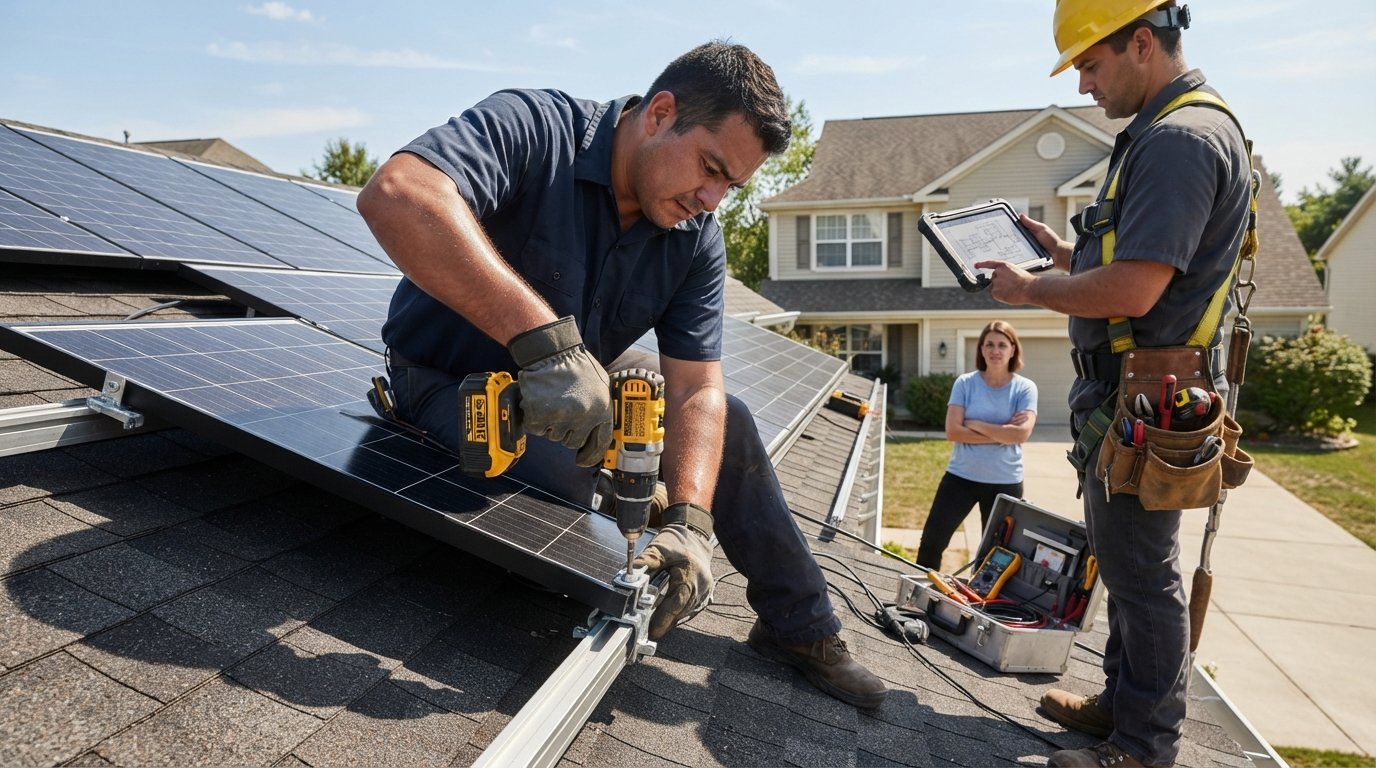
Solar Installer Certifications: What They Mean for You
Understand what solar installer certifications really mean, how they protect your investment, and how to verify them before signing a contract.

By Ethan Whitaker
Learn more about Solar Panel Installation and Repair for guides, costs, and what to expect.
Compare Solar Panel Installation and Repair Pros Near You

Enter your ZIP code to compare top-rated local professionals and request free quotes.
When you start shopping for solar panels, you will hear installers toss around terms like NABCEP certification, master electrician license, and manufacturer certification. These credentials sound impressive, but what do they actually mean for your project? More importantly, do they guarantee that your installation will be safe, reliable, and eligible for warranty coverage? Understanding solar installer certifications is not just about checking boxes on a sales pitch. It is about protecting your investment, ensuring your system performs for decades, and avoiding costly mistakes that could leave you with a nonfunctional array and no recourse.
This guide breaks down the most important certifications in the solar industry, what they truly signify, and how you can use them to vet any contractor before you sign a contract. By the end, you will know exactly what to look for on a quote and what questions to ask during an in-home consultation. If you are also wondering how to verify an installer's legitimacy before committing, our detailed guide on how to verify solar installer legitimacy offers a practical checklist that complements the insights here.
The Core Certification: NABCEP
The North American Board of Certified Energy Practitioners, or NABCEP, is the gold standard for solar professionals in the United States. When an installer holds a NABCEP certification, it means they have passed a rigorous exam that tests both technical knowledge and practical application of solar installation best practices. The board also requires continuing education credits to maintain the credential, so certified professionals stay current with evolving code requirements and equipment advancements.
However, there is nuance. NABCEP offers several different certifications, including the Board Certified PV Installation Professional (PVIP), the PV Installer Specialist, and the PV Design Specialist. The PVIP is the most comprehensive and requires a combination of advanced coursework, field experience, and a passing score on a demanding exam. Many states and municipalities actually reference NABCEP certification in their licensing requirements, and some utility rebate programs explicitly require that the installing company have at least one NABCEP certified professional on staff.
When you see NABCEP on a proposal, ask whether the person who will actually be on your roof holds the certification or if it is merely a company credential held by a sales engineer. The distinction matters because the certifying body is testing the individual, not the company. A reputable firm will gladly tell you the names and certification numbers of the team leads assigned to your project.
State and Local Licenses: The Legal Baseline
Every state that allows solar installations requires some form of contractor licensing, though the specifics vary widely. In Texas, for example, solar installers must hold a state electrical license, typically a journeyman or master electrician license, because the work involves wiring and grid interconnection. In Florida, contractors need a state license that covers electrical and general contracting work, and some local jurisdictions add their own requirements. California has its own Solar Contractor license classification under the Contractors State License Board.
These licenses are not optional, and they are not just a formality. They prove that the individual or company has passed background checks, demonstrated financial responsibility, and met minimum experience thresholds. More importantly, they give you legal recourse if something goes wrong. If you hire an unlicensed contractor, you lose important consumer protections, and your homeowner's insurance may not cover damage caused by their work.
Before you let anyone on your roof, ask to see their license and verify it with your state's licensing board. Most states have online lookup tools that let you confirm the license is active and check for any disciplinary actions. This step takes five minutes and can save you from a nightmare scenario.
Manufacturer Certifications: The Warranty Key
Beyond general industry credentials, solar equipment manufacturers often run their own training and certification programs. For example, Tesla requires certified installers for its Powerwall battery systems, and Enphase and SolarEdge have similar programs for their microinverters and power optimizers. These certifications are not just marketing badges. They are directly tied to equipment warranties.
If a manufacturer finds that an installation was performed by someone who did not complete their required training, they may refuse to honor warranty claims. That means a defective inverter or a prematurely failing panel could become your financial responsibility, not the installer's. When you are comparing quotes, ask each company which manufacturer certifications they hold and confirm that those certifications cover every major component of your system, including panels, inverters, and batteries.
You should also ask for written confirmation that the warranty is fully transferable if you sell your home. In competitive markets, a solar system with a valid, transferable warranty can be a real selling point. But that promise only holds if the installation was done correctly and documented properly.
Insurance and Bonding: The Safety Net
A certification is only as good as the company's financial stability and risk management. Every reputable solar installer should carry general liability insurance and workers' compensation coverage. General liability protects you if the installer damages your property, and workers' comp covers injuries sustained by workers on your job site. Without these policies, you could be held personally liable for an accident that happens on your roof.
Ask for a certificate of insurance directly from the installer's insurance provider, not just a copy of a policy that may have lapsed. The certificate should list your name and property address as the additional insured. This is a standard request, and any legitimate company will provide it without hesitation. If an installer balks or makes excuses, walk away.
Bonding is another layer of protection. A bonded contractor has secured a surety bond that can pay out if they fail to complete the job or violate building codes. Not every state requires bonds for solar contractors, but many do. Check your local requirements and ask the installer if they are bonded. This credential signals that their work is backed by a third party that has reviewed their financial and legal history.
What Certifications Do Not Tell You
Certifications are valuable, but they have limits. A NABCEP certified professional can still design a system that underperforms because of poor shading analysis or an undersized inverter. Manufacturer certifications do not guarantee that the installer will follow best practices for roof penetrations or flashing, which are common sources of leaks. State licenses confirm legal standing, not the quality of the crew that shows up on install day.
This is why certifications should be the starting point, not the final word, in your vetting process. Pair credentials with a thorough review of the proposed system design, a clear timeline, a detailed contract, and a realistic savings estimate. Look for installers who offer a production guarantee or a workmanship warranty that extends beyond the industry standard of one or two years. Those guarantees often say more about confidence than any certificate.
You should also verify how long the company has been in business and ask for references from installations completed at least a year ago. A company that has survived for a decade has a track record of solving problems and honoring warranties. Newer companies may have great credentials but less experience handling unexpected issues like complicated roof geometry or utility interconnection delays.
The Financial Angle: How Credentials Affect Your Payback
Hiring a certified installer can directly impact your return on investment. Many state and local incentive programs, as well as some utility rebates, require the installation to be performed by a licensed and certified professional. If you skip that step, you may miss out on thousands of dollars in incentives. For example, the federal Investment Tax Credit does not have a certification requirement, but many state programs, such as those in New York and Massachusetts, do.
Beyond incentives, a certified installer is more likely to size your system correctly, optimize panel placement, and ensure your inverter is appropriately matched to your array. These design decisions affect how much electricity you generate, which in turn determines your monthly savings and your system's payback period. A system that underperforms by 10 percent could extend your payback by several years, negating the savings you expected.
To understand the full financial picture, use a reliable solar cost calculator that factors in your local rates, sun exposure, and available incentives. Our partners at NewSolarQuotes offer an independent resource with cost calculators and energy savings analysis tailored to U.S. homeowners, which can help you model different installer options before you commit.
How to Verify Certifications During Your Search
You do not need to become a solar expert to verify an installer's credentials. You just need to know where to look and what to ask. Start with the NABCEP website, which has a searchable directory of certified professionals. You can also check your state's contractor licensing board online, as most now provide public lookup tools. For manufacturer credentials, contact the equipment maker directly or ask the installer for their certificate of completion.
Here is a quick checklist to use when comparing quotes:
- Confirm the installing company holds an active state license and that the license covers electrical work in your jurisdiction.
- Ask for the NABCEP certification number of the project lead and verify it on the NABCEP website.
- Request a certificate of insurance and verify that the policy is current and lists you as an additional insured.
- Check that the installer is certified by the manufacturers of the panels, inverters, and batteries they propose to install.
- Inquire about workmanship warranties and ask for the warranty terms in writing before you sign.
After you run through this list, you will have a clear picture of which installers are truly qualified and which are simply collecting permits and subbing out the work. The extra effort pays off in the form of a system that performs as promised, a roof that does not leak, and a warranty that actually covers you for the long haul.
Red Flags to Watch For
Certain warning signs should trigger immediate caution. If an installer cannot provide their license number or NABCEP certificate, that is a hard stop. If they ask you to obtain the permit yourself or tell you that permits are not necessary, run the other way. If they pressure you to sign before you have verified their credentials, they are likely hiding something.
Also be wary of companies that claim to be "certified" without specifying the certifying body. Vague language like "fully certified and insured" is meaningless without details. A legitimate installer will proudly tell you exactly which certifications they hold, who issued them, and how to verify them.
Putting It All Together
Solar installer certifications are not just bureaucratic hurdles. They are your first line of defense against shoddy workmanship, failed inspections, and voided warranties. By taking the time to understand what each credential actually means and how to verify it, you position yourself to choose a contractor who will deliver a safe, efficient, and durable solar system.
Remember that certifications work in concert with other factors: company reputation, financial stability, and the quality of the equipment they install. Use the checklist above, get multiple quotes, and never sign a contract until you have confirmed that the people working on your roof have the right credentials and the insurance to back them up. When you do, you can enjoy the financial and environmental benefits of solar with confidence, knowing that your investment is protected from the ground up.
If you are ready to take the next step, compare quotes from certified installers in your area through a service like FreeSolarPowerQuotes, which connects you with vetted professionals who meet strict credential and insurance requirements. This approach saves you time and ensures you are only speaking with companies that have already passed a basic screening. Then, armed with your knowledge of certifications, you can make the final decision with clarity and peace of mind.