
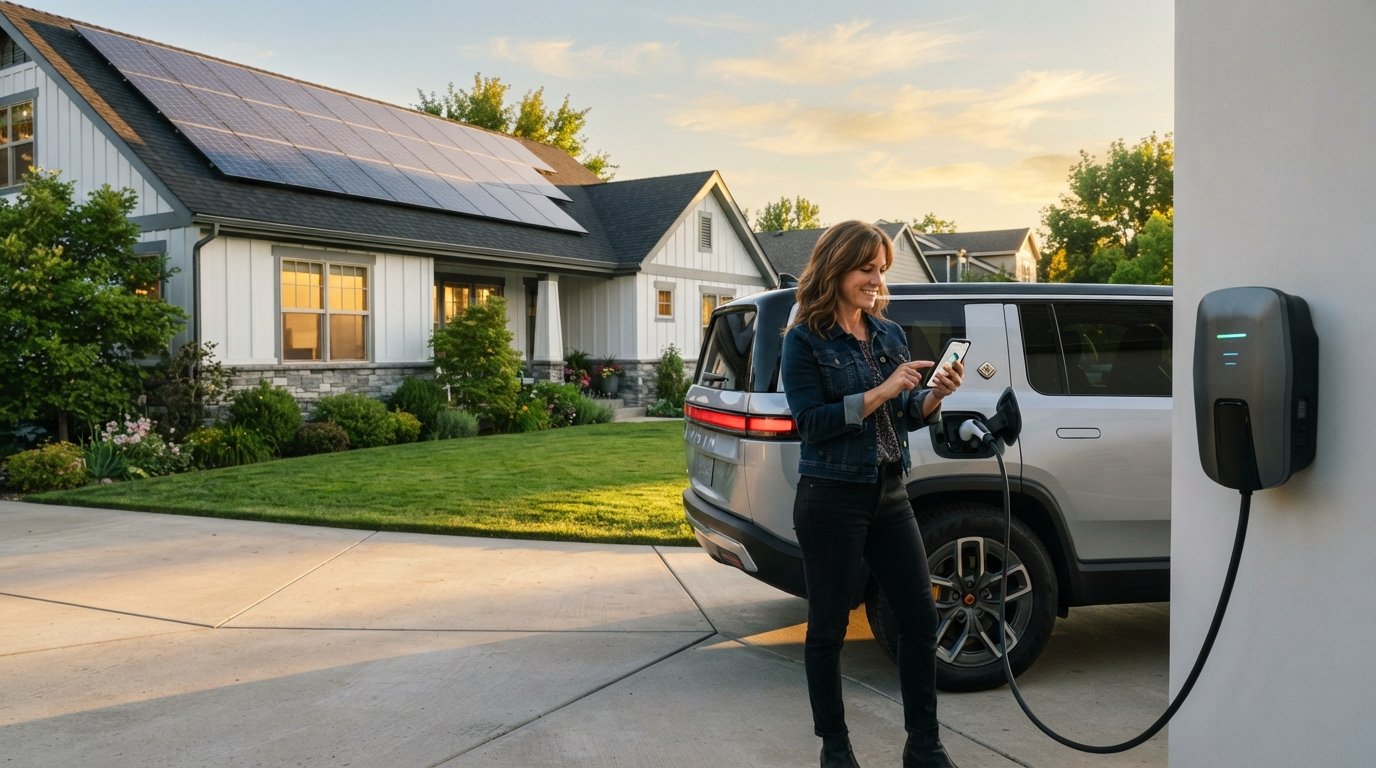
Solar EV Charging: How to Match Schedule to Sunlight
Align your EV charging with solar production to cut costs and boost efficiency. Learn how to use smart chargers and schedule for maximum savings.

By Liam Parker
Learn more about Solar Panel Installation and Repair for guides, costs, and what to expect.
Compare Solar Panel Installation and Repair Pros Near You

Enter your ZIP code to compare top-rated local professionals and request free quotes.
Imagine waking up to a fully charged electric vehicle (EV) every morning, knowing that every mile you drive came from the sun. This is no longer a distant dream. As solar panel systems become more affordable and EVs dominate new car sales, the next frontier for homeowners is learning how to align their charging habits with solar production. Optimizing EV charging schedule with solar production is not just a clever way to save money; it is the most practical path to true energy independence. Instead of pulling power from a grid that may rely on fossil fuels, you can turn your home into a self-sufficient microgrid that powers your daily commute with clean, free sunlight.
For many, the initial appeal of solar is offsetting the household's electricity use. But transportation is often the largest energy drain in a typical American home. When you add an EV to the mix, your electricity consumption can double. Without a smart strategy, you might end up charging your car at night with expensive grid power, undermining the financial and environmental benefits of your solar investment. This article will walk you through the exact steps, tools, and technologies needed to make your solar panels and EV work as one cohesive unit, ensuring you maximize your savings and minimize your carbon footprint.
Why Your Charging Schedule Matters More Than You Think
The simple act of plugging in your car at the right time can be the difference between a solar payback period of five years or eight years. Most solar systems are designed to offset your total annual electricity usage, but the timing of that usage is critical. Utility companies often use time-of-use (TOU) rate plans, which charge more for electricity during peak hours (typically late afternoon and evening) and less during off-peak hours (typically late night). If you charge your EV during peak grid hours, you will be paying the highest rates for electricity that you could have generated yourself just a few hours earlier.
Moreover, if your utility does not offer net metering or offers it at a less favorable rate (like wholesale), sending your excess solar energy back to the grid is a losing proposition. You are essentially giving away your valuable clean energy for pennies while later buying it back at retail price. Optimizing EV charging schedule with solar production flips this script. Instead of exporting your solar energy, you store it in your EV's battery, effectively using your car as a rolling energy storage unit. This approach maximizes the value of every kilowatt-hour your panels produce.
The Core Concept: Aligning Production with Consumption
The sun's energy is not constant. It peaks at solar noon, drops to zero at night, and varies with weather and seasons. Your EV's energy demand is also variable, but unlike the sun, you can often control when you charge. The goal is to shift your vehicle's charging load to coincide with the peak production window of your solar array, usually between 10 a.m. and 4 p.m. During these hours, your panels are generating the most power, and you can use that power directly to charge your car, bypassing the grid entirely.
This is a practical solution for many. If you work from home or have a flexible schedule, you can plug in your car when the sun is high. For those who are away during the day, the challenge is greater, but not insurmountable. The key is to understand your specific solar production curve and your driving needs, then use smart technology to automate the process. You do not need to be a solar engineer to get this right, but you do need to understand a few basic concepts and use the right equipment.
Method 1: Manual Scheduling for the Hands-On Owner
Before smart chargers and apps became common, the only way to align solar with EV charging was to do it manually. This is still a viable option for those who are at home during the day. The process is simple: set a reminder on your phone to plug in your car when you see your solar production numbers are high, typically during the late morning and early afternoon. If you have a basic EV charger (Level 1 or Level 2) without smart features, this is your only built-in option.
To execute this effectively, you need to monitor your solar inverter's output. Most modern systems come with an app that shows real-time generation. You can use this data to decide when to start charging. For example, if you see your system is producing 7 kW and your home is only using 1 kW, you have 6 kW of surplus that can go into your EV. A standard Level 2 charger draws about 7.2 kW, so you could charge your car almost entirely on solar power during that window.
- Check your solar app to see when production peaks on a typical sunny day.
- Set a charging timer on your EV or charger to start at that time, even if you are not home.
- Adjust for weather: cloudy days may require you to start charging earlier or later to catch the best production.
- Use a basic timer plug for Level 1 chargers to automate a start/stop time if your car lacks scheduling features.
While manual scheduling works, it is far from foolproof. Life gets in the way, and you might forget to plug in or adjust the schedule. Moreover, it requires you to be present or to have a charger with a timer function. For those who want a more hands-off approach, smart technology offers a far better solution.
Method 2: Smart Chargers and Solar-Aware Apps
The most effective way to optimize EV charging with solar is to invest in a smart EV charger or use a solar-aware charging app. These devices and software solutions can communicate with your solar inverter and your electric meter to determine in real time how much excess solar power you are generating. They then adjust the charging speed of your EV to match this surplus. If your panels are producing 5 kW and your home is using 2 kW, the smart charger will draw 3 kW to charge your car, ensuring you use 100% of your solar energy.
This is a game-changer because it eliminates the need for manual intervention. You simply plug in your car, and the system does the rest. It can also be programmed to never draw from the grid, or to draw at a minimum level if you need a faster charge. This approach is often called solar or eco mode. Many chargers, such as those from Enphase, SolarEdge (with their EV chargers), and even some third-party brands like Wallbox, offer this capability. The app will show you a live breakdown of where your energy is coming from, giving you peace of mind.
Beyond individual chargers, you can also use a home energy management system (HEMS) that coordinates all your large loads. These systems can intelligently route solar power to your EV, your water heater, and your battery storage in order of priority. While more complex, they offer the highest level of optimization and are a great choice for tech-savvy homeowners with larger systems. If you are also considering solar battery storage, the integration becomes even more powerful. A battery can store excess solar during the day, and then charge your EV at night without pulling grid power, offering a solution for those who must drive in the morning.
Setting Up a Smart Charging Profile
To get the most from a smart charger, you will need to configure it correctly. The process usually involves connecting the charger to your home's Wi-Fi and linking it to your solar inverter's monitoring platform. Once connected, you can set specific charging rules. For example, you can set a maximum amperage for solar-only charging, ensuring you never exceed your panel's output. You can also set a departure time, so the car is fully charged by the time you need to leave, even if the charger prioritizes solar during the afternoon.
Here is a simple step-by-step process:
- Check compatibility: Ensure your solar inverter and EV charger can communicate. Most modern systems use the Open Charge Point Protocol (OCPP) or proprietary APIs to share data.
- Connect and link accounts: Follow the manufacturer's instructions to link your charger app with your solar monitoring app (e.g., Enphase Envoy, SolarEdge monitoring portal).
- Set your solar priority: In the charger settings, select a mode like "Solar Only" or "Eco" to ensure it only uses excess solar power.
- Configure fallback options: If you need a full charge by a certain time, set a fallback schedule that allows grid power late at night if solar was insufficient.
- Monitor performance: Use the app to track how many kWh were charged from solar each day and adjust settings as needed.
This setup not only maximizes your savings but also reduces stress on the grid. By avoiding evening peak demand, you are helping to stabilize the grid and reduce the need for fossil fuel peaker plants, a benefit that extends beyond your own home.
Dealing with the Realities of Net Metering and Grid Policies
Your local utility's net metering policy will heavily influence your charging strategy. In states with 1:1 net metering, you are credited for every kWh you send to the grid at the retail rate. In this scenario, you can treat the grid as a giant battery. You can charge your car at night using those credits, and it will not cost you more than charging during the day. However, many utilities are moving to net billing or lower export rates, which makes it financially better to use your solar power directly. In those cases, optimizing EV charging schedule with solar production becomes crucial.
Even with favorable net metering, you should consider the environmental benefits of direct solar charging. Charging during the day with solar is the greenest option, as it reduces the need to draw from the grid at night, which is often when utilities ramp up coal and natural gas generation. By using a solar-aware charger, you are not just saving money; you are actively reducing your carbon footprint. To fully understand your local policy, check your utility's website or your latest bill. The terms can be complex, but a good rule of thumb is that if you are paid less than you pay for electricity, you should prioritize self-consumption.
When to Consider Battery Storage
If you are unable to charge your EV during the day, either because you drive to work or your utility's TOU rates are unfavorable, a home battery is a powerful companion. A battery allows you to store your solar energy when it is produced and then discharge it later to charge your EV. This decouples the timing of production and consumption, giving you ultimate flexibility. For instance, you can charge your battery during a sunny afternoon, then plug in your EV at 6 p.m. and draw from the battery, avoiding peak grid rates entirely.
Pairing a solar battery with an EV charger is the ultimate setup for energy independence. It provides backup power during outages and allows you to power your home and car for days during an emergency. The cost of batteries has fallen, and with the 30% federal tax credit available for storage systems installed with solar (or standalone for certain battery types), they are increasingly affordable. However, batteries are not always necessary. If you have good net metering or can charge during the day, you can skip the battery and save thousands. Analyze your daily commute and work schedule before making this investment.
The Role of Free Solar Quotes and Professional Guidance
Designing a system that perfectly balances solar generation, EV charging, and battery storage is not a DIY project. It requires careful sizing of your solar array, choosing the right inverter (string, microinverter, or optimizers), and selecting a charger that integrates seamlessly. This is where professional guidance becomes invaluable. A qualified solar installer can perform a comprehensive energy audit, analyze your driving habits, and design a system tailored to your specific needs. They can also advise you on the best tariff plan and whether a battery is worth the extra expense.
Getting multiple quotes is essential to ensure you get the best price and system design. This is where services like FreeSolarPowerQuotes can help by connecting you with vetted, pre-screened local installers. They provide free, no-obligation quotes, allowing you to compare options without any pressure. For more detailed information on how to achieve a fully optimized home energy setup, you can read our guide on how to achieve energy independence with solar power. Additionally, independent resources like NewSolarQuotes can offer further education on the latest solar technologies and market trends.
When you receive quotes, ask each installer specifically about EV charger integration. Inquire about the compatibility of their recommended inverter with popular smart chargers. A good installer will not just sell you panels; they will design a holistic energy system that includes your electric vehicle. They should also explain the performance guarantees and warranties, ensuring that your system will deliver the promised solar production for decades to come.
Practical Steps to Start Optimizing Today
You do not need to wait for a new system to start optimizing your charging. If you already have solar and an EV, you can begin right now with these simple steps. First, check your solar monitoring app to understand your production patterns. Second, review your utility rate plan to see when peak and off-peak times are. Third, if your EV or charger has a timer, set it to start charging two hours before your panels reach peak output. This is a simple, immediate win.
If you have a Level 2 charger, consider upgrading to a solar-aware model. The cost of a smart charger is typically between $500 and $1,000, and the extra savings on your electricity bill can pay for it in a few years. Alternatively, use a smart plug for your Level 1 charger to schedule charging windows. The key is to become conscious of when your energy is being produced and when it is being consumed. Over time, you will develop a habit that becomes second nature, ensuring you are always using your own clean energy first. This not only protects you from rising electricity rates but also adds tangible value to your home, as buyers increasingly look for properties with solar panels and EV charging infrastructure.
In conclusion, the shift to electric vehicles and solar power is inevitable. The smartest homeowners are those who learn to combine these two technologies for maximum benefit. By understanding your solar production curve and using the right scheduling tools, you can make your EV a true solar-powered vehicle, reducing your dependence on the grid and making your solar investment work harder than ever before.