
Flow Battery vs Lithium Ion Home Solar Storage: 2026 Comparison
Compare flow batteries and lithium-ion for home solar storage, including cost, lifespan, and backup power. Call (833)-793-7166 for guidance.

Learn more about Solar Panel Installation and Repair for guides, costs, and what to expect.
Compare Solar Panel Installation and Repair Pros Near You

Enter your ZIP code to compare top-rated local professionals and request free quotes.
When you add a battery to a home solar system, you are buying a specific kind of insurance against high bills and blackouts. Lithium-ion batteries, especially lithium iron phosphate (LFP) models, currently dominate the residential market. Flow batteries, long common in utility-scale projects, are now appearing in homeowner conversations as a possible alternative. This flow battery vs lithium ion home solar storage comparison breaks down how each technology works, what it costs, how long it lasts, and which type of household actually benefits from each option. The goal is not to crown a universal winner, but to help you ask better questions before you sign an installation contract.
How Flow Batteries and Lithium-Ion Batteries Actually Work
A lithium-ion home battery stores energy inside sealed cells, similar in principle to the battery in your phone or electric vehicle. When you charge the battery, lithium ions move between electrodes. The amount of energy the battery can hold is fixed at the factory because the electrodes themselves are the storage medium. Most residential units use lithium iron phosphate chemistry because it is more thermally stable than older nickel manganese cobalt blends.
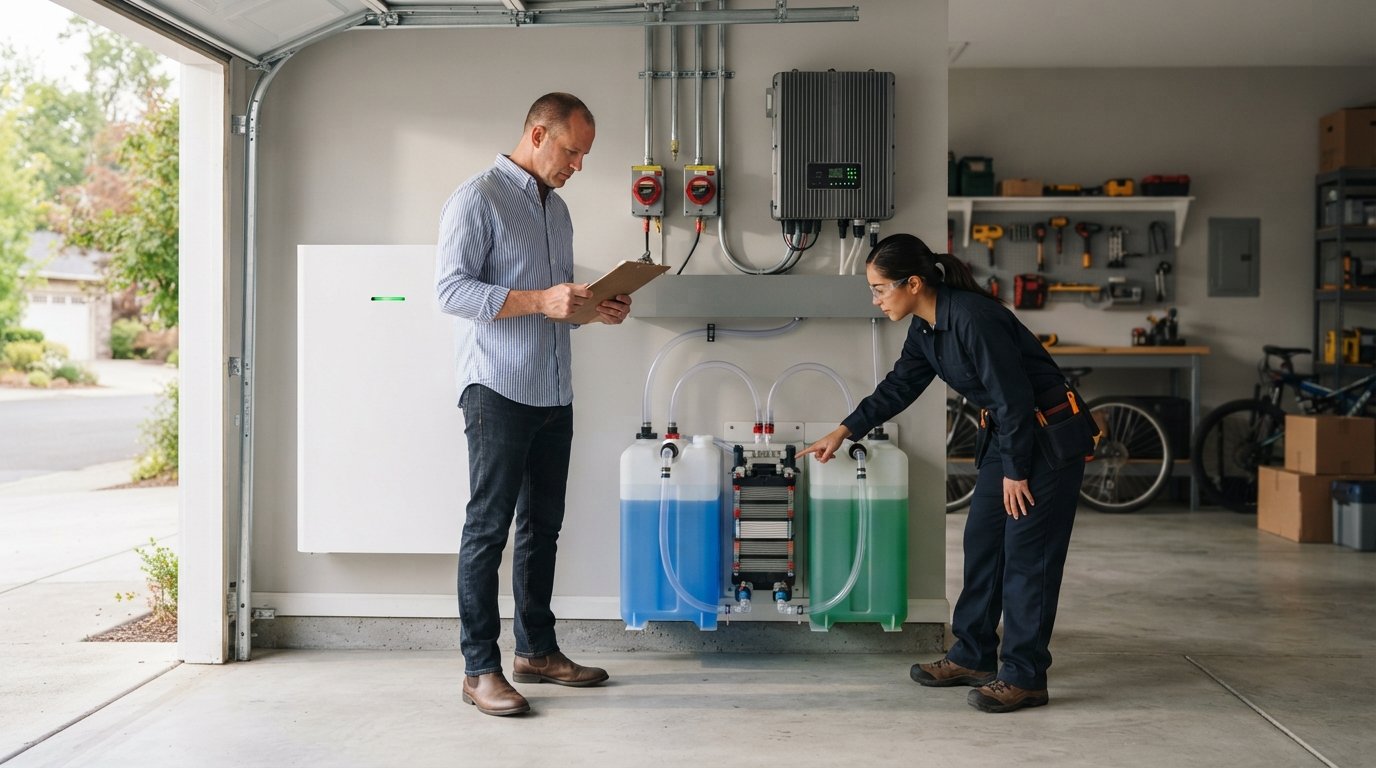
A flow battery separates power from energy. The energy is stored in liquid electrolytes held in two tanks, and those liquids circulate through a stack of cells where the electrochemical reaction happens. To store more energy, you add larger tanks or more electrolyte. To increase power output, you add more cell stacks. This decoupling is the defining feature of flow technology, and it is why flow batteries scale so well for long-duration storage.
For a homeowner, the practical difference is this: a lithium-ion battery is a single sealed box that does a little of everything, while a flow battery is a small chemical plant with pumps, tanks, and plumbing. That complexity affects footprint, maintenance, and where the system can be installed. It also explains why flow batteries have historically been used in commercial and utility settings where long runtimes matter more than a compact cabinet.
Why Long-Duration Storage Matters for Home Backup
Most home batteries are sized for daily cycling: charge from solar in the afternoon, discharge in the evening, repeat. A typical residential lithium-ion battery holds between 10 and 20 kilowatt-hours, which covers a few hours of essential loads during an outage. If a storm knocks out power for two or three days, that capacity can disappear quickly, especially if you are running air conditioning, a well pump, or medical equipment.
Long-duration storage means a battery that can discharge for eight, twelve, or even twenty-four hours at a useful power level. Flow batteries are naturally suited to this because their energy capacity scales with tank size. A homeowner who wants multi-day resilience during wildfire season, hurricane season, or a fragile rural grid has a legitimate reason to look beyond the standard lithium-ion cabinet.
However, long duration comes at a cost. If your main goal is to shave evening peak rates and keep the refrigerator running for a few hours, a lithium-ion battery sized for daily cycling is almost always the more economical choice. The flow battery advantage only becomes meaningful when outage length and energy volume are the dominant concerns.
Lifespan, Degradation, and Safety Compared
Lifespan is where flow batteries make their strongest case. Lithium-ion batteries degrade with every cycle, and most residential warranties guarantee a certain percentage of capacity after ten to fifteen years. LFP chemistry has improved dramatically, but the cells still age. Flow batteries, by contrast, store energy in electrolytes that do not degrade in the same way. Many flow systems are rated for 20 years or more, and some can have their electrolyte refreshed rather than replaced.
Safety profiles differ as well. Lithium-ion batteries require thermal management and must be installed with clearances and sometimes fire separation from living space. LFP is safer than older chemistries, but the risk of thermal runaway is not zero. Flow batteries use nonflammable, water-based electrolytes in most commercial designs. They can leak, and the pumps and plumbing require inspection, but they do not present the same fire risk as a lithium cabinet. For homeowners in garages or tight utility rooms, that distinction can matter to insurers and local permitting officials.
Degradation also affects warranty value. A lithium-ion warranty typically promises a specific throughput in megawatt-hours and a minimum capacity retention. A flow battery warranty tends to focus on system availability, stack life, and electrolyte performance. Reading these documents side by side is essential, because a 20-year warranty means little if service support or replacement parts are not available in your region.
Availability, Footprint, and Installed Cost in the US Market
Lithium-ion home batteries are widely available from multiple manufacturers and can be installed by most certified solar contractors. Flow batteries for residential use are far less common. A handful of companies offer home-scale systems, but installer networks are thin, and lead times can be long. In many US markets, a homeowner interested in flow technology may struggle to find a local contractor with direct experience.
Footprint is another practical hurdle. A flow battery needs space for tanks, a stack, and plumbing, often in a garage, basement, or weather-protected outbuilding. Lithium-ion cabinets are compact and can be wall-mounted. For a typical suburban home with limited utility space, the lithium option is simpler to site and permit.
Installed cost currently favors lithium-ion. Residential LFP batteries have benefited from massive manufacturing scale, and prices have fallen steadily. Flow batteries remain a niche product with higher upfront costs per kilowatt-hour of power, though the cost per kilowatt-hour of energy can improve at larger sizes. For most homeowners comparing quotes today, a flow battery will carry a premium that is difficult to justify unless long-duration backup is a primary requirement.
Before requesting quotes, it helps to understand how installation pricing is structured. In our guide on how to compare free solar quotes, we explain how to separate equipment costs from labor and permitting so you can evaluate battery add-ons fairly. That same discipline applies when you compare a flow battery quote against a lithium-ion quote.
Which Households Benefit From Each Technology
Lithium-ion batteries are the better fit for most homes. They work well for daily solar self-consumption, time-of-use rate arbitrage, and short outage protection. They are compact, widely supported, and priced competitively. If your utility offers net metering or a generous export rate, the battery's job is mostly financial, and lithium-ion does that job efficiently.
Flow batteries make sense in a narrower set of situations. Consider them if you meet several of these conditions:
- You face outages that regularly last more than a day, such as in wildfire zones or areas with unreliable rural grids.
- You have space for tanks and plumbing in a garage, basement, or outbuilding.
- You plan to stay in the home for 15 to 25 years and value longevity over lowest upfront cost.
- You have a local installer or service provider with flow battery experience.
- Your insurance or permitting situation makes nonflammable chemistry a priority.
If only one or two of those conditions apply, a well-sized lithium-ion system is likely the more practical investment. If three or more apply, a flow battery deserves a serious look, provided you can find qualified local support.
What to Verify With Installers About Warranty and Service
Battery warranties are not interchangeable, and the differences matter more with flow technology because the installer network is smaller. Ask each contractor for the full warranty document, not just the summary sheet. Confirm what is covered: the cells or stack, the pumps, the inverter, labor, and shipping. Check whether the warranty is transferable if you sell the home, and whether it requires annual maintenance visits that carry a fee.
Service support is the quiet risk with any emerging technology. For a flow battery, ask how many systems the installer has commissioned, who performs routine maintenance, and how quickly replacement parts arrive. For lithium-ion, ask about firmware updates, monitoring platforms, and what happens if the manufacturer exits the market. In both cases, get the answers in writing.
Finally, treat any savings projection as an estimate, not a guarantee. Battery performance depends on your usage patterns, local rates, and utility programs, and incentive rules can change. Verify current federal and state incentives with official sources before finalizing a budget. For a broader view of how storage fits into a complete solar plan, independent resources such as NewSolarQuotes provide educational guides and cost calculators that can help you sanity-check installer proposals.
The flow battery vs lithium ion home solar storage comparison ultimately comes down to your priorities. Lithium-ion wins on availability, footprint, and upfront cost for typical daily cycling. Flow batteries win on longevity and long-duration resilience, but only if you have the space, the budget, and local service support. Start with a clear picture of your outage risk and energy goals, then let those answers drive the technology choice rather than the other way around.