
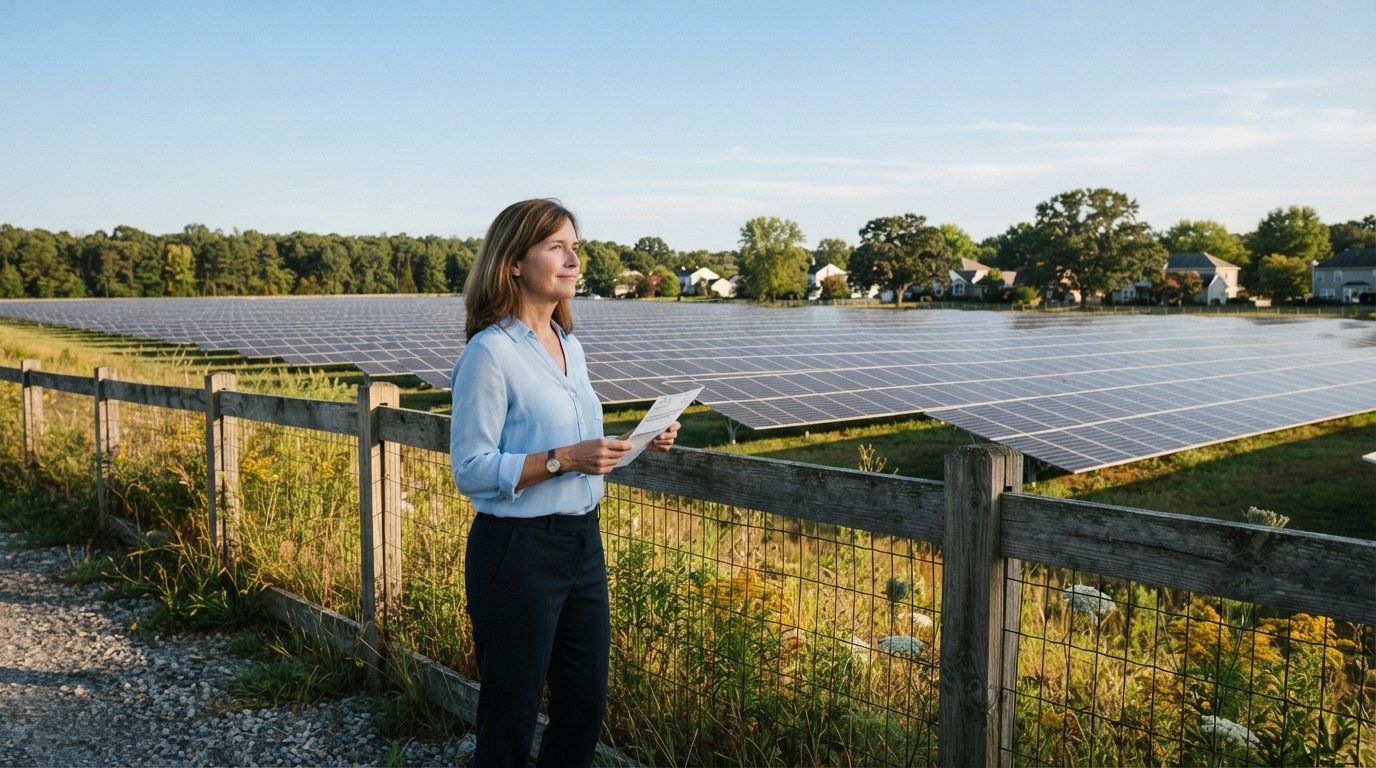
Community Solar Programs Explained Without Rooftop Panels
Community solar programs explained without rooftop panels: subscribe to an offsite solar farm and save on your utility bill. Call (833)-793-7166 to compare options.

By Thomas Hayes
Learn more about Solar Panel Installation and Repair for guides, costs, and what to expect.
Compare Solar Panel Installation and Repair Pros Near You

Enter your ZIP code to compare top-rated local professionals and request free quotes.
Not every home can host solar panels. Renters, apartment dwellers, and homeowners with shaded or aging roofs often assume renewable energy is out of reach. Community solar programs explained without rooftop panels change that equation entirely. Instead of installing equipment on your property, you subscribe to a share of a large offsite solar farm and receive credits on your monthly utility bill. It is a simple concept with real financial upside, but the details matter enormously. This guide walks through how credits appear on your bill, who qualifies, what contracts actually say, and how the savings stack up against going solar at home.
What Is Community Solar and How Does It Work?
Community solar, sometimes called solar gardens or shared solar, is a model where multiple participants share the output of a single solar array. That array sits on a rooftop, a vacant lot, or a brownfield somewhere within your utility's service territory. You do not own the panels. You do not host them. You simply enroll in a subscription and the electricity generated by your portion of the farm is credited to your utility account.
The mechanics follow a predictable pattern. A developer builds the solar farm and signs an agreement with the local utility. The utility agrees to purchase the electricity and, critically, to credit subscribers for their share of the production. You sign a contract with the developer or a program administrator. Each month, the solar farm generates electricity, the utility calculates your share of that production, and a credit appears on your bill. You then pay the developer for those credits, typically at a discount.
The savings come from that discount. If your share of the solar farm produces $100 worth of electricity in a given month, you might pay the developer $90 and keep $10 as savings. Over a year, those small margins can add up to hundreds of dollars depending on your usage and the program's terms. The exact discount varies widely by state, utility, and specific program.
One of the most common misconceptions is that community solar replaces your utility. It does not. You remain a utility customer. Your utility still delivers power, maintains the grid, and sends your bill. The community solar subscription simply adds a credit line and, in most cases, a corresponding charge from your solar provider. The two appear on the same statement or on paired statements, depending on how the program is structured.
How Community Solar Credits Appear on Your Utility Bill
Understanding your bill is essential before you sign anything. The credit mechanism varies by state and utility, but most programs follow one of two models: consolidated billing or dual billing. In consolidated billing, the utility applies your solar credit directly to your electric charges and then bills you for the subscription payment on behalf of the developer. In dual billing, you receive one bill from the utility with the solar credit applied and a separate invoice from the solar company for your subscription payment.
Here is what typically appears on a consolidated bill:
- Solar production credit: A line item showing the dollar value of your share of the farm's output for that month.
- Subscription charge: The amount you owe the solar provider, usually calculated as your credit multiplied by a discount rate (for example, 90% of the credit value).
- Net utility charges: Your remaining electric charges after the solar credit is applied.
- Rollover or banked credits: Any excess credits that exceed your current bill and carry forward to future months.
The timing of credits can surprise new subscribers. Solar farms produce more in summer and less in winter. In many programs, you earn larger credits in sunny months and smaller credits in cloudy ones. Some programs allow you to bank excess credits from high-production months and draw them down in low-production months. Others reconcile annually, meaning you might see a true-up at the end of the year. Always ask how banking and annual reconciliation work before enrolling.
Another detail to verify is whether credits apply to the full bill or only to supply charges. In some utilities, solar credits offset generation and transmission but not fixed customer charges or taxes. That means your savings may be smaller than the headline discount suggests. A transparent program administrator will show you a sample bill with real numbers before you commit.
Who Qualifies for Community Solar in 2026?
Eligibility rules vary by state and utility, but community solar is generally designed to be inclusive. Renters qualify. Apartment residents qualify. Homeowners with shaded roofs qualify. Businesses, nonprofits, and municipalities often qualify as well. The main requirement is that you are a customer of the utility served by the solar farm.
That last point is critical. You cannot subscribe to a community solar farm in a utility territory where you do not receive electric service. If you move, you typically need to transfer or cancel your subscription. Some programs allow you to port your subscription to a new address within the same utility territory. Others require cancellation. Always ask about move policies upfront.
Income-qualified programs exist in many states and often carry additional benefits. These programs reserve a portion of the solar farm for low-to-moderate-income households and may offer larger discounts or waived fees. If you participate in assistance programs like LIHEAP or SNAP, you may automatically qualify for priority enrollment. These slots often fill quickly, so it pays to ask specifically about income-qualified options.
State activity in 2026 remains concentrated in a handful of markets with supportive policies. States with active or expanding community solar programs include Minnesota, Massachusetts, New York, Illinois, Colorado, Maryland, New Jersey, and Maine. Several additional states have pilot programs or utility-specific offerings. Texas, Florida, and other Sun Belt states have seen growing interest, though program availability depends heavily on individual utility decisions rather than statewide mandates. Because policies shift, always confirm current program availability with your utility or a trusted solar information resource before making assumptions based on older articles.
If you are comparing your options, our guide on community solar versus rooftop solar breaks down the tradeoffs in detail. The short version: community solar wins on accessibility and zero upfront cost, while rooftop solar typically delivers higher long-term savings for homeowners who can host panels and claim the federal tax credit.
Contract Terms, Exit Fees, and Savings Expectations
The contract is where community solar programs succeed or fail for subscribers. Most agreements run 12 to 36 months, though some are month-to-month. The discount rate, the cancellation policy, and the credit calculation method are the three clauses that matter most.
Start with the discount rate. A typical offer promises savings of 5% to 15% off your solar credits. If a salesperson promises 30% or more, ask for the fine print. Unusually high discounts sometimes come with minimum usage requirements, escalating fees, or credits that apply only to a narrow portion of your bill. A legitimate program will show you a historical production estimate and a sample savings calculation based on your actual usage.
Next, examine the exit terms. Some contracts allow cancellation with 30 to 60 days notice and no penalty. Others impose exit fees that can range from $100 to several hundred dollars, or require you to purchase remaining credits. These fees are not inherently predatory, but they should be clearly disclosed. If a sales representative glosses over cancellation terms, treat that as a red flag.
Finally, understand how your savings are calculated. The most common method applies your discount to the credit value. If the farm produces $80 in credits and your discount is 10%, you pay $72 and save $8. That $8 is real, but it is modest. Over a year, depending on your usage, you might save $50 to $200. Households with higher electricity usage tend to see larger dollar savings because they absorb more credits. Households with very low usage may find that credits exceed their bill and roll over, delaying the actual savings.
Before signing, gather these details in writing:
- The discount rate and whether it is fixed or variable.
- The contract length and cancellation policy, including any exit fees.
- How credits are calculated and whether they offset the full bill or only supply charges.
- What happens if you move within or outside the utility territory.
- Whether the program is consolidated or dual billing.
- Any minimum usage requirements or annual true-up provisions.
If you are also considering a move in the near future, it helps to coordinate your energy decisions with your relocation timeline. Resources like Moving.Homes offer practical checklists for renters and homeowners planning a move, which can help you decide whether to enroll now or wait until you are settled in a new utility territory.
Community Solar vs Rooftop Solar: Which Fits Your Household?
The right choice depends on your living situation, your long-term plans, and your appetite for upfront investment. Rooftop solar offers the highest lifetime savings for homeowners who can host panels, claim the 30% federal Investment Tax Credit, and benefit from net metering. It also increases property value and provides energy independence. But it requires a suitable roof, thousands of dollars in upfront cost or a financing arrangement, and a commitment measured in decades.
Community solar requires none of that. There is no equipment, no installation, no roof inspection, and no upfront cost. You can enroll in minutes and cancel according to your contract terms. For renters, apartment dwellers, and homeowners with shaded or structurally unsuitable roofs, it is often the only practical way to access solar savings. The tradeoff is smaller savings and less control. You are a subscriber, not an owner, and your benefits depend on the program administrator's performance and the utility's crediting rules.
Here is a simple framework for deciding:
- Can you host rooftop panels? If yes, get quotes and compare lifetime savings against community solar.
- Do you plan to stay in your home for 10 or more years? If yes, rooftop solar usually wins on total return.
- Do you rent or have a shaded roof? If yes, community solar is likely your best option.
- Do you want zero upfront cost and minimal commitment? Community solar fits that profile.
- Do you want maximum control and ownership? Rooftop solar is the stronger choice.
Many households can also combine strategies over time. You might subscribe to community solar now as a renter and later install rooftop panels when you buy a home. The two are not mutually exclusive, and the experience of participating in a community solar program can make you a more informed solar consumer later.
How to Evaluate a Community Solar Offer
Not all programs are created equal. Some are administered by reputable developers with transparent billing and strong customer service. Others rely on aggressive sales tactics and obscure contract terms. Protecting yourself starts with asking the right questions and verifying claims independently.
Begin by confirming that the program is approved by your state public utility commission or is part of a utility-administered offering. Legitimate programs are regulated and must file tariffs and disclosure documents. If you cannot find public documentation, proceed with caution. Next, request a sample bill or savings estimate based on your actual usage history. A credible provider will have this ready. If they cannot produce it, that is a warning sign.
Check the Better Business Bureau, state consumer protection agencies, and online reviews for complaints about billing errors, unexpected fees, or cancellation difficulties. A few negative reviews are normal for any business. A pattern of complaints about the same issue is not. Finally, read the contract yourself. Do not rely on a sales presentation. The written agreement is what governs your rights.
If you decide that rooftop solar is a better fit after all, the next step is gathering quotes from vetted local installers. FreeSolarPowerQuotes connects homeowners and businesses with reputable third-party solar providers for free, no-obligation quotes. The service is independent, does not install panels directly, and focuses on transparent information so you can compare offers with confidence. Whether you choose community solar or rooftop solar, the goal is the same: lower bills, cleaner energy, and a decision you understand fully.
Community solar programs explained without rooftop panels come down to a simple trade: you give up ownership and some savings in exchange for accessibility and zero upfront cost. For millions of renters and homeowners who cannot go solar at home, that trade is worth making. Just read the contract, verify the numbers, and ask questions until you are comfortable. The savings are real, but so are the fine print traps.