
Community Solar vs Rooftop: Which Is Better?
Compare community solar vs rooftop solar: upfront costs, long-term savings, eligibility, and control. Find the best fit for your home.

By Ethan Whitaker
Learn more about Solar Panel Installation and Repair for guides, costs, and what to expect.
Compare Solar Panel Installation and Repair Pros Near You

Enter your ZIP code to compare top-rated local professionals and request free quotes.
Imagine slashing your electricity bill without installing a single panel on your roof. Or picture owning your power system outright, with panels tucked neatly against your shingles. Both scenarios are possible, but they lead to very different solar journeys. The choice between community solar and rooftop solar is not about which technology is superior; it is about which model fits your home, your finances, and your lifestyle. In this detailed community solar vs rooftop solar comparison, we break down costs, savings, control, and practicality to help you decide which path will power your home more effectively.
Understanding the Two Solar Models
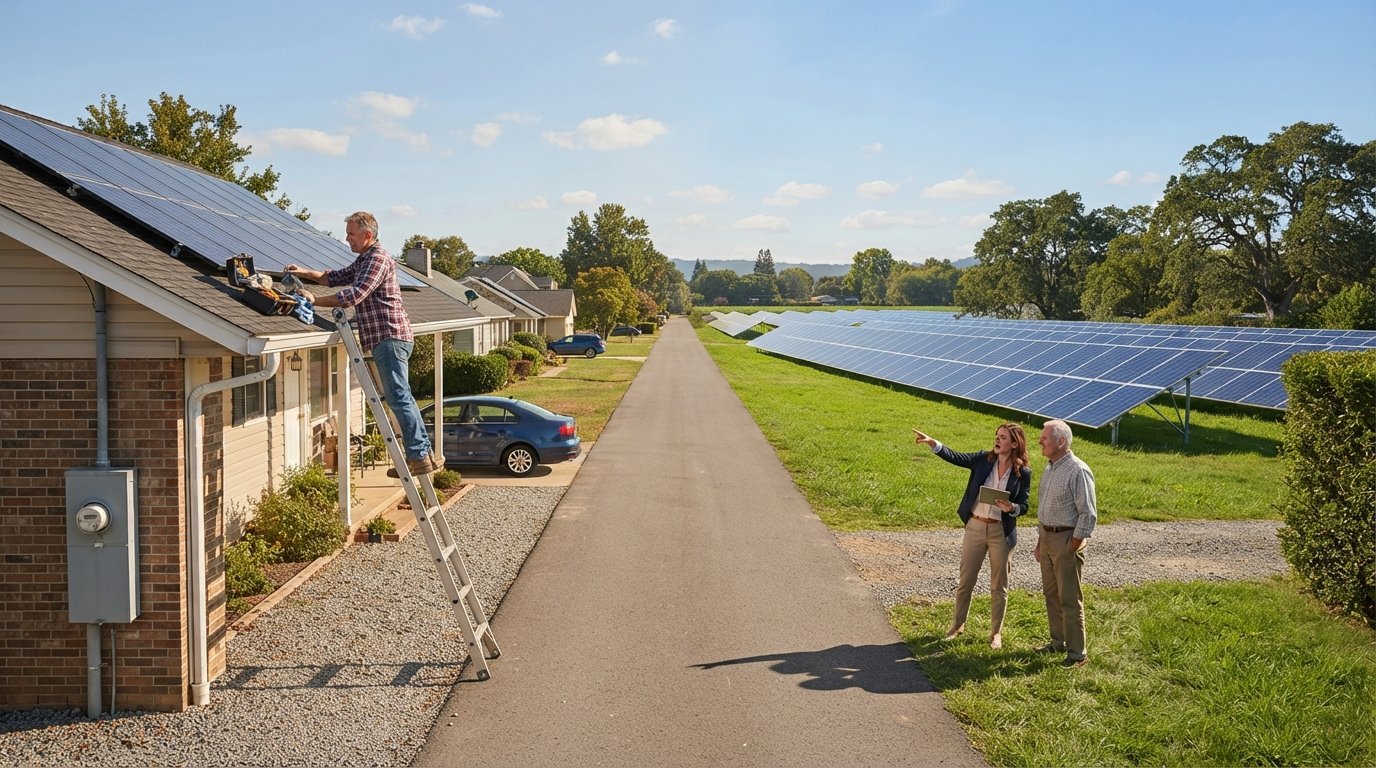
Rooftop solar is the classic image of home renewables: photovoltaic panels installed on your property, connected to your electrical panel, and sized to offset your household usage. You own or lease the equipment, and the electricity it generates flows directly into your home. Any surplus power is typically sent to the grid, earning you credits through net metering programs.
Community solar, also known as a solar farm or shared solar, operates on a different premise. Instead of putting panels on your roof, you subscribe to a share of a larger, off-site solar array. That array feeds power into the local grid, and the utility then applies the value of your share to your monthly electricity bill. You might receive a credit for the kilowatt-hours your subscription generates, often at a discounted rate.
These two models serve different needs. Rooftop solar gives you direct control and maximum long-term savings, but it requires a suitable roof, upfront investment, and ownership responsibilities. Community solar offers accessibility and simplicity, making it ideal for renters, those with shaded roofs, or anyone who cannot install panels. The right answer in a community solar vs rooftop solar comparison depends heavily on your personal circumstances.
Cost Comparison: Upfront, Monthly, and Long-Term
Money is often the first filter in any solar decision. Rooftop systems demand a significant initial outlay. In 2026, the average residential installation costs between $15,000 and $25,000 before incentives. The federal 30% Investment Tax Credit reduces that burden, and many homeowners finance the remainder with solar loans, bringing monthly payments close to their previous utility bills. Over the system's 25- to 30-year lifespan, however, ownership typically delivers the highest return on investment.
Community solar flips the financial model. There is no upfront cost, no equipment to buy, and no maintenance budget. Instead, you enroll in a program and agree to purchase a portion of the array's output. Most programs charge a per-kilowatt-hour rate that is 5% to 15% cheaper than your utility's standard rate. You do not own anything, but you also do not bear any risk of equipment failure or performance degradation.
To illustrate the difference, consider a household using 1,000 kWh per month at $0.15 per kWh.
- Rooftop Solar: After a $20,000 installation and the 30% tax credit, net cost is $14,000. If financed over 20 years at 5% interest, monthly payments run about $92. Over 25 years, total cost including interest is roughly $27,600, but you offset $45,000 in grid electricity, saving about $17,400.
- Community Solar: No upfront cost. You pay $0.12 per kWh for your subscription. Monthly cost is $120, which replaces your $150 utility bill, saving $30 monthly or $9,000 over 25 years.
Rooftop solar wins on total savings, but community solar wins on cash flow and risk. If you cannot afford a large upfront payment or prefer not to take on debt, community solar provides immediate bill relief without capital. If your goal is maximum wealth accumulation from your energy spend, rooftop ownership is the stronger choice.
Eligibility and Site Suitability
Not every roof is a good solar candidate. Age, orientation, shading, and structural integrity all play a role. An asphalt shingle roof with 20 years of life remaining and a south-facing slope is ideal. If your roof needs replacement in five years, you will face the added cost of removing and reinstalling panels. If your home sits under heavy tree cover, production drops significantly. Renters and those with homeowners association restrictions may be locked out entirely.
Community solar removes all physical barriers. You do not need a suitable roof, and you do not need to own your home. As long as your utility offers a community solar program and there are available subscriptions in your area, you can enroll. This makes community solar a powerful option for the 40% of US households that cannot host rooftop panels due to renting, shading, or roof conditions.
Geographic availability is the catch. Community solar is not offered everywhere. As of 2026, states like New York, Massachusetts, Minnesota, Colorado, and Maryland have robust programs, while others lag. Rooftop solar, by contrast, is available to nearly every homeowner with a viable roof, regardless of state-level community solar legislation. In a community solar vs rooftop solar comparison, evaluate your local market first.
Financial Benefits and Incentives
Rooftop solar unlocks the full suite of solar incentives. The federal Investment Tax Credit (ITC) covers 30% of your system cost, and many states add rebates, performance payments, or Solar Renewable Energy Certificates (SRECs). Net metering allows you to bank excess generation for nighttime use or credit it at retail rates. For example, in Texas, homeowners often pair rooftop arrays with time-of-use plans to maximize savings. These incentives directly reduce your payback period, often to between 6 and 10 years.
Community solar subscribers generally do not qualify for the ITC, as the developer owns the array and claims the credit. Instead, you receive savings through discounted subscription rates. Some programs offer low-income or community-focused discounts, but these vary widely. The benefit is simpler: you pay less per kWh than your utility charges, with no paperwork or tax filings. For those who cannot use tax credits due to low tax liability, community solar avoids the lost-value problem that plagues some rooftop buyers.
One nuance: when you sell your home, rooftop solar can add value. A 2023 Zillow study found homes with solar panels sell for 4.1% more on average. Community solar subscriptions, however, are tied to the subscriber, not the property, so they do not transfer with the home sale. If you move frequently, community solar offers more flexibility, but it also means you miss the property-value boost that rooftop systems provide.
Control, Maintenance, and Peace of Mind
Owning a rooftop system gives you control over every aspect of production. You monitor your app, track generation, and schedule maintenance when needed. Inverters might fail after 10 to 15 years, and panels can degrade, but warranties typically cover both. The responsibility is yours, but so is the reward. When a storm knocks out a panel, you arrange the repair. When you want to add a battery for backup power, you can do so seamlessly.
Community solar is a hands-off experience. The developer handles all operations, maintenance, and insurance. If a panel underperforms, the company fixes it, and your credits adjust accordingly. You never climb on a roof, clean modules, or worry about inverter warranties. This simplicity is a major draw for busy homeowners or those who prefer not to manage equipment.
However, you also have limited control. You cannot choose your panel brand, expand your share easily, or add storage. Your savings depend on the developer's subscription terms, which can change with contract renewals. Some programs have exit fees or auto-renewal clauses, so read the fine print. In a community solar vs rooftop solar comparison, decide how much involvement you want in your energy system.
Environmental Impact and Grid Resilience
Both models reduce your carbon footprint by displacing fossil-fuel generation. Rooftop solar generates power exactly where you use it, reducing transmission losses and easing strain on local transformers. Community solar drives larger, utility-scale projects that can be sited on brownfields or degraded land, supporting grid-wide renewable adoption.
Community solar also enhances grid resilience by diversifying generation sources across a wider geographic area. If your neighborhood experiences an outage, a rooftop system with a battery can keep your lights on, but a community solar subscription does nothing for you during a blackout. The array feeds the grid, not your home, so you need a separate battery or generator for emergency backup. Roooftop systems with storage offer true energy independence, which is why many homeowners pair panels with batteries in hurricane-prone regions like Florida or Texas.
For renters or those in apartments, community solar is often the only way to personally support renewable energy. It democratizes access, allowing anyone with a utility bill to participate in the clean energy transition. If your primary motivation is environmental, both options deliver, but rooftop provides additional resilience benefits.
Making the Decision: A Practical Framework
To choose between community and rooftop solar, ask yourself these five questions:
- Do I own my home and have a suitable roof? If yes, rooftop is feasible. If you rent or your roof is shaded, community solar is your path.
- Can I handle the upfront cost or a solar loan? If you have $5,000 to $10,000 for a down payment or can qualify for a 0.99% APR loan, rooftop financing can be attractive. Community solar requires zero capital.
- How long will I stay in this home? Rooftop solar pays off over 6 to 12 years. If you plan to move in five years, community solar with a short-term contract offers more flexibility.
- Do I want backup power? If energy independence and outage protection matter, rooftop with battery storage is the only option. Community solar cannot power your home during a blackout.
- Is community solar available in my utility territory? Check programs like those in New York or Massachusetts. If not, rooftop remains your only choice.
This framework clarifies trade-offs. For a homeowner with a sunny, south-facing roof who plans to stay for a decade, rooftop solar almost always generates superior financial returns. For a renter or a retiree on a fixed income who wants predictable bill savings without hassle, community solar is the smarter fit.
Real-World Examples and Scenarios
Consider Maria in Denver. She owns a townhome with a small, partially shaded roof and a strict HOA that limits panel placement. Rooftop solar would produce only 60% of her usage, making the payback period stretch to 15 years. Instead, she subscribes to a community solar farm in nearby Adams County. Her monthly bill drops by 10%, and she avoids any installation headaches. Community solar was her clear winner.
Now look at James in Houston. He has a large, unshaded roof and high electricity usage due to an electric vehicle and a pool. He installs a 12 kW system with a battery, paying $28,000 upfront. After the ITC, his net cost is $19,600. His average bill drops from $300 to $30, with annual true-up credits. In under seven years, he breaks even, and over 25 years, he saves more than $50,000. Rooftop solar is his champion.
These scenarios highlight that there is no universal winner in a community solar vs rooftop solar comparison. The answer is personal, based on your property's characteristics, your financial situation, and your long-term goals. Both models are valid tools for reducing your carbon footprint and lowering energy costs, but they serve different audiences.
How to Get Started
If you lean toward rooftop solar, begin by getting multiple quotes from vetted installers. Use tools like a solar cost calculator to estimate your payback period. A free quote service can connect you with pre-screened providers in your area. For detailed steps on evaluating offers, our guide on joining community solar programs offers a structured approach to enrollment, though the principles of due diligence apply to both.
If community solar appeals to you, contact your utility or state energy office to find available projects. Review the subscription agreement carefully, noting the rate discount, contract length, and escalation clauses. Compare those rates to your current utility tariff. Also, check whether your utility offers net metering, as that affects the value of your credits.
Ultimately, the choice hinges on your unique situation. Rooftop solar delivers higher long-term savings and energy independence, but requires capital and a suitable roof. Community solar offers accessibility, simplicity, and instant savings, but with lower total return and no backup power. For expert guidance and personalized cost estimates, platforms like SolarEnergy.ai can help you model both options based on your address and usage.
Whichever route you choose, you are taking a meaningful step toward cleaner energy and greater control over your utility bills. Start by assessing your roof, your budget, and your local programs, then choose the model that aligns with your priorities. The sun is shining on both paths, and the power to decide is in your hands.