
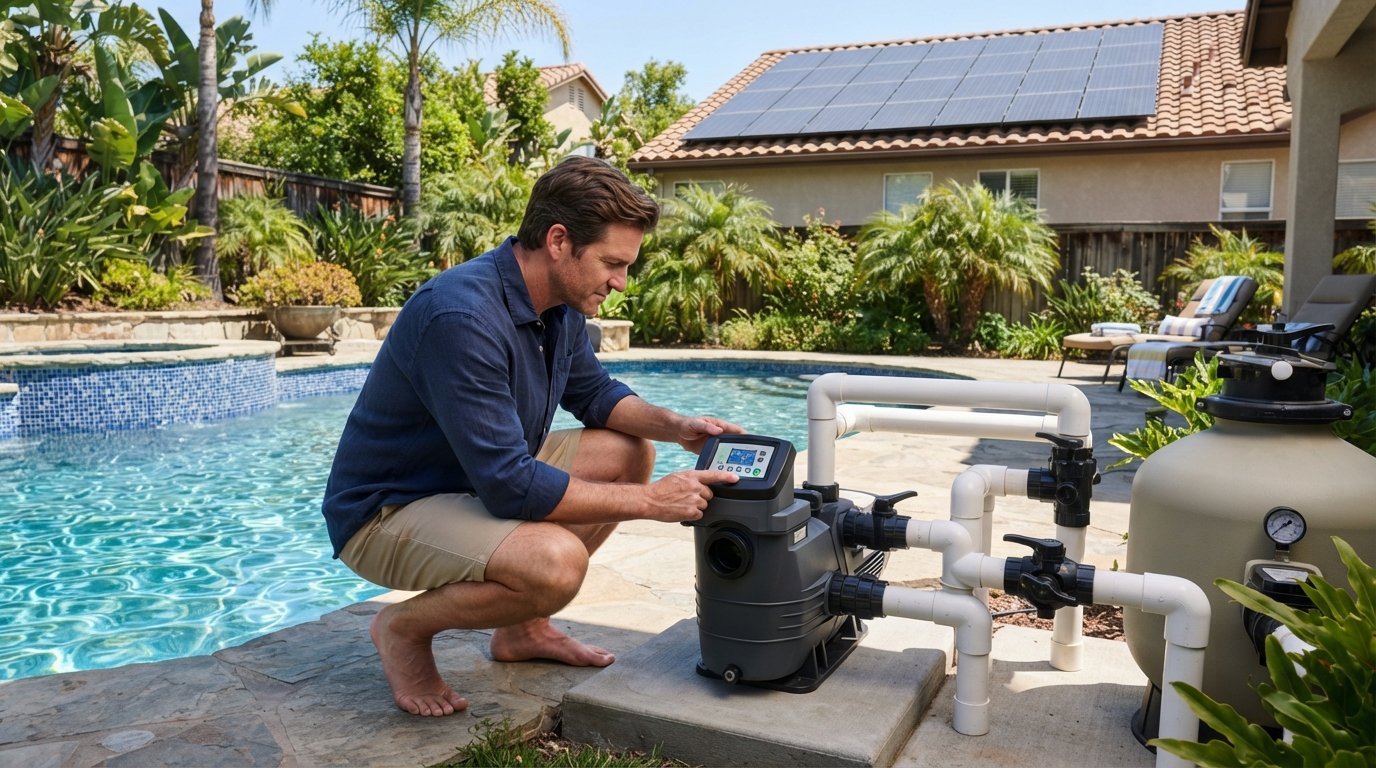
Solar Plus Pool Pump Integration for Lower Summer Bills
Solar plus pool pump integration for lower summer electric bills starts with smarter scheduling and right-sized arrays. Call (833)-793-7166 for free quotes.

By Leo Owens
Learn more about Solar Panel Installation and Repair for guides, costs, and what to expect.
Compare Solar Panel Installation and Repair Pros Near You

Enter your ZIP code to compare top-rated local professionals and request free quotes.
Your pool pump is likely the hardest-working appliance you own, and it works hardest exactly when your electric rates climb. A typical single-speed pump can consume 2,000 to 3,000 watts while running, and in many households it runs six to eight hours a day through the hottest months. That combination of long runtime and high wattage can add 3,000 to 6,000 kilowatt-hours to your annual consumption, which is enough to rival a small electric vehicle or a second refrigerator plus central air in a guest wing. Pairing that load with solar plus pool pump integration for lower summer electric bills is one of the most practical upgrades a pool owner can make, because it attacks the problem from both sides: it shrinks the load with a better pump and it offsets the remaining load with clean, self-generated power.
How Much Electricity Does a Pool Pump Really Use?
Before you size a single panel, you need a realistic picture of your pump's appetite. Pool volume, turnover goals, plumbing friction, and filter type all influence runtime, but the motor's wattage is the dominant variable. A traditional 1.5-horsepower single-speed pump draws roughly 1,500 to 2,000 watts. A 2-horsepower unit can pull 2,500 watts or more. Multiply that by daily runtime and then by 120 to 180 days of swimming season, and the numbers add up quickly.
Here is a practical way to estimate your own baseline. Check the motor nameplate for amps and volts, multiply them to get watts, then multiply by your average daily runtime. A pump drawing 2,200 watts for six hours uses 13.2 kWh per day. Over a 150-day season that is nearly 2,000 kWh, and in warmer climates with year-round filtration it can exceed 4,000 kWh. Your utility bill may show this as a general household increase rather than a labeled pool line item, which is why many owners underestimate it. The U.S. Department of Energy notes that pool pumps are often the second-largest energy user in a home after heating and cooling, and in some homes they take the top spot during summer.
That load matters for array sizing. A 2,000 kWh seasonal pool load is roughly equivalent to adding 1.5 to 2 kilowatts of solar capacity in a sunny climate, depending on panel orientation and shading. When you request quotes through a service like FreeSolarPowerQuotes, tell the installer your pump's wattage and runtime so the array is sized for the whole house, not just the air conditioner. For a deeper look at how generation and consumption appear on your statement, see this guide on how to read your electricity bill with solar panels.
The Variable-Speed Pump Advantage
Solar and pool equipment work best as a team when the pump itself is efficient. A variable-speed pump lets you run longer at lower RPM, and because pump power scales roughly with the cube of speed, dropping from full speed to half speed can cut energy use by 70 percent or more while still achieving adequate turnover. A pump that used 13 kWh per day at high speed might use 3 to 5 kWh per day on a well-tuned low-speed schedule. That reduction changes the solar math dramatically, because a smaller array can cover the load and the payback period shortens.
Modern variable-speed pumps also include programmable schedules and, in some models, internal timers that make it easy to align filtration with solar production. If your utility offers time-of-use rates, the savings compound: you avoid expensive evening rates and you consume your own solar kilowatt-hours instead of exporting them for a lower credit. Many utilities and state energy offices offer rebates for qualifying variable-speed pumps, so check current incentive listings before you buy. Pairing an efficient pump with solar plus pool pump integration for lower summer electric bills is the combination that produces the most predictable results.
Scheduling Filtration Around Peak Solar Production
The simplest and least expensive optimization is also the most overlooked: run the pump when the sun is shining. Solar panels produce the most power between about 9 a.m. and 4 p.m., with peak output near midday. If your pump runs from 8 a.m. to 2 p.m., most of its electricity comes directly from your roof rather than from the grid. If it runs from 6 p.m. to midnight, you are buying every kilowatt-hour from the utility and probably paying a premium for it.
Adjusting the schedule is usually a matter of reprogramming a timer, and the change can shift hundreds of dollars of annual cost from the grid to your array. A few practical steps help you get it right:
- Measure your pump's actual daily energy use with a plug-in meter or a smart home energy monitor for one week.
- Identify your solar system's peak production window using your monitoring app or inverter data.
- Shift the longest filtration block into that window, then add a shorter evening or early morning skim cycle if your pool needs it.
- Verify water clarity and chemistry over two weeks, adjusting runtime only if circulation suffers.
Most pools need one full turnover per day, and many need less during light use. Running a variable-speed pump for eight hours at low speed often provides better filtration than four hours at high speed, and it matches solar production more closely. If you have a salt chlorine generator, remember that it needs adequate runtime to produce sanitizer, so do not cut the schedule below the manufacturer's minimum. The goal is not zero grid use but maximum overlap between generation and demand.
Solar Pool Heating Versus PV-Powered Pumps
Homeowners often confuse two different technologies. Solar pool heating uses thermal collectors, usually black plastic or rubber mats on a roof or rack, to warm the water directly. It does not generate electricity, and it does not run the pump. Photovoltaic solar, by contrast, generates electricity that can power the pump, the filter, the salt system, and the rest of the house. The two systems can coexist, but they solve different problems.
If your goal is a warmer pool, thermal collectors are usually the lower-cost option, and they can extend your swimming season by weeks. If your goal is lower electric bills, photovoltaics are the tool that matters. A common and sensible approach is to install PV for the pump and household load first, then add thermal heating later if you want warmer water. Some homeowners install both at once to capture economies of scale on labor and mounting hardware. Discuss the sequence with your installer so the roof layout accommodates both, and confirm that the thermal panels will not shade the PV array.
Cost and complexity differ as well. Thermal systems involve plumbing, a diverter valve, and a roof or ground rack, with typical installed costs in the low thousands. A PV system is a larger investment but produces bill savings year-round and can be financed. Neither approach is automatically better; the right choice depends on whether you value warmer water, lower bills, or both.
Battery or No Battery for Evening Filtration
Some pool owners prefer to run filtration in the evening when the family swims, or they need a late skim cycle after a party. Without storage, those evening hours come from the grid. A home battery can shift daytime solar production into the evening, but batteries are expensive and pool pumps are a modest load compared with air conditioning or an electric vehicle. In most cases, a battery sized specifically for a pump is not cost-effective unless you also want backup power for the home.
A more economical strategy is to schedule the heavy filtration during the day and reserve a short, low-speed evening cycle if needed. If you already plan to add a battery for outage protection, include the pump in your backup load panel and program it to run at low speed during an outage. That approach gives you resilience without oversizing the battery. For most homeowners, the no-battery path, meaning daytime pumping plus net metering, delivers the best return, while a battery makes sense when resilience is a priority or when your utility's rate structure strongly penalizes evening consumption.
Estimating Summer Savings and Verifying With Data
Savings estimates should be grounded in your own numbers, not generic claims. Start with your pump's daily kWh, multiply by your marginal electric rate, and multiply again by the number of days you run the pump. If your pump uses 10 kWh per day and your rate is 16 cents per kWh, that is $1.60 per day, or about $240 over a 150-day season. A variable-speed pump that cuts use to 4 kWh per day drops that to roughly $96. Solar then offsets the remaining cost at the times it produces power.
To verify results, use your inverter or monitoring app alongside a whole-home energy monitor. Compare daily solar production with pump runtime, and look for days when production clearly exceeds consumption during the filtration window. Your utility's net metering credits will show the exported surplus. If you want a formal estimate before you buy, a solar cost calculator can model array size, incentives, and payback for your address, and a quote comparison will reveal how installers account for pool loads.
Remember that incentives and rate structures change. The federal residential clean energy credit, state rebates, and utility programs should be verified with current official sources before you sign a contract. If you are also planning a move or a major home upgrade, resources like Moving.Homes relocation guides can help you think through how a pool and solar system affect resale value and transfer paperwork. And if you are comparing offers, ask each installer how they sized the array for your pump and whether they recommend a variable-speed upgrade as part of the project.
Solar plus pool pump integration for lower summer electric bills works best as a sequence: measure the load, upgrade to a variable-speed pump if it makes sense, shift runtime into the solar window, and size the array for the whole house. Homeowners who take those steps usually see the pool stop being a seasonal budget shock and start being a predictable, largely self-powered part of the property. To compare vetted local installers and get no-obligation quotes for a system sized around your actual pool load, start with a free quote request and bring your pump's wattage and runtime to the conversation.