
Solar Plus Home Energy Management: Whole Home Optimization
Maximize solar savings with whole home optimization. Call (833)-793-7166 to connect with trusted solar pros near you.

By Leo Owens
Learn more about Solar Panel Installation and Repair for guides, costs, and what to expect.
Compare Solar Panel Installation and Repair Pros Near You

Enter your ZIP code to compare top-rated local professionals and request free quotes.
Your solar panels generate clean power, but without intelligent coordination, much of that value can slip away. A home energy management system (HEMS) transforms isolated solar panels and batteries into a single, thinking organism that decides when to store, when to use, and when to sell. For homeowners who want to squeeze every possible dollar from their investment, pairing solar with a HEMS is the difference between a good system and a great one. This guide explains what whole home optimization really means, how load shedding works during outages, which brands play well together, and what savings you can realistically expect.
Beyond Solar Monitoring: What a HEMS Actually Controls
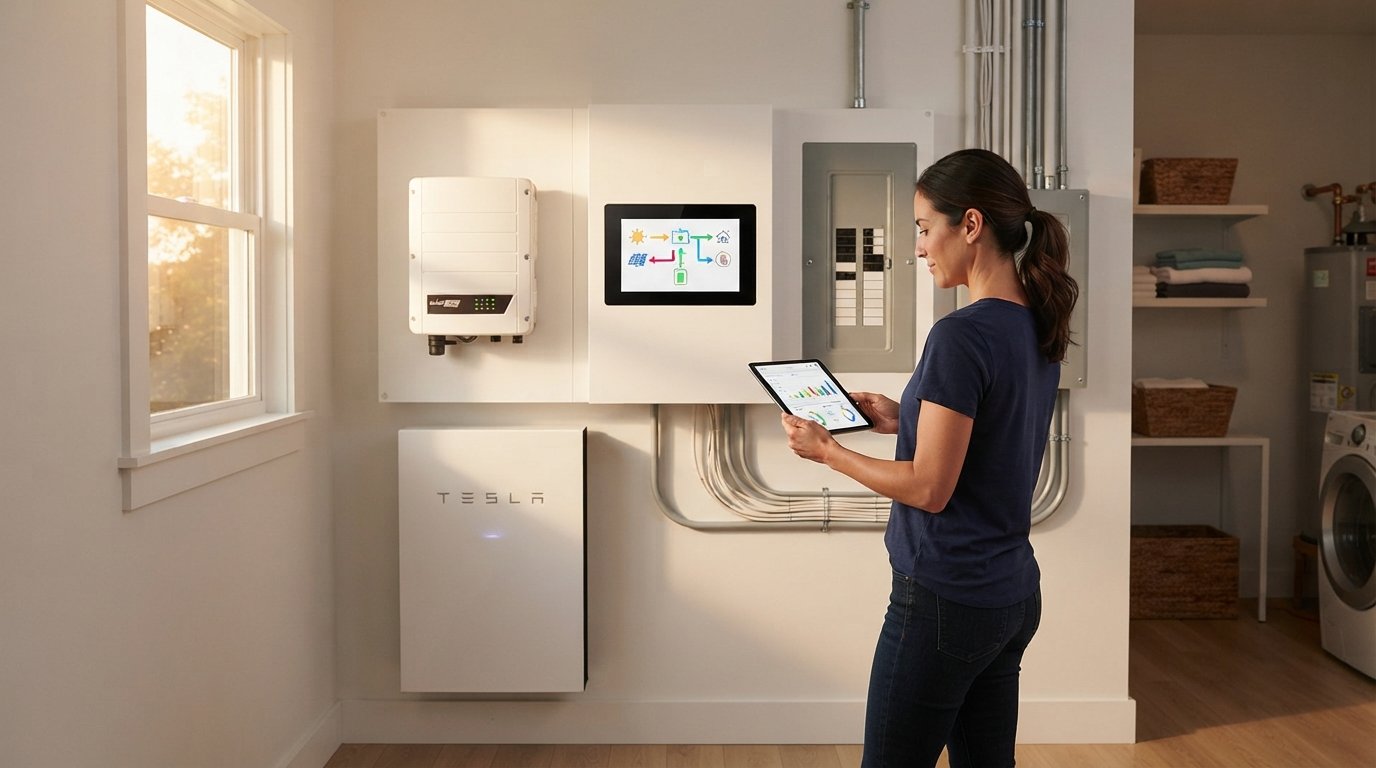
Most solar owners start with a monitoring app that shows production and consumption. That is useful, but it is passive. A true home energy management system actively controls loads, storage, and even grid interactions based on real-time data, weather forecasts, and utility rate structures. Think of it as the conductor of an orchestra where solar panels, batteries, EV chargers, heat pumps, and appliances all play different instruments.
At its core, a HEMS connects to your electrical panel through smart breakers or relays. It reads signals from your inverter, battery, and utility meter. Then it makes decisions: should the battery discharge now to avoid a peak-rate charge, or hold until the evening when rates spike? Should the EV charger wait until midday when solar production is highest? Should the water heater run during a negative pricing event? These are not hypotheticals; they are daily optimization choices that add up.
Beyond simple scheduling, advanced systems integrate weather forecasting and machine learning. If tomorrow is predicted to be cloudy, the HEMS may prioritize charging the battery today. If a heat wave is coming, it might pre-cool the house while solar is abundant. This level of whole home optimization turns your property into a microgrid that reacts to conditions automatically.
Load Shedding and Circuit-Level Control for Backup Scenarios
When the grid goes down, most solar systems without a battery simply shut off to protect line workers. With a battery and a HEMS, you can keep selected circuits running. But not all loads are equal. A circuit-level control system lets you decide which breakers stay energized during an outage: refrigerator, internet, a few lights, and medical equipment, for example. The HEMS sheds heavy loads like the electric range, pool pump, or central air conditioner to stretch battery reserve.
This is not just about convenience. It is about resilience. During a multi-day outage, a homeowner with a 10 kWh battery and smart load shedding can power essential circuits for days, while a neighbor without management might drain the same battery in hours. The HEMS continuously monitors battery state of charge and automatically reconnects shed loads when the battery recovers or solar begins producing again.
Some systems go further with priority tiers. You can assign critical, discretionary, and luxury loads. The HEMS then follows a hierarchy: critical loads never shed, discretionary loads shed only when battery drops below a threshold, and luxury loads stay off until the grid returns or battery is full. This framework gives you control without constant manual intervention.
Compatibility with Major Inverter and Battery Brands
One of the biggest questions homeowners ask is whether a HEMS will work with their existing equipment. The good news is that the industry is moving toward open standards, but compatibility still varies. Here is a quick rundown of how major brands interact with leading management systems.
- Enphase: The IQ Gateway and IQ Battery work well with third-party HEMS via APIs, though full control often requires Enphase's own software for backup modes.
- SolarEdge: The Energy Hub inverter supports direct generator and battery integration; HEMS like Span or Lumin can control circuits but may need additional hardware for full optimization.
- Tesla Powerwall: Tesla's ecosystem is somewhat closed, but its Gateway can be integrated with certain HEMS through Modbus or local APIs, allowing load control and time-of-use shifting.
- Generac PWRcell: Generac offers its own management platform, but the system can be paired with third-party HEMS for circuit-level control if the installer configures it correctly.
- FranklinWH: This newer battery brand emphasizes open communication and works with several HEMS platforms out of the box, making it a favorite for optimization-focused installers.
Before committing to a HEMS, verify that your inverter and battery support the necessary communication protocols. Your installer should be able to confirm compatibility or recommend a management system that bridges any gaps. In many cases, a qualified solar pro can design a solution that ties everything together, even if individual components come from different manufacturers.
Realistic Savings Expectations from Automated Load Shifting
How much can you actually save with whole home optimization? The answer depends on your utility rates, usage patterns, and the capabilities of your HEMS. But we can outline a realistic framework. Most savings come from three areas: time-of-use arbitrage, solar self-consumption, and demand charge reduction (for those on such tariffs).
Time-of-use arbitrage means charging your battery when rates are low (or when solar is excess) and discharging when rates are high. A well-optimized system can shift 80% or more of your evening consumption to stored solar, avoiding peak rates that might be double or triple off-peak. For a typical home using 30 kWh per day, that could mean $50 to $100 in monthly savings, depending on local rates.
Solar self-consumption improves when the HEMS directs surplus solar to flexible loads like EV charging, water heating, or pre-cooling. Instead of exporting power for a low net-metering credit, you use it on-site, which is almost always more valuable. This can add another 10-20% to your solar savings.
Demand charge reduction applies to utilities that bill based on your highest 15-minute usage spike. A HEMS can shave peaks by staggering large loads and discharging the battery strategically. For homeowners with demand charges, this alone can save hundreds per year. However, it is important to note that actual savings vary widely, and you should verify current utility programs and incentives with official sources.
Designing Your Whole Home Optimization Strategy
Getting started with solar plus home energy management system whole home optimization requires a plan. First, assess your loads and identify which circuits can be controlled. Not every appliance needs smart control; focus on the big flexible ones: EV charger, water heater, HVAC, pool pump, and laundry. Second, choose a HEMS that matches your inverter and battery, or select a battery that is known for open compatibility. Third, work with a qualified installer who understands both solar and energy management. They can configure the system to your utility's rate structure and your household priorities.
Financially, you can evaluate the investment using a solar system investment analysis for homeowners to compare payback periods with and without optimization. Many HEMS cost between $1,500 and $4,000 installed, and federal tax credits may apply when installed with a solar-plus-storage system. Your installer can clarify eligibility.
For homeowners looking to find reputable contractors who specialize in solar and energy management, platforms like Contractor.Homes connect you with pre-vetted local professionals. This can simplify the process of getting multiple quotes and ensuring your system is designed for optimization from day one.
Common Pitfalls and How to Avoid Them
Even with the best intentions, some homeowners end up with a HEMS that underdelivers. One common mistake is buying a system that only monitors, not controls. Monitoring alone does not shift loads; you need relays or smart breakers. Another pitfall is ignoring compatibility: a HEMS that cannot talk to your battery is like a brain without limbs. Always confirm integration before purchase.
Overcomplicating the setup is another risk. Start with a few high-impact circuits and expand as you learn. Finally, do not assume savings are guaranteed. Utility rates change, and your behavior matters. The HEMS automates, but you still need to set realistic expectations and review performance monthly.
When in doubt, consult a solar professional who has experience with energy management systems. They can model your specific usage and rate plan to predict savings more accurately.
Whole home optimization is not a luxury; it is the logical next step for any solar owner who wants maximum return. By combining solar, storage, and intelligent control, you turn your home into a responsive energy asset that saves money, increases resilience, and reduces waste. Whether you are just starting your solar journey or upgrading an existing system, a home energy management system can unlock value you did not know you were missing.