
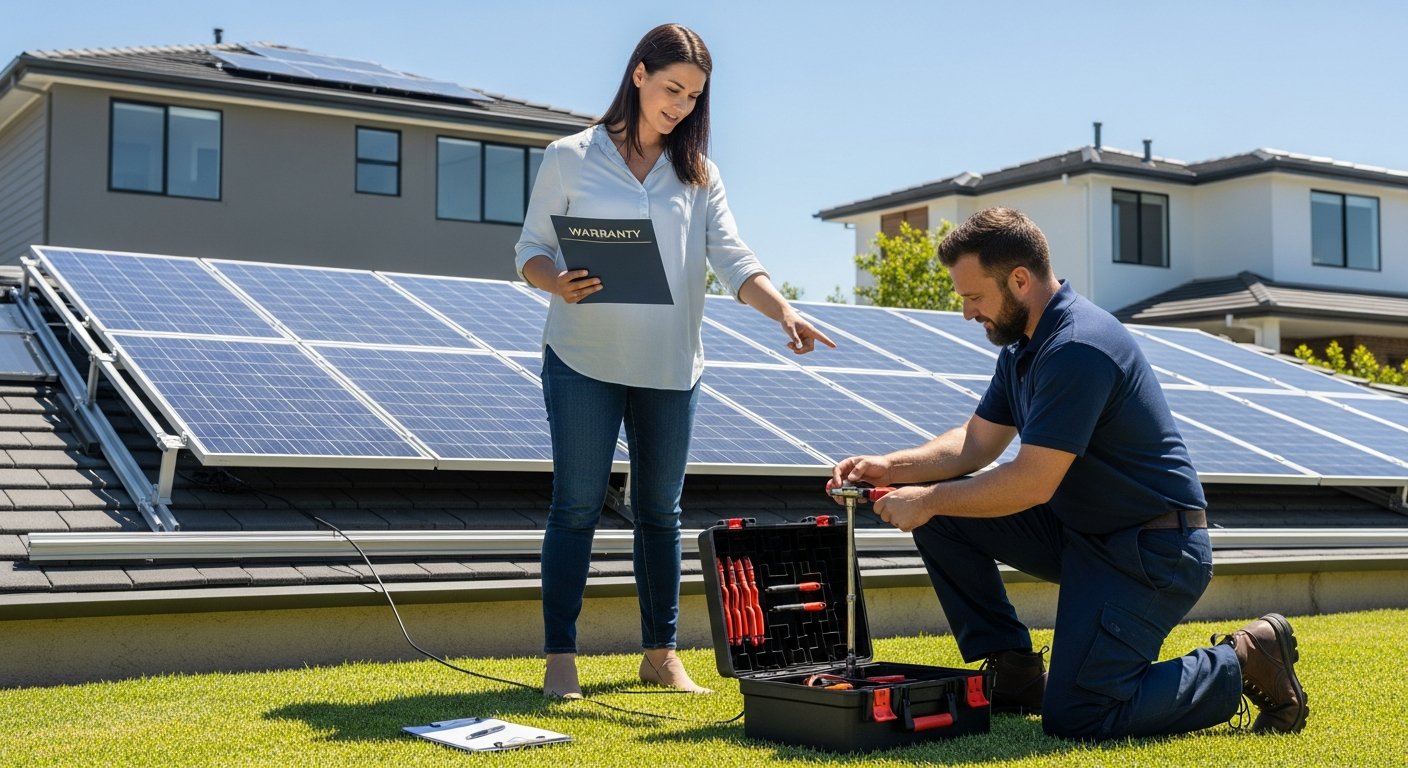
Solar Panel Warranty: What It Covers and What to Check
Understand what solar panel warranties cover, how to compare them, and why they matter for your long term savings.

By Brandon Moore
Learn more about Solar Panel Installation and Repair for guides, costs, and what to expect.
Compare Solar Panel Installation and Repair Pros Near You

Enter your ZIP code to compare top-rated local professionals and request free quotes.
When you invest in a solar energy system, the warranty is your financial safety net. It determines whether a panel failure, inverter breakdown, or workmanship issue becomes a minor inconvenience or a costly repair. Many homeowners focus on the upfront price and efficiency ratings, but the warranty can be just as important as the equipment itself. Understanding what your solar panel warranty covers, how long it lasts, and what exclusions exist can save you thousands of dollars over the 25 to 30 year life of your system.
This guide breaks down the different types of solar warranties, what they actually cover, and how to compare them when you receive quotes from installers. By the end, you will know exactly what questions to ask and what documents to keep in a safe place.
The Two Main Types of Solar Panel Warranties
Solar warranties fall into two broad categories: the equipment warranty (provided by the manufacturer) and the workmanship warranty (provided by the installer). Both are essential, but they protect you in different ways.
The equipment warranty covers the physical hardware itself, including the solar panels, inverter, and racking. The workmanship warranty covers the quality of the installation, such as roof penetrations, wiring connections, and mounting. A robust warranty package includes strong coverage in both areas.
Manufacturer Equipment Warranty
The manufacturer warranty is the most important protection for your solar panels. It typically lasts 25 years, though some premium panels now offer 30 year warranties. This warranty covers defects in materials and manufacturing, such as microcracks, delamination, or premature degradation. If a panel fails within the warranty period, the manufacturer will repair or replace it.
There are two key components to a manufacturer warranty: the product warranty and the performance warranty. The product warranty covers physical defects and failures. The performance warranty, also called the power output warranty, guarantees that your panels will produce at least a certain percentage of their rated power over time. For example, a panel might guarantee 92% of its rated output after 10 years and 85% after 25 years.
Installer Workmanship Warranty
The installer's workmanship warranty protects you from installation errors. This includes issues like improper mounting, faulty wiring, roof leaks caused by poor flashing, or damage to your roof during installation. Most installers offer a 5 to 10 year workmanship warranty, but some premium installers provide 25 year coverage.
This warranty is separate from the manufacturer warranty. If your roof leaks because the installer did not seal the mounting points correctly, the manufacturer warranty will not cover it. You need to rely on the installer's workmanship warranty. Always get the workmanship warranty in writing, and make sure it clearly states what is covered and for how long.
What Does a Solar Panel Warranty Actually Cover?
Understanding the specific components of your solar panel warranty is crucial. Here are the main areas that are typically covered:
- Panel defects: Covers manufacturing flaws, such as microcracks, hot spots, or solder joint failures that cause a panel to underperform or stop working.
- Inverter failure: Most inverters have a separate warranty, often 10 to 12 years, though some string inverters come with 15 year options. Microinverters and power optimizers may have 20 to 25 year warranties.
- Racking and mounting: Covers structural defects in the mounting system that could cause panels to shift or detach.
- Labor and removal: Some warranties include the cost of removing a defective panel and reinstalling the replacement, while others only cover the part. This can be a significant expense, so check if labor is included.
- Roof penetration warranty: Many quality installers offer a separate warranty on the roof penetrations they make, often matching the workmanship warranty period.
It is equally important to know what is not covered. Most warranties exclude damage from natural disasters (hail, hurricanes, lightning), improper cleaning, vandalism, or modifications made by unauthorized personnel. They also usually require that the system be installed by a certified professional and maintained according to the manufacturer's guidelines.
Performance Warranty vs. Product Warranty: Why Both Matter
Many homeowners confuse the performance warranty with the product warranty, but they serve different purposes. The product warranty is a promise that the panel will function without physical defects. The performance warranty is a promise about how much power the panel will produce over time.
Solar panels naturally degrade at a rate of about 0.5% to 0.8% per year. The performance warranty guarantees that this degradation will not exceed a certain threshold. For instance, a panel with a 0.5% annual degradation rate will still produce about 88% of its rated power after 25 years. If your panels degrade faster than the warranty allows, the manufacturer must compensate you, typically by providing additional panels or a financial settlement.
When comparing quotes, look at both the product warranty length and the performance warranty terms. A 25 year product warranty with a 90% output guarantee after 25 years is stronger than a 25 year product warranty with only an 85% output guarantee. These numbers directly affect your long term energy production and savings.
How to Compare Solar Panel Warranties When Getting Quotes
When you request solar quotes, you should receive a detailed proposal that includes the warranty information for the specific equipment being installed. Do not assume that all warranties are the same. Here is a simple framework to compare them:
- Check the product warranty length: Look for at least 25 years on the panels, and note whether the inverter warranty matches or if it is shorter.
- Review the performance warranty: Compare the guaranteed output at year 25. A higher percentage means better long term performance.
- Confirm labor coverage: Ask if the warranty includes labor costs for replacement, and how much it would cost if labor is not covered.
- Verify the workmanship warranty: Ensure the installer offers at least 5 years, but preferably 10 years or more, and that it covers roof leaks.
- Check for warranty transferability: If you sell your home, can the warranty be transferred to the new owner? This can increase your home's resale value.
Once you have this information, you can make an informed decision. Remember that the cheapest quote may come with a weaker warranty, and the most expensive quote may include a more comprehensive package. The warranty is part of the overall value of your solar investment.
Warranty Claims Process: What to Expect
If you experience a problem with your solar system, the first step is to contact your installer. They will diagnose the issue and determine if it falls under the manufacturer or workmanship warranty. If the installer is no longer in business, you can contact the manufacturer directly, but you will need to find a certified technician to perform the diagnosis and replacement.
The claims process typically involves submitting proof of purchase, the system serial numbers, and photos or diagnostic reports. Most manufacturers have a streamlined process, but it can take a few weeks to a few months to complete a replacement. During this time, your system may be partially or fully nonfunctional, which could affect your savings.
To avoid surprises, keep all warranty documents and receipts in a safe place. Register your system with the manufacturer after installation, and note the contact information for both the installer and the manufacturer. If you are considering a system with a 410 watt solar panel or a 540 watt solar panel, check the warranty terms for those specific models, as they can vary by product line.
Warranty Considerations for Different Equipment Types
Not all solar components have the same warranty coverage. Here is a breakdown of what to expect for each major piece of equipment:
- Solar panels: 25 to 30 years product warranty, 25 to 30 years performance warranty. Premium brands like SunPower or LG (now out of the residential business) offer 25 year warranties with strong output guarantees.
- String inverters: 10 to 12 years standard, with options to extend to 15 or 20 years at an additional cost. Replacement costs can be significant, so consider extended warranties.
- Microinverters: 20 to 25 years, which is why they are increasingly popular. They are more expensive upfront but offer longer protection.
- Power optimizers: Typically 20 to 25 years, similar to microinverters.
- Battery storage: 10 to 15 years, but note that capacity degradation is often covered separately. Check the throughput or cycles warranty.
- Racking and mounting: 10 to 25 years, depending on the manufacturer. Ensure it covers structural integrity and corrosion.
When you are comparing a 5kW solar panel system, the inverter warranty is especially important because the inverter is the most likely component to fail. If you are quoted a string inverter with a 10 year warranty, consider upgrading to a longer warranty or choosing microinverters for better long term protection.
Red Flags and Hidden Pitfalls in Solar Warranties
Not all warranties are created equal, and some contain clauses that can leave you unprotected. Watch out for these common pitfalls:
- Prorated warranties: Some warranties reduce the coverage amount over time. For example, a 25 year warranty might only cover 100% of the cost in the first 5 years, then decrease by 4% per year. This means you could pay a significant portion of the replacement cost in year 20.
- Exclusions for environmental damage: If you live in an area prone to hail, hurricanes, or extreme heat, check if these events are excluded. Some manufacturers have specific weather related exclusions.
- Installation requirements: The warranty may be void if the system is not installed by a certified professional or if it is installed on a roof that does not meet certain specifications.
- Maintenance obligations: Some warranties require regular professional maintenance, which can be an additional cost. Understand what you are required to do to keep the warranty valid.
- Limited transferability: If you sell your home, the warranty may not transfer to the new owner, which could lower your property's appeal.
Always read the full warranty document before signing. If a term is unclear, ask the installer to explain it in writing. A reputable installer will be happy to provide clarity.
How a Solar Panel Warranty Affects Your ROI
Your solar panel warranty directly impacts your return on investment (ROI). A system that fails or underperforms after 10 years can wipe out your savings if the warranty does not cover the repair. Conversely, a strong warranty ensures that your system continues to produce the expected energy for decades, maximizing your financial benefit.
When evaluating a quote, consider the warranty as part of the total cost. A $2,000 higher upfront cost for a system with a 25 year warranty and labor coverage is often worth it compared to a cheaper system with a 10 year warranty and no labor coverage. Over 25 years, the additional protection can save you thousands in potential repair costs.
If you are still in the research phase and want to compare system costs and payback periods, our guide on 410 watt solar panel power and efficiency can help you understand the performance and warranty options for that specific panel size. Similarly, if you are considering higher output panels, our article on 540 watt solar panel efficiency explains the benefits and warranty considerations for those larger modules.
When you are ready to get quotes, be sure to ask each installer about their warranty terms in writing. This will allow you to compare apples to apples and choose the system that offers the best combination of price, performance, and protection. For a typical residential setup, you can also review our recommendations for affordable 5kW solar panel options to see which brands offer the strongest warranties at a reasonable cost.
In the end, a solar panel warranty is a promise. The best warranties are backed by reputable manufacturers and installers who have a track record of honoring their commitments. Do not hesitate to ask for references or to research the manufacturer's claims process online. A little due diligence now can prevent a major headache later.
Your solar system is a long term investment. Treat the warranty as a key part of that investment, and you will enjoy clean energy and savings for decades to come.