
Whole Home Battery Backup vs Partial Load Panel
Compare whole home battery backup vs partial load panel designs, including costs, runtime, and which circuits stay powered during an outage.

By Benjamin Taylor
Learn more about Solar Panel Installation and Repair for guides, costs, and what to expect.
Compare Solar Panel Installation and Repair Pros Near You

Enter your ZIP code to compare top-rated local professionals and request free quotes.
When a storm knocks out the grid, the difference between a dark house and a fully powered home often comes down to one decision: whole home battery backup vs partial load panel design. Both approaches use the same lithium iron phosphate batteries and hybrid inverters, but they deliver very different experiences. One keeps every circuit alive, from the sump pump to the microwave. The other powers a curated list of essentials and leaves the rest dark. Choosing between them is not just a technical question. It shapes your installation cost, your battery runtime, your contractor's wiring plan, and how your family lives through the next outage.
Most homeowners start this journey after a bad storm season or a utility rate hike. They call an installer, hear the phrase "critical loads panel," and quietly wonder what they are giving up. This guide breaks down the real trade-offs between whole home battery backup and partial load panel setups, including costs, code requirements, and the scenarios where each one wins.
What Whole Home Battery Backup Actually Means
Whole home battery backup is a design where the battery system is sized and wired to carry your entire electrical service, not just a subset of circuits. The battery connects through a transfer switch or a smart gateway, and when the grid fails, every breaker in your main panel stays energized. Lights, outlets, HVAC, well pump, garage door, and even a Level 2 EV charger can keep running, as long as the battery has capacity and the inverter can meet your peak demand.
The engineering behind this is more demanding than most homeowners expect. A typical house has a service panel rated at 200 amps, which translates to roughly 48 kilowatts of potential draw at 240 volts. No residential battery can deliver that continuously. Installers solve this with load management: the system monitors which appliances run at the same time and staggers or sheds the heaviest loads. A smart panel or gateway may temporarily pause the EV charger while the oven and dryer run, then resume it when demand drops.
Whole home backup also requires a battery inverter with enough surge capacity to start motors. An air conditioner compressor, for example, can pull three to five times its running wattage for a few seconds at startup. If the inverter cannot handle that inrush, the system trips offline even though the battery has plenty of stored energy. This is why whole home systems often use two or more inverters or a high-output hybrid unit.
Homeowners who want this level of coverage usually pair it with a solar array so the battery recharges during the day. In our solar battery backup explained guide, we walk through how panels, inverters, and batteries work together to keep a home running through multi-day outages.
How Partial Load Panels Work and Why Installers Recommend Them
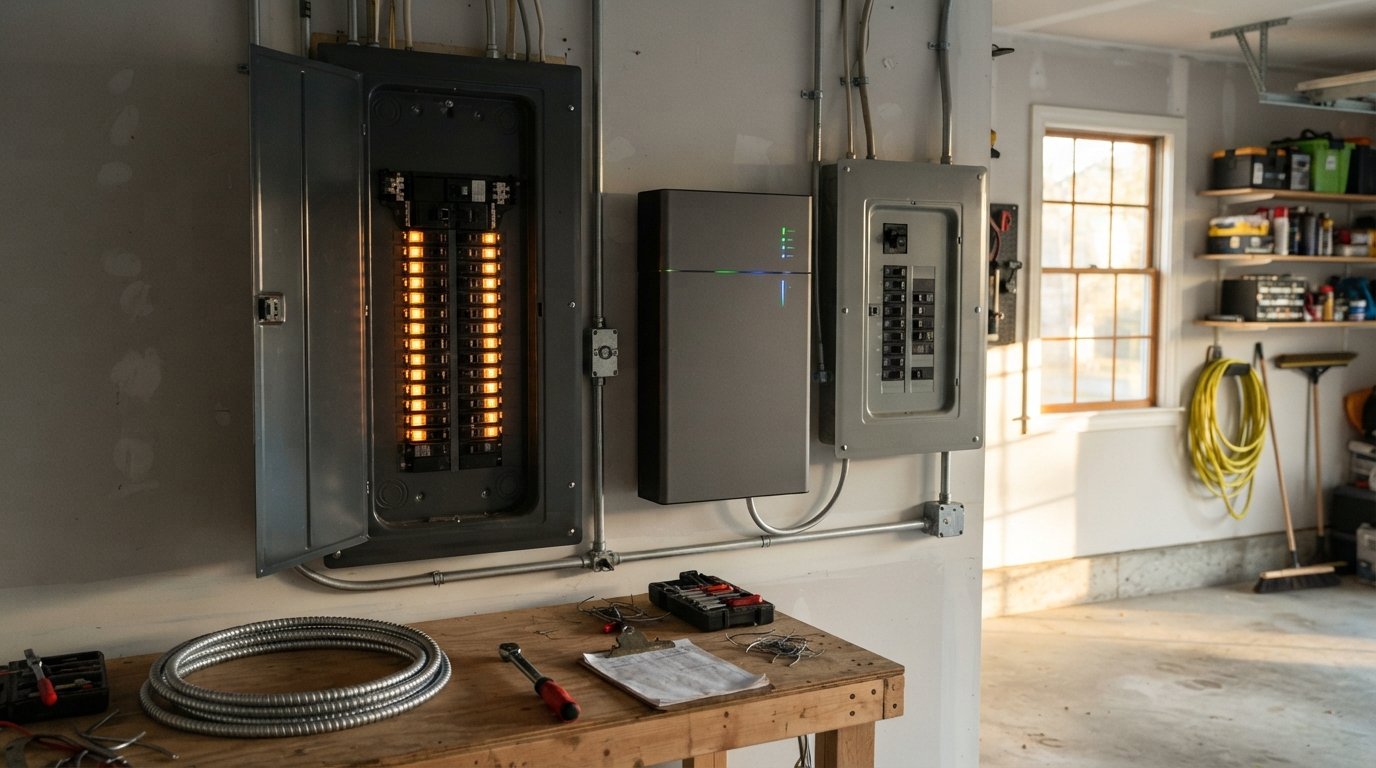
A partial load panel, sometimes called a critical loads panel or subpanel, is a smaller breaker box wired to selected circuits in the home. During an outage, the battery powers only those circuits. The rest of the house goes dark until the grid returns. The idea is simple: instead of trying to carry every load, you decide in advance which ones matter most and size the battery for that smaller demand.
Contractors often default to this approach for three reasons. First, it is cheaper. A smaller battery and a single inverter can handle a few thousand watts, so the equipment cost drops significantly. Second, it is faster to install because the electrician only needs to move a handful of circuits from the main panel to the subpanel. Third, it avoids the complex load management software and larger wiring that whole home systems require.
The catch is that the homeowner has to live with the limits. If the furnace is not on the critical loads panel, a winter outage means no heat. If the kitchen outlets are excluded, you cannot run the coffee maker or the microwave. Many families discover too late that the circuits they assumed were essential, like the garage freezer or the home office, were left off the list.
Typical circuits that end up on a partial load panel include:
- Refrigerator and freezer outlets
- Furnace blower or a mini-split for heating and cooling
- Internet router, modem, and a few lighting circuits
- Sump pump or well pump
- Medical equipment and phone charging outlets
That list covers the basics, but it also reveals the trade-off. A partial load panel is a compromise. You get longer runtime per kilowatt-hour because you are powering fewer loads, but you give up comfort and convenience. For some households, that is a fair deal. For others, it feels like camping in their own living room.
Cost Comparison: Whole Home Battery Backup vs Partial Load Panel
Price is usually the deciding factor between these two designs. A partial load panel system with a single 10 to 13.5 kilowatt-hour battery typically lands in the $10,000 to $16,000 range before incentives, depending on the inverter and labor. A whole home system with 20 to 40 kilowatt-hours of storage, a smart gateway, and load management hardware often runs $25,000 to $45,000 or more. The gap is wide enough that many homeowners start with a partial load design and expand later.
The 30 percent federal Investment Tax Credit applies to both configurations when the battery is charged by solar, which softens the difference. Some states and utilities add rebates or performance payments on top. Always verify current incentive terms with a qualified tax professional, because program rules change.
It also helps to think about cost per usable kilowatt-hour rather than sticker price. A partial load system that covers 10 essential circuits may cost $1,200 per usable kilowatt-hour. A whole home system with load management may cost $900 per usable kilowatt-hour because the larger battery and smarter controls spread the fixed installation cost across more capacity. The upfront number is higher, but the value per unit of storage can be better.
If you are still comparing equipment options, the team at SolarEnergy.ai publishes independent reviews of home battery systems and hybrid inverters that can help you benchmark quotes before you sign.
Sizing and Runtime: What Each Design Delivers
Runtime depends on three variables: battery capacity, household load, and weather. A partial load panel system powering 2 kilowatts of essential circuits on a 13.5 kilowatt-hour battery can run roughly five to six hours before hitting the reserve floor. Add solar recharging during the day, and that same system can ride through a multi-day outage if the sun cooperates. A whole home system carrying 5 kilowatts of average load needs at least 30 kilowatt-hours to deliver a similar overnight window, which is why whole home batteries are physically larger and more expensive.
Load management changes the math. Smart panels can reduce average draw by cycling heavy appliances on and off. A house that normally pulls 5 kilowatts may drop to 3 kilowatts under management, extending runtime by 40 percent or more. This is one reason whole home systems have become more practical in recent years. The hardware no longer needs to match the full service rating; it only needs to match the managed load profile.
Climate matters too. In Phoenix, air conditioning dominates summer demand and can push a whole home system to its limits. In Charlotte or Houston, mild shoulder seasons make partial load designs more attractive. In Florida, hurricane season drives demand for multi-day resilience, which favors larger batteries regardless of panel design.
When a Partial Load Panel Is the Smarter Choice
A partial load panel is not a consolation prize. It is the right answer in several common situations. If your budget is tight and you want to start with solar plus a single battery, a critical loads panel gets you outage protection without stretching your finances. If your main panel is older or has limited space, adding a subpanel is often simpler than a full service upgrade. If your utility has a small service rating or your home has a long list of low-priority circuits, a partial load design keeps the project manageable.
Partial load panels also shine for specific use cases:
- Medical needs: powering a CPAP, oxygen concentrator, or refrigerator reliably without paying for whole home capacity.
- Remote work: keeping internet, computers, and lighting online through short outages.
- Rental properties: providing essential backup without investing in high-end load management.
- Starter systems: installing a small battery now with a plan to add capacity later.
The key is to plan the circuit list carefully. Walk through your house during a blackout drill and note which breakers you would actually miss. Most families find that 8 to 12 circuits cover 80 percent of their daily needs. That insight alone can save thousands of dollars.
When Whole Home Battery Backup Is Worth the Investment
Whole home backup earns its premium when the cost of an outage is high or when comfort matters as much as survival. If you run a home business, store temperature-sensitive inventory, or have family members with medical devices that draw significant power, a partial load panel may not be enough. Whole home systems also make sense if you plan to add an EV charger, a heat pump, or a home addition that will increase your electrical demand.
There is also a resale argument. A home with whole home battery backup and a smart panel is marketed as resilient and future-ready. Buyers in storm-prone markets increasingly ask about backup power, and a system that powers every room is a stronger selling point than one that keeps the lights on in the kitchen.
The decision often comes down to a simple question: do you want to manage an outage or ignore it? A partial load panel requires you to think about which appliances you can run. A whole home system lets you live normally, within the limits of stored energy, and lets the software handle the rest.
Practical Steps Before You Choose
Start by auditing your electrical panel. List every breaker, note the wattage of major appliances, and mark which circuits are truly essential. Your installer will use this information to design either a critical loads subpanel or a whole home configuration with load management. Ask for a load calculation that shows peak demand, average demand, and surge requirements for motors.
Next, get at least three quotes. Ask each installer whether they recommend whole home battery backup vs partial load panel for your specific house, and why. Compare the battery capacity, inverter output, warranty terms, and whether the design includes a smart panel or a manual transfer switch. A good quote will show the circuit list, the expected runtime, and the assumptions behind it.
Finally, confirm the incentives and financing options available in your state. The federal tax credit, state rebates, and utility programs can change the payback period dramatically. FreeSolarPowerQuotes connects homeowners with vetted local installers who provide free, no-obligation quotes, so you can compare designs side by side without pressure.
Whichever path you choose, the goal is the same: a home that stays livable when the grid goes down. Whole home battery backup delivers convenience at a higher price. A partial load panel delivers essential power at a lower cost. Match the design to your budget, your climate, and your family's definition of normal, and you will get the most value from every kilowatt-hour you store.