
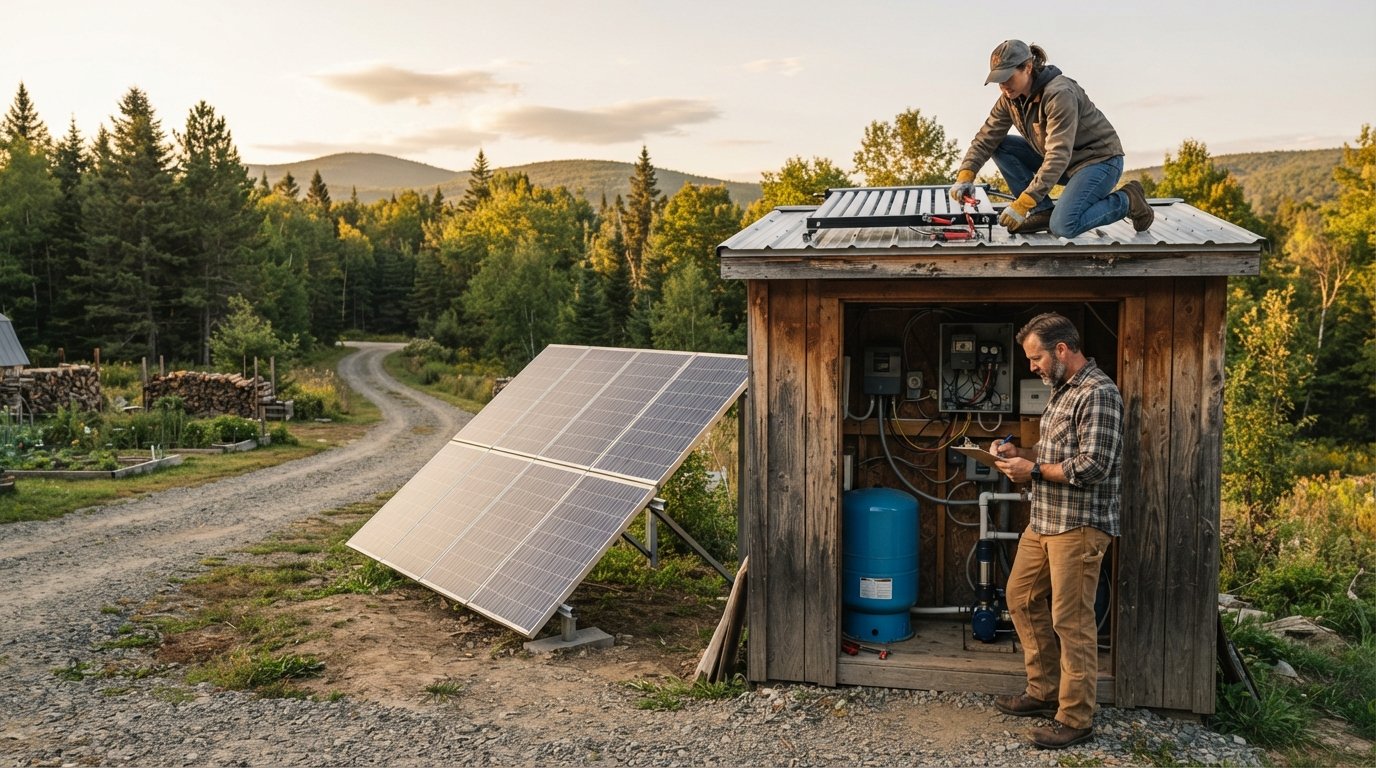
Solar Well Pump & Water Heating Off Grid Guide
Master off-grid water with our solar powered well pump and water heating off grid guide. Call (833)-793-7166 for expert help.

By Leo Owens
Learn more about Solar Panel Installation and Repair for guides, costs, and what to expect.
Compare Solar Panel Installation and Repair Pros Near You

Enter your ZIP code to compare top-rated local professionals and request free quotes.
Living off the grid doesn't mean sacrificing hot showers or running water. With the right solar powered well pump and water heating off grid guide, you can enjoy modern comforts while staying energy independent. The challenge is that well pumps and water heaters are two of the most energy-intensive appliances in any home, and sizing a solar system to handle them requires careful planning. This guide walks you through the critical decisions: from calculating the surge loads of a deep well pump to choosing between heat pump and thermal water heating, and from permitting to load scheduling. By the end, you'll have a clear roadmap to design a reliable, efficient off-grid water system that won't leave you cold.
Sizing Your Solar Array and Battery Bank for a Deep Well Pump
The well pump is often the largest electrical load in an off-grid home, and its starting surge can be several times its running wattage. A typical 1 HP submersible pump might draw 1,000 watts while running but require 3,000 to 4,000 watts for a second or two at startup. If your solar array and battery bank can't deliver that surge, the pump won't start, or the inverter will shut down. Therefore, sizing must account for both continuous and surge power.
Start by determining your pump's specifications: horsepower, voltage, phase, and whether it uses a standard induction motor or a variable-frequency drive (VFD). A VFD pump soft-starts, gradually ramping up speed, which drastically reduces surge. That makes it far more solar-friendly. Next, estimate daily water usage. A family of four might use 200 to 300 gallons per day. Multiply by the pump's flow rate (gallons per minute) and head height to find the daily energy requirement in watt-hours. For example, pumping 300 gallons from a 200-foot well with a 10 GPM pump running for 30 minutes uses roughly 500 watt-hours. But that's just the pump; you also need to account for pressure tank cycling and any booster pumps.
Battery bank sizing follows: you need enough storage to run the pump during cloudy spells and to handle surge. Lithium iron phosphate (LiFePO4) batteries are excellent because they can deliver high surge currents without voltage sag. A good rule of thumb is to size the battery bank to cover at least two days of typical consumption, plus a 30% reserve for surge and inefficiency. For a pump that uses 1 kWh per day, a 5 kWh battery bank gives comfortable headroom. Remember that the inverter must also handle the surge; choose a pure sine wave inverter with a surge rating at least double the pump's running wattage.
Solar array sizing depends on your location's peak sun hours. If you need 1 kWh per day and get 4 peak sun hours, a 400-watt array (accounting for system losses) is sufficient for the pump alone. But you'll also be heating water, so the array must cover both loads. A common mistake is to size the array for average daily load without considering winter's lower sun angles. Always use the worst-case month for sizing.
Variable-Frequency Pump Controllers vs. Standard Pressure Switches
The control method you choose for your well pump has a huge impact on efficiency and solar compatibility. Traditional pressure switches turn the pump on and off at preset pressures, causing frequent starts and high surge currents. That's hard on both the pump and the solar system. Variable-frequency controllers (VFCs), on the other hand, adjust the pump's speed to match demand, maintaining constant pressure without cycling. This soft-start capability reduces surge to nearly zero, making it ideal for off-grid solar.
A VFC also allows the pump to run at lower speeds when water demand is low, which saves energy and extends pump life. For solar applications, some VFCs include maximum power point tracking (MPPT) that optimizes the pump's operation based on available solar power. That means on cloudy days, the pump slows down rather than stopping entirely, as long as there's enough power. Standard pressure switches, by contrast, might cause the pump to short-cycle and drain the battery quickly.
Cost is the main trade-off: a VFC can add $500 to $1,500 to the system, but it often pays for itself by reducing battery and inverter sizing requirements. If you're building a new off-grid system, a VFC is almost always the better choice. For existing pumps, retrofitting a VFC is possible but requires checking motor compatibility. In either case, consult a solar professional to ensure the controller matches your pump and inverter.
Solar Water Heating: Electric Heat Pump vs. Dedicated Thermal
Heating water off grid is a major energy draw, often second only to space heating. You have two main solar options: electric heat pump water heaters powered by solar electricity, or dedicated solar thermal collectors that heat water directly. Each has distinct advantages for off-grid living.
Electric heat pump water heaters (HPWHs) are highly efficient, using about 60% less electricity than conventional electric tanks. They work by moving heat from the air into the water, rather than generating heat directly. For off-grid homes, an HPWH can be a great match because it reduces the solar array and battery bank size needed. However, HPWHs require a consistent power source and don't handle frequent on/off cycling well. They also produce condensate and need adequate space for air circulation. Most models are 240V, though some 120V versions exist. In a solar system, you'd need to ensure the inverter can handle the compressor's surge (typically 1,500 to 2,000 watts).
Dedicated solar thermal systems use roof-mounted collectors to heat water or a glycol mixture, which then transfers heat to a storage tank. They can be very efficient, achieving 60% to 80% solar fraction, and they don't draw any electricity for heating (though pumps and controls use a small amount). For off-grid applications, solar thermal reduces the electrical load significantly, allowing a smaller solar array. However, they require plumbing, freeze protection in cold climates, and regular maintenance. They also need a backup heat source for cloudy periods.
Which is better? If you have a large solar array and battery bank, an HPWH is simpler and integrates seamlessly with your electrical system. If you want to minimize electrical demand and have space for collectors, solar thermal is worth considering. Many off-grid experts recommend a hybrid approach: solar thermal for preheating plus an HPWH for backup. In our guide on best solar generator for reliable off grid power solutions, we explain how to choose a generator that can back up your critical loads, including water heating.
Avoiding Oversizing: Duty Cycles, Storage Tanks, and Load Scheduling
Oversizing your solar array and battery bank is a common and costly mistake. Off-grid systems are expensive, and unnecessary capacity adds thousands of dollars. The key is to right-size by understanding duty cycles and using storage and scheduling to your advantage.
Well pumps don't run continuously; they cycle based on water demand. A larger pressure tank reduces cycling by storing pressurized water, allowing the pump to run less frequently but for longer periods. That's better for the pump and for solar, because long runs at lower power are more efficient than frequent starts. Aim for a pressure tank that holds at least 10 gallons per bedroom. Similarly, a large, well-insulated water heating tank lets you heat water when the sun is shining and store it for later. A 80-gallon tank with good insulation can provide hot water for a day or more.
Load scheduling is another powerful tool. Run the well pump to fill a cistern or storage tank during peak sun hours, and heat water during the day when solar production is highest. Use timers or smart controllers to automate. By shifting loads to daylight, you reduce battery bank size. For example, if you pump 300 gallons daily, you can do it in one 30-minute run at noon instead of several short runs. That allows a smaller battery because you're not storing energy for pump operation at night.
Here are three practical steps to avoid oversizing:
- Measure your actual water usage over a week to find the true daily average, not a guess.
- Install a cistern or large storage tank to decouple pumping from consumption; pump only when the sun is out.
- Use a variable-frequency pump controller to eliminate surge and allow the pump to run at low speed for extended periods.
Following these steps can cut your solar array and battery requirements by 20% to 30%, saving thousands of dollars. And remember that efficiency upgrades, like LED lighting and insulation, reduce overall load, further shrinking the system.
Permitting and Inspection for Rural Water Systems
Off-grid water systems are subject to various regulations, and ignoring them can lead to costly fines or forced removal. Permitting requirements vary by state and county, but typically involve well construction permits, electrical permits for the solar and pump, and plumbing permits for water heating. Rural areas often have more lenient rules, but you must still comply with health and safety codes.
Start by contacting your local building department and health department. They can tell you what permits are needed for drilling a well, installing a pump, and wiring the solar system. Many jurisdictions require a licensed well driller and electrician. For solar, you may need an electrical permit and inspection to ensure compliance with the National Electrical Code (NEC). Some states offer simplified permitting for small solar systems, but off-grid systems with batteries often require additional scrutiny.
Water heating systems also have codes: thermal systems need freeze protection and pressure relief valves, while electric heat pump water heaters must be installed per manufacturer instructions and local plumbing codes. Inspections typically occur at rough-in and final stages. To smooth the process, keep detailed plans and product specifications on hand. If you're unsure, hire a local contractor familiar with off-grid systems. For finding qualified professionals, resources like PlanRemodel's contractor directory can connect you with vetted experts in your area.
Finally, don't forget about water rights. In some rural areas, you may need a permit to withdraw groundwater, especially for large-scale use. Check with your state's water resources department. While off-grid systems are often exempt for single-family domestic use, it's better to verify than to risk penalties.
Designing a solar powered well pump and water heating off grid guide requires balancing power needs, efficiency, and practical constraints. By focusing on surge management, smart controls, and load scheduling, you can build a system that delivers reliable water and hot showers without breaking the bank. Always consult local experts and verify incentives, as programs change. With careful planning, your off-grid water system will serve you for decades.