
Solar Panel Snow Shedding and Winter Production Guide
Solar panel snow shedding and winter production explained: learn when snow slides off, when to intervene, and how to protect your energy savings.

By Brandon Moore
Learn more about Solar Panel Cleaning for guides, costs, and what to expect.
Compare Solar Panel Cleaning Pros Near You

Enter your ZIP code to compare top-rated local professionals and request free quotes.
When the first heavy snowfall blankets your neighborhood, your solar panels do not simply stop working. They enter a different operating mode, one defined by snow shedding dynamics, reduced daylight hours, and a surprising amount of residual output. Homeowners across the northern United States often assume that winter means a total pause on solar generation, but the reality is far more nuanced. Understanding how snow interacts with your array, when it slides off on its own, and when you should intervene can mean the difference between a smooth winter season and months of unnecessarily lost production. This guide walks through the science, the practical steps, and the financial implications of solar panel snow shedding and winter production so you can protect both your investment and your energy bill.
How Snow Affects Solar Panel Performance
Snow accumulation on solar panels is not a simple on or off switch. A thin dusting of snow may barely register on your production monitor, while a thick, wet blanket can reduce output to near zero for days. The key variables are snow depth, moisture content, ambient temperature, and the angle of your roof or ground mount. Dry, powdery snow reflects sunlight but also allows some diffuse light to pass through to the cells beneath, especially if the layer is less than an inch thick. Wet, heavy snow, by contrast, blocks nearly all irradiance and can linger far longer because it bonds to the glass surface.
What surprises many homeowners is that solar panels continue to generate electricity even when partially covered. If snow slides off the lower portion of an array while the upper rows remain buried, the unshaded cells can still produce meaningful power. In a string inverter system, however, shading on even one panel can drag down the performance of the entire string. That is why modern module-level power electronics, such as microinverters or DC optimizers, are particularly valuable in snowy climates. They allow each panel to operate independently, so snow on one module does not cripple the rest of the system.
Temperature also plays a counterintuitive role. Cold air actually improves solar panel efficiency, because photovoltaic cells generate more voltage at lower temperatures. A crisp, clear winter day with no snow on the panels can produce excellent output, sometimes even better than a hot summer afternoon. The challenge is simply getting the snow off so the panels can take advantage of that cold-weather efficiency boost. For a deeper look at how panels can fail under stress, including snow load and thermal cycling, see this guide on solar panel failure and protection.
The Science of Solar Panel Snow Shedding
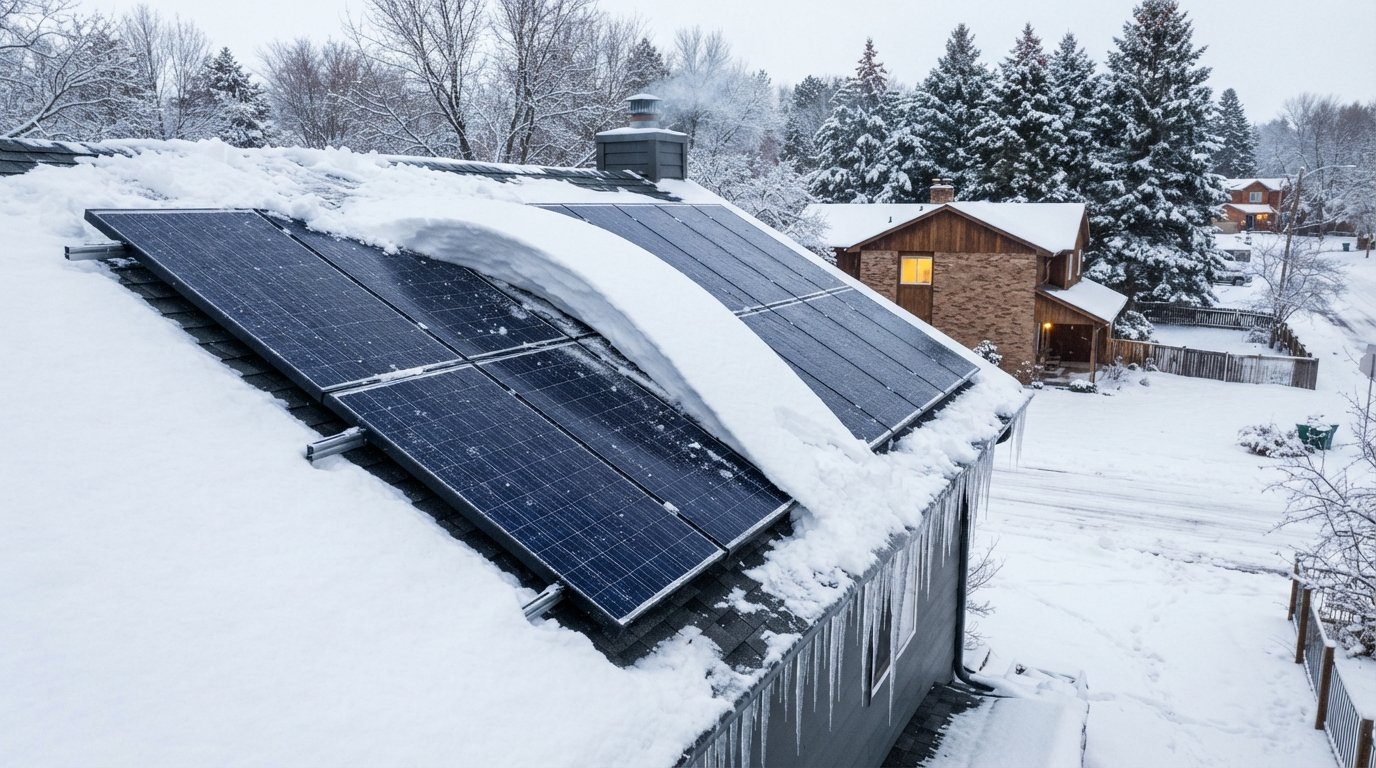
Snow shedding is the process by which accumulated snow slides off a solar array, either on its own or with assistance. It is driven by three main forces: gravity, solar gain, and surface friction. Solar panels are mounted at an angle, typically between 15 and 40 degrees for residential roofs, and that tilt encourages snow to slide. When sunlight hits the dark surface of the panels, even through clouds, the glass warms slightly. That warmth melts the bottom layer of snow, creating a thin film of water that lubricates the interface between snow and glass. Once the bond weakens, gravity takes over and the snow mass slides off in sheets or chunks.
Several factors accelerate or inhibit this process. Dark-colored frames and backsheets absorb more heat and speed melting. A smooth, hydrophobic coating on the glass reduces friction and helps snow release faster. Roof pitch matters enormously: a 40-degree roof sheds snow far more readily than a 15-degree roof. Wind can also help by undercutting the snowpack and pushing it off the edge. On the flip side, ice dams, freezing rain, and repeated freeze-thaw cycles can lock snow in place for weeks. If your roof has dormers, chimneys, or other obstructions that cast shadows, those shaded sections may stay snow-covered long after the rest of the array has cleared.
Ground-mounted systems and adjustable-tilt racks often shed snow better than roof-mounted arrays because they can be set to a steeper winter angle. Many installers recommend increasing the tilt to 45 degrees or more in snowy regions specifically to promote shedding. If you are planning a new installation, ask your installer about winter tilt optimization. If you already have a system, you may be able to adjust the tilt manually on certain racking products. The goal is to let physics do the work so you do not have to climb onto a slippery roof.
When and How to Remove Snow Safely
Most of the time, the best course of action is patience. Solar panels are designed to shed snow naturally, and the vast majority of arrays clear themselves within a day or two of a storm, especially once the sun returns. Trying to remove snow manually introduces real risks: falls from height, electrical hazards, and the potential to scratch or crack the glass. Before you grab a snow rake, consider whether the expected production gain justifies the risk. If a sunny week is forecast and your panels are buried under a foot of snow, a gentle intervention may be worthwhile. If another storm is coming tomorrow, waiting is almost always smarter.
If you do decide to clear snow, follow a strict safety protocol. Never use a metal shovel, ice pick, or any tool that could scratch the glass or damage the frame. Never pour hot water on the panels, because the sudden temperature change can crack the glass or damage the cells. Never stand on the roof if it is icy or if your roof pitch is steep. The safest approach is to use a soft-bristled roof rake with an extendable handle, working from the ground. Push snow gently downward; do not chop or hammer at ice. If ice is bonded to the surface, leave it alone and let the sun melt it. For stubborn cases, a garden hose with lukewarm water can help, but only if outdoor temperatures are above freezing and you can avoid spraying near electrical connections.
Here is a simple decision framework for winter snow removal:
- Less than two inches of dry snow: Leave it. It will likely slide off or melt within hours, and production loss is minimal.
- More than four inches of wet snow and a sunny forecast: Consider gentle removal with a soft roof rake from the ground, but only if you can do so safely.
- Ice or freezing rain: Do not attempt removal. You risk damaging the panels and injuring yourself. Wait for a thaw.
- Steep roof or icy conditions: Do not go on the roof. Call a professional solar maintenance provider if production loss is severe.
After any removal effort, inspect the panels from the ground for cracks, chipped glass, or displaced frames. If you notice damage, contact your installer promptly. Many solar monitoring apps will alert you to sudden production drops, which can help you distinguish between snow cover and a genuine equipment fault.
Winter Production: What to Expect Month by Month
Winter solar production varies widely by latitude, local weather patterns, and system design. In northern states like Minnesota or Maine, December and January can see production drop to 30 to 50 percent of summer peaks, even with regular snow shedding. In mid-Atlantic states like Pennsylvania or Virginia, winter output may be 50 to 70 percent of summer levels. In southern states like Georgia or Texas, winter production often remains above 70 percent of summer peaks because snow is rare and daylight hours are longer. The National Renewable Energy Laboratory and independent monitoring studies consistently show that annual snow losses in snowy climates range from 1 to 5 percent of total yearly production for systems that shed naturally, and up to 10 percent or more for systems that remain covered for extended periods.
It helps to think in terms of monthly energy budgets rather than daily snapshots. A homeowner in Vermont with a 10 kW system might see 1,200 kWh in July but only 400 kWh in December. That is a normal seasonal swing, not a malfunction. Your utility bill will reflect this pattern, which is why net metering and annualized billing cycles are so important. If your utility trues up your account once a year, summer credits can offset winter consumption. If your utility bills monthly, you may see higher winter bills even with a well-performing solar array. Understanding your specific utility's rate structure is essential for accurate financial planning.
Battery storage can help smooth winter variability, but it is not a cure-all. A typical home battery holds enough energy for a few hours to a day of essential loads, not weeks of low production. If winter energy independence is a priority, you may need a larger battery bank, a backup generator, or a grid connection as a fallback. For most homeowners, the grid remains the most cost-effective winter backup, and solar plus net metering delivers the best financial outcome. If you want to explore how solar fits into your overall energy strategy, including financing and incentives, a trusted educational resource like NewSolarQuotes can help you compare options and understand the numbers before you commit.
Maximizing Winter Output: Design and Maintenance Tips
The best way to protect winter production is to design for it from the start. If you are still in the planning phase, ask your installer about tilt angle, row spacing, and module-level power electronics. A steeper tilt promotes snow shedding. Wider row spacing reduces inter-row shading when the sun is low in the sky. Microinverters or optimizers ensure that partial snow cover on one panel does not drag down the entire array. In snowy regions, some installers recommend adding a few extra panels to compensate for winter losses, a practice known as oversizing. This can improve annual yield without significantly increasing cost.
For existing systems, regular maintenance pays dividends. Before winter arrives, clear gutters and downspouts so melting snow has somewhere to go. Trim tree branches that could cast shadows or drop debris onto the array. Check that your monitoring system is online and sending alerts. If your panels have a hydrophobic coating, avoid abrasive cleaning that could wear it away. After a major storm, visually inspect the array from the ground and note any areas where snow lingers unusually long. Persistent snow pockets may indicate a shading issue or a panel that is not warming up as expected.
It is also worth reviewing your homeowner's insurance policy to confirm that snow load damage is covered. Most standard policies include weight of ice and snow coverage, but limits and deductibles vary. If you live in an area with extreme snow loads, you may need a rider or a separate endorsement. Document your system's installation and maintenance history, because insurers may ask for proof of proper upkeep if you file a claim. For a broader look at protecting your solar investment from all types of failures, including snow-related stress, review this resource on what happens when solar panels fail.
Frequently Asked Questions About Snow and Winter Solar
Do solar panels stop working completely when covered in snow?
No. Even a thin layer of snow allows some diffuse light to reach the cells, and partial snow cover often leaves some panels fully exposed. Production may drop significantly, but it rarely goes to absolute zero unless the array is completely buried under heavy, wet snow for an extended period.
Can I use a roof rake on my solar panels?
Only a soft-bristled roof rake designed for solar panels, and only from the ground. Never use a metal shovel, ice pick, or pressure washer. If you cannot reach the panels safely from the ground, hire a professional. The risk of damaging the glass or falling off the roof outweighs the benefit of a few extra kilowatt-hours.
How much does snow cost me in lost production?
In snowy climates, annual snow losses typically range from 1 to 5 percent of total production for systems that shed naturally. If snow remains on the panels for weeks at a time, losses can reach 10 percent or more. The exact figure depends on your location, roof pitch, and how quickly snow slides off.
Do I need a battery to get through winter?
Not necessarily. Most grid-tied solar systems rely on net metering to bank summer credits for winter use. A battery can provide backup power during outages and help you use more of your own solar energy, but it is not required to keep the lights on in winter. Evaluate your goals and budget before adding storage.
Will snow damage my solar panels?
Solar panels are engineered to withstand significant snow loads, typically 30 to 50 pounds per square foot or more, depending on the model. However, extreme accumulation, ice dams, or falling ice from a higher roof can cause damage. Regular inspection and proper installation are your best defenses.
Winter does not have to be a lost season for solar. With the right design, a little patience, and a clear understanding of how snow sheds from your panels, you can keep production flowing and protect your investment for years to come. If you are still shopping for a solar system or want to compare quotes from reputable installers, start by gathering free, no-obligation estimates so you can make an informed decision before the next snowflake falls.