
Home EV Charging: Costs, Installation, and Savings
Learn how home EV charging cuts fuel costs, boosts convenience, and pairs with solar for maximum savings. Get expert installation tips and incentives.

By Caleb Morgan
Learn more about Wiring Installation for guides, costs, and what to expect.
Compare Wiring Installation Pros Near You

Enter your ZIP code to compare top-rated local professionals and request free quotes.
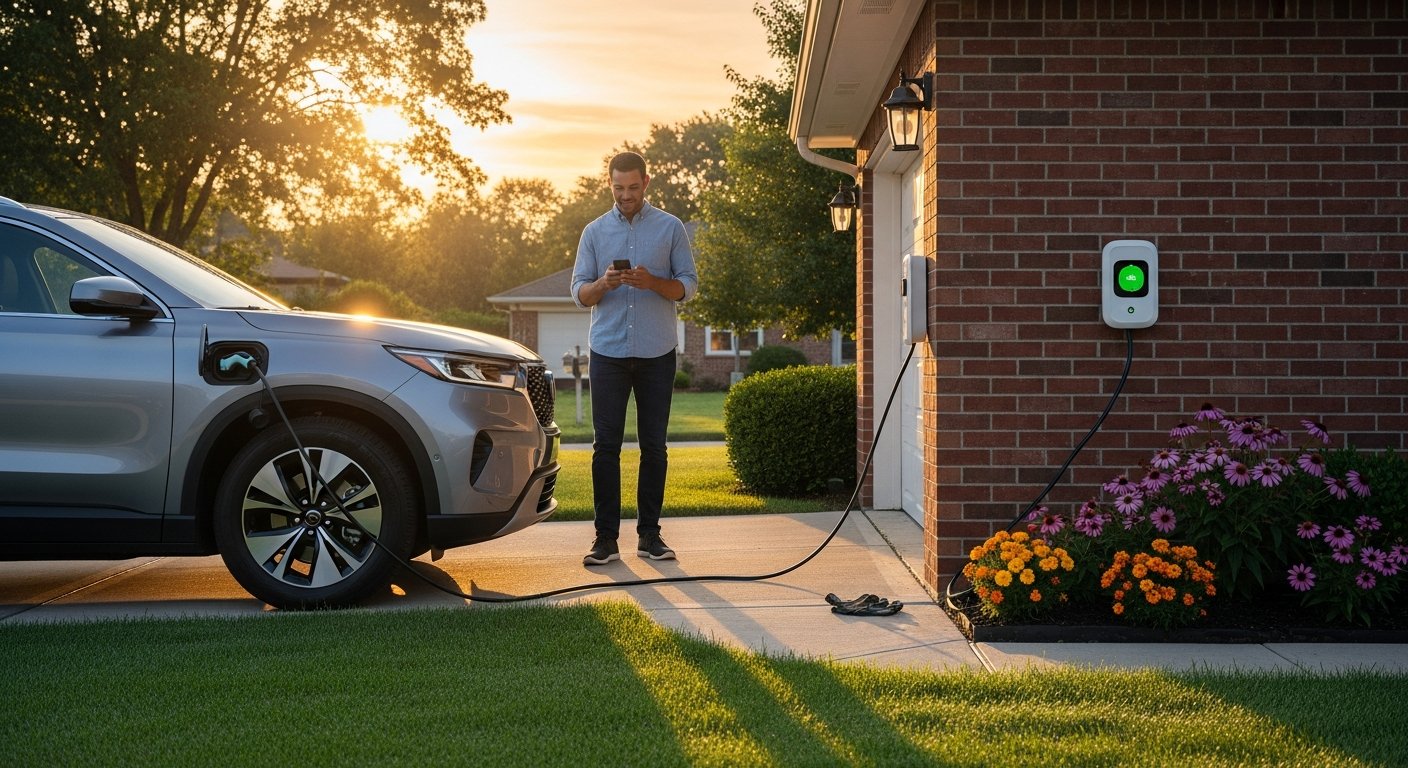
Imagine waking up every morning to a fully charged electric vehicle, ready for your commute, without ever stopping at a gas station or public charging port. That is the everyday reality for homeowners who install a dedicated home EV charging station. It is convenient, cost-effective, and increasingly essential as electric vehicle adoption grows across the United States. But moving from Level 1 trickle charging to a fast, safe, and smart home setup involves a few key decisions. This guide walks you through everything you need to know about home EV charging, from hardware choices and installation costs to potential savings and solar integration.
Why Home EV Charging Beats Public Charging Every Time
Public charging networks are improving, but they remain a backup option rather than a primary strategy for most EV owners. Home charging offers unmatched convenience. You plug in when you get home, and your car is ready when you leave. No waiting in line, no worrying about station availability, and no paying premium per-kilowatt-hour rates that public fast chargers often demand. Over the course of a year, the difference in cost between home electricity rates and public charging fees can be substantial, especially if you take advantage of time-of-use utility plans that offer lower rates overnight.
Moreover, home charging protects your battery health. Level 2 charging at 240 volts is gentler on your battery than frequent DC fast charging, which generates more heat and can accelerate degradation over time. By making home the primary place you charge, you extend the lifespan of your EV battery and maintain its resale value. For many drivers, the ability to start every day with a full battery also reduces range anxiety, making longer trips and unexpected errands far less stressful.
There is also the financial angle. The cost per mile of driving on electricity is typically one-third to one-half the cost of gasoline, and home charging maximizes that margin. If you pair your home EV charger with a solar panel system, you can drive on sunshine and further insulate yourself from rising electricity and fuel prices. In our guide on solar for new homes evaluation, we explain how solar and EV charging create a powerful combination for long-term savings.
Level 1 vs. Level 2: Which Charger Do You Need?
The first decision is the type of charger. Every EV comes with a portable Level 1 charger that plugs into a standard 120-volt outlet. It adds only about 3 to 5 miles of range per hour, which means a full charge can take 20 hours or more. For plug-in hybrids or drivers with very short commutes, Level 1 might suffice, but for most EV owners, it is painfully slow and impractical as a primary charging method.
Level 2 chargers operate at 240 volts, the same voltage used by electric dryers and ovens. They deliver 20 to 60 miles of range per hour, depending on the charger's amperage and your vehicle's onboard charger. A typical 32-amp or 40-amp Level 2 charger can fully recharge a long-range EV in 6 to 10 hours, which is perfect for overnight charging. These chargers require a dedicated circuit and a professional installation, but they are the standard for home charging.
When choosing a Level 2 charger, consider the following features:
- Amperage rating: A 32-amp charger is sufficient for most EVs, while a 40-amp or 48-amp unit provides faster charging if your electrical panel and vehicle support it.
- Smart features: Wi-Fi connectivity, smartphone apps, and voice control let you schedule charging during off-peak hours, monitor energy usage, and receive notifications.
- Cable length: A longer cable (20 to 25 feet) offers more flexibility in parking configurations and reduces the need for precise alignment.
- Connector type: Most EVs in North America use the J1772 connector, while Tesla drivers need a charger with a Tesla connector or an adapter. Many modern chargers support both.
- Portability: Some units are designed to be portable and can be used at home or carried in the trunk for emergency charging at friends' houses.
These features can make a significant difference in your daily routine. Smart scheduling alone can save you money by aligning charging with lower electricity rates, which we will explore later. While the upfront cost of a smarter charger is higher, the long-term savings and convenience often justify the investment.
Installation Costs: What to Expect and How to Save
The cost of installing a home EV charger varies widely based on your home's electrical infrastructure, the charger's specs, and local labor rates. On average, homeowners spend between $500 and $2,500 for a complete installation. The charger itself typically costs $300 to $1,200, with smart models at the higher end. The labor and materials for installation can range from $200 to $1,500, depending on the complexity.
The biggest cost driver is the condition of your electrical panel. If your panel has spare capacity and is close to your parking area, installation is straightforward and cheaper. If you need a new circuit, a subpanel, or a service upgrade (for example, going from 100-amp to 200-amp service), costs can escalate. In some older homes, a service upgrade is unavoidable and can cost $1,500 to $3,000 on its own.
To minimize costs, get multiple quotes from licensed electricians and ask about any available rebates or incentives. Many utilities offer rebates for installing a Level 2 charger, and some states provide additional incentives. The federal government also offers a tax credit for EV charger installation, currently up to 30% of the cost, capped at $1,000 for residential installations. This credit applies to both the equipment and installation labor, making it a significant discount.
Another way to save is to bundle your EV charger installation with other electrical upgrades, such as solar panel installation. If you are already having an electrician or solar installer at your home, adding a charger circuit may cost less than a separate visit. This is where a comprehensive approach to your home's energy systems pays off, and it ties directly into the solar for new homes evaluation we mentioned earlier, where we detail how to plan for both solar and EV charging from the start.
Maximizing Savings with Time-of-Use Rates and Solar
One of the most effective ways to reduce the cost of home EV charging is to take advantage of time-of-use (TOU) electricity rates. Many utilities offer lower rates during off-peak hours, typically late at night and early morning. By scheduling your EV to charge during these windows, you can cut your electricity cost per kilowatt-hour by 30% to 50% or more. Smart chargers make this effortless, as they can be programmed to start charging automatically at a specific time.
Pairing home EV charging with solar panels takes savings to the next level. Solar panels generate clean electricity during the day, which you can use to power your home and charge your EV. With net metering, excess solar energy sent to the grid earns credits that you can draw on at night to charge your EV at no additional cost. In essence, your car runs on sunshine, making your fuel cost effectively zero.
If you are considering solar but have not yet installed it, the decision to add an EV charger should factor into your system sizing. An EV can add 3,000 to 6,000 kilowatt-hours of annual electricity consumption, depending on your driving habits. Your solar installer can design a system that covers both your household loads and your EV charging needs, ensuring you maximize your return on investment. For a deeper dive into how solar and new construction can be optimized, our solar for new homes evaluation provides a step-by-step framework.
Finally, consider the environmental benefit. According to the U.S. Environmental Protection Agency, transportation accounts for the largest share of greenhouse gas emissions in the country. By charging your EV with solar power, you reduce your carbon footprint dramatically and contribute to a cleaner grid. This aligns with the broader goal of renewable energy adoption that benefits both your wallet and the planet.
Planning for the Future: Smart Charging and Grid Integration
Home EV charging is not static; it is evolving rapidly with new technologies. Smart charging, vehicle-to-grid (V2G), and vehicle-to-home (V2H) systems are emerging, enabling your EV to act as a backup battery for your home during outages. While V2G is still in its infancy, many new EVs and chargers already support bidirectional charging. This capability can turn your car into a mobile power source, potentially earning you money by selling electricity back to the grid during peak demand.
Another trend is the integration of home energy management systems that coordinate your EV charger, solar panels, battery storage, and major appliances. These systems optimize energy usage in real time, shifting loads to maximize solar consumption and minimize grid purchases. For example, during a sunny day, your system might direct excess solar power to your EV charger instead of exporting it to the grid at a lower rate. This dynamic control increases your overall savings and reduces strain on the grid.
When selecting a charger, consider its compatibility with future technologies. Look for models that support OCPP (Open Charge Point Protocol) and have firmware updates. While you may not need V2G today, choosing a charger with that capability can future-proof your investment. Similarly, ensure your electrical panel has room for a future battery storage system if you plan to go off-grid or want backup power.
As the electric grid becomes cleaner with more renewable energy sources, the environmental case for home EV charging strengthens. By charging during times when solar and wind generation are high, you are effectively driving on renewable energy. This is a win for your finances and the environment, and it positions you as a leader in the clean energy transition.
Common Mistakes to Avoid When Setting Up Home Charging
Even with the best intentions, homeowners often make avoidable errors during EV charger installation. Here are the most common pitfalls and how to steer clear of them:
- Underestimating electrical panel capacity: Before buying a charger, have an electrician assess your panel. Upgrading later is costly and time-consuming.
- Choosing the wrong charger amperage: A 32-amp charger may be adequate now, but if you buy a larger EV with a bigger battery later, you might wish you had installed a 48-amp unit. The price difference is small, but the labor cost to swap is significant.
- Ignoring local permits and codes: Some jurisdictions require permits for EV charger installations. Skipping this step can lead to fines and complications when selling your home.
- Not considering cable management: A charger with a messy cable can be a tripping hazard and an eyesore. Plan for a cable hook or a retractable system.
- Failing to claim incentives: Many rebates and tax credits expire or have limited funding. Research what is available in your area and apply promptly.
Avoiding these mistakes will save you money and frustration. If you are unsure about any aspect of the installation, consult a professional electrician who specializes in EV charging. They can guide you through the process, ensure code compliance, and help you take advantage of all available incentives.
Is Home EV Charging Worth It? A Final Verdict
For the vast majority of EV owners, home EV charging is not just a convenience; it is a necessity. The upfront cost of a charger and installation is quickly offset by the savings on fuel and reduced reliance on public charging. With the federal tax credit and utility rebates, the payback period can be as short as one to two years for drivers with average commutes. Over a vehicle's lifetime, the savings can amount to thousands of dollars, not to mention the time saved by not visiting charging stations.
Moreover, home EV charging increases the value of your home. As more buyers seek homes with EV infrastructure, a dedicated charger is a desirable feature that can make your property more attractive. Combined with solar panels, it creates a self-sufficient energy ecosystem that appeals to environmentally conscious buyers.
If you are ready to take the next step, start by getting a free, no-obligation quote from a licensed electrician or a solar installer who can assess your home and recommend the best setup. With careful planning, you can enjoy the ultimate convenience of charging your EV at home while maximizing your financial and environmental returns.