
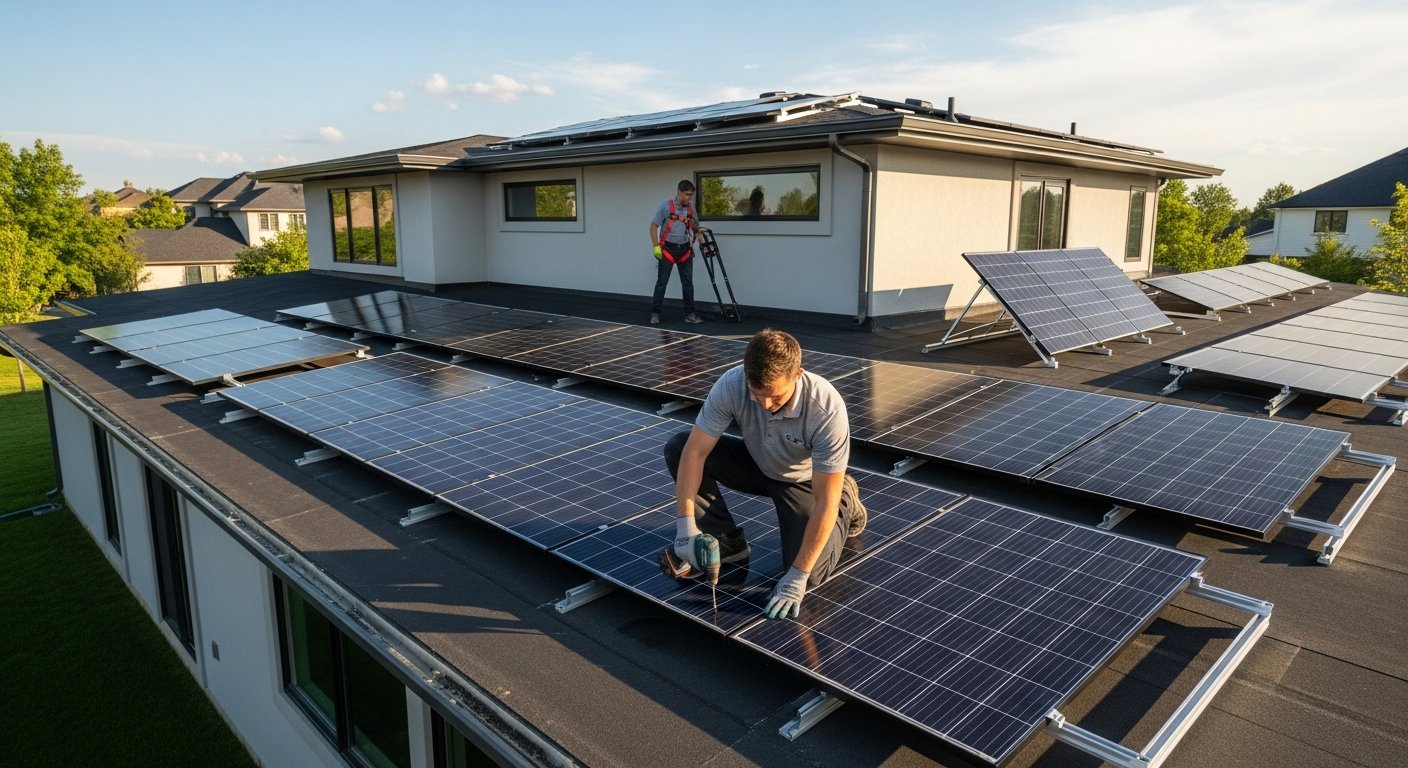
Flat Roof Solar Panels: Complete Guide for Homeowners
Flat roof solar panels are easy to install and can cut your electricity bills. Learn about mounting options, costs, and how to get a free quote.

By Caleb Morgan
Learn more about Solar Panel Installation and Repair for guides, costs, and what to expect.
Compare Solar Panel Installation and Repair Pros Near You

Enter your ZIP code to compare top-rated local professionals and request free quotes.
Flat roofs are no longer a barrier to solar energy. In fact, they can be ideal for photovoltaic (PV) systems, offering flexibility and efficiency that pitched roofs often cannot match. If you are a homeowner with a flat roof, you can harness the sun's power, potentially cut your electricity bills, and increase your property's value. This comprehensive guide walks you through everything you need to know about flat roof solar panels, from installation techniques and costs to maintenance and the best way to get a customized quote.
Why Flat Roofs Are a Good Fit for Solar
Many homeowners assume solar panels require a sloped roof to shed rain and capture maximum sunlight. That is a misconception. Flat roofs provide unique advantages, primarily because of the freedom to position panels at the optimal angle without being constrained by the roof's existing pitch. This means you can achieve near-peak efficiency, often better than what is possible on a sloped roof that faces east or west.
Another benefit is the ease of installation. Without the need for complex roof-penetrating mounts that are common on sloped roofs, installers can use ballasted or low-penetration systems. This reduces the risk of leaks and simplifies the process. Furthermore, a flat roof acts as a natural work platform, which can lower labor costs and safety risks. The visual impact is also less noticeable, as panels can be tilted just a few degrees, making them nearly invisible from the street.
Key Considerations Before Installing
Before you commit to a solar installation, you need to evaluate your roof's condition, the available space, and any local regulations. Start with a thorough roof inspection. A flat roof has a shorter lifespan than a sloped one, often needing replacement every 20 to 25 years. Since solar panels are designed to last 25 to 30 years, it is wise to repair or replace your roof before installation, not after. This avoids the costly process of removing and reinstalling panels later.
Next, assess the amount of unobstructed space. You will need roughly 100 square feet of roof area for every 1 kW of solar capacity. A typical home may require 300 to 800 square feet, depending on your energy consumption and the efficiency of the panels you choose. Shading from nearby trees, chimneys, or parapet walls can significantly reduce output, so consider whether any obstructions can be trimmed or if panels can be placed to minimize shade.
Finally, check your local building codes and homeowners association (HOA) rules. Some municipalities require a fire setback path on the roof, which dictates where panels can be placed. Your solar installer should handle permitting, but you need to be aware of any restrictions that could affect your system's size or design.
Mounting Systems for Flat Roof Solar Panels
Choosing the right mounting system is critical for the long-term performance and safety of your flat roof solar array. There are three main types: ballasted, penetrating, and hybrid systems. Each has its own advantages and is suited for different roof types and wind conditions.
Ballasted systems rely on the weight of the panels and concrete blocks to hold them in place. They do not penetrate the roof membrane, which minimizes the risk of leaks and makes them a popular choice for commercial buildings. However, they add significant weight, often 5 to 10 pounds per square foot, so your roof structure must be able to support it. They also may not be suitable in high-wind areas unless additional anchoring is used.
Penetrating systems use metal brackets that are bolted directly to the roof structure. These are lighter than ballasted systems and offer superior wind resistance. The downside is that every penetration creates a potential leak point, so the flashing and sealing must be done meticulously. This is often the preferred choice for residential flat roofs where weight is a concern.
Hybrid systems combine both methods, using ballasted blocks for some panels and penetrating mounts for others, often at the perimeter. This balances wind resistance with reduced roof penetrations. Your installer will recommend the best approach based on your roof's condition, local wind speeds, and the type of flat roof you have.
Ballasted vs. Penetrating: Which Is Better for Your Home?
The decision often comes down to roof type. If you have a modern TPO, PVC, or EPDM membrane roof, a ballasted system is attractive because it preserves the membrane's integrity. If you have a built-up roof or a concrete deck, a penetrating system might be easier and more secure. Always get a structural assessment from a qualified engineer, especially if you are considering ballasted systems.
Maximizing Efficiency: Tilt, Orientation, and Spacing
Unlike sloped roofs, where panels are typically mounted parallel to the roof surface, flat roof panels are installed on racks that tilt them toward the sun. The optimal tilt angle in the United States generally equals your latitude, but a compromise of 10 to 20 degrees is common for flat roofs to reduce wind uplift and maximize spacing. This slight tilt also allows rainwater to wash away dust and debris naturally.
Orientation is also flexible. South-facing panels capture the most total energy over the year, but east- and west-facing panels can be valuable if you want to match your energy use pattern, such as using more power in the morning or evening. The spacing between rows is equally important. Panels must be far enough apart to avoid one row shading the next, especially during winter when the sun is lower. This spacing reduces the total capacity you can install but ensures each panel operates at peak performance.
To get the most out of your flat roof, many homeowners now pair solar panels with battery storage. This allows you to store excess energy generated during the day and use it at night, further increasing your energy independence. For more on pairing solar with storage and other upgrades, see our guide on affordable 5K solar panels, which often include battery-ready configurations.
Costs and Financial Incentives
The cost of a flat roof solar system is influenced by the type of mounting system, the number of panels, and the complexity of the installation. On average, residential solar in the U.S. ranges from $2.50 to $3.50 per watt before incentives. For a 6 kW system, that translates to $15,000 to $21,000. Flat roof installations can be slightly more expensive due to the need for specialized racking, but the flexibility in design can also lead to more efficient layouts that offset those costs.
You can significantly reduce the upfront cost with the federal Investment Tax Credit (ITC), which offers a 30% tax credit on the total system cost. Many states, including Texas, Florida, and Arizona, offer additional incentives such as rebates, performance-based incentives, or property tax exemptions. To find what is available in your area, you can use the Database of State Incentives for Renewables & Efficiency (DSIRE) or ask your installer.
Financing options are plentiful, including solar loans, leases, and power purchase agreements (PPAs). A solar loan allows you to own the system and benefit from the ITC, while a lease or PPA lets you go solar with $0 upfront but you do not own the system. For a deeper understanding of how solar loans work and how to choose the right one, we have a detailed article on 360W solar panels, which often come with financing guidance.
Maintenance and Long-Term Performance
Flat roof solar panels are relatively low maintenance, but they do require some attention. The main task is keeping them clean. Since they are installed at a low tilt, they do not self-clean as effectively as steeper systems. Dust, pollen, bird droppings, and leaves can accumulate and reduce efficiency by 5% to 15%. In dry or dusty climates, you may need to clean the panels a few times a year. A simple hose down or a soft brush with soapy water is usually sufficient, but avoid using abrasive materials.
You should also inspect the mounting system and roof membrane annually. Look for signs of wear, loose bolts, or cracks in the sealant. Because flat roofs are prone to ponding water, ensure that the area around the mounts remains clear of debris to prevent water damage. Most solar panels come with a 25-year performance warranty, guaranteeing they will produce at least 80% of their rated output after that time.
Monitoring your system's performance is essential. Many inverters come with built-in monitoring that lets you track daily production. If you notice a sudden drop, it may indicate a panel issue, a shading problem, or a malfunctioning inverter. Early detection can save you from costly repairs later.
Choosing the Right Solar Installer
Not every solar installer is experienced with flat roof installations. It is crucial to choose a company that has a proven track record with your specific roof type. Look for installers who are certified by the North American Board of Certified Energy Practitioners (NABCEP) and who have positive reviews from homeowners with flat roofs.
When getting quotes, ask about the mounting system they recommend and why. Request a structural analysis and a detailed layout plan. Compare warranties not only on the panels but also on the workmanship and the roof integrity. A reputable installer will offer a 10-year workmanship warranty and will coordinate with a roofer if any modifications are needed.
To simplify your search, FreeSolarPowerQuotes connects you with vetted solar providers in your area. By filling out a short form, you can receive up to three free, no-obligation quotes from experienced installers who specialize in flat roof systems. This allows you to compare options and choose the best fit for your home without any pressure.
Environmental Impact and Energy Independence
By installing solar panels on your flat roof, you are not just saving money; you are also reducing your carbon footprint. A typical 6 kW system offsets about 4 to 5 tons of carbon dioxide annually, equivalent to planting 100 trees each year. Over the system's 25-year life, that is a significant contribution to a cleaner environment.
Moreover, solar panels increase your resilience to grid outages and rising electricity rates. With net metering, you can sell excess power back to the grid, earning credits on your utility bill. In many states, these credits are worth the full retail rate, further accelerating your return on investment. As electricity prices continue to climb, your solar system becomes a hedge against future increases, providing predictable energy costs for decades.
Frequently Asked Questions
Will solar panels damage my flat roof? Not if installed correctly. Ballasted systems use no penetrations, while penetrating systems are properly flashed and sealed. The key is choosing an experienced installer and ensuring your roof is in good condition before installation.
How long do flat roof solar panels last? Panels typically last 25 to 30 years, with a 25-year performance warranty. The mounting system can last even longer if maintained. Regular inspections will help extend the life of both your roof and your solar system.
Can I install solar panels on a metal flat roof? Yes, but the installation method may differ. Metal roofs can accommodate both ballasted and penetrating mounts, but the metal gauge must be assessed. A professional installer will determine the best approach.
Is it worth going solar on a flat roof? Absolutely. The flexibility of flat roofs often allows for a more efficient array than a sloped roof, leading to higher energy production and faster payback. You also have the option to adjust the tilt and orientation for maximum performance.
Your Next Steps to Going Solar
Going solar on a flat roof is a smart investment that combines energy savings, environmental stewardship, and increased property value. The process involves careful planning: evaluate your roof, understand your energy needs, choose the right mounting system, and select a qualified installer. By taking these steps, you can enjoy the benefits of solar power without the limitations that come with a sloped roof.
Ready to get started? The easiest way to move forward is to request free quotes from trusted solar installers. They will assess your roof, provide a customized design, and give you a transparent cost estimate. For more information on selecting the right panel size for your home, you might find our article on 440W solar panels helpful, as these higher-wattage panels are becoming popular for both flat and sloped roofs.
Take the first step today: visit FreeSolarPowerQuotes, fill out the simple form, and discover how easy it is to power your home with the sun. With the right guidance, your flat roof can become an asset that pays you back for years to come.