
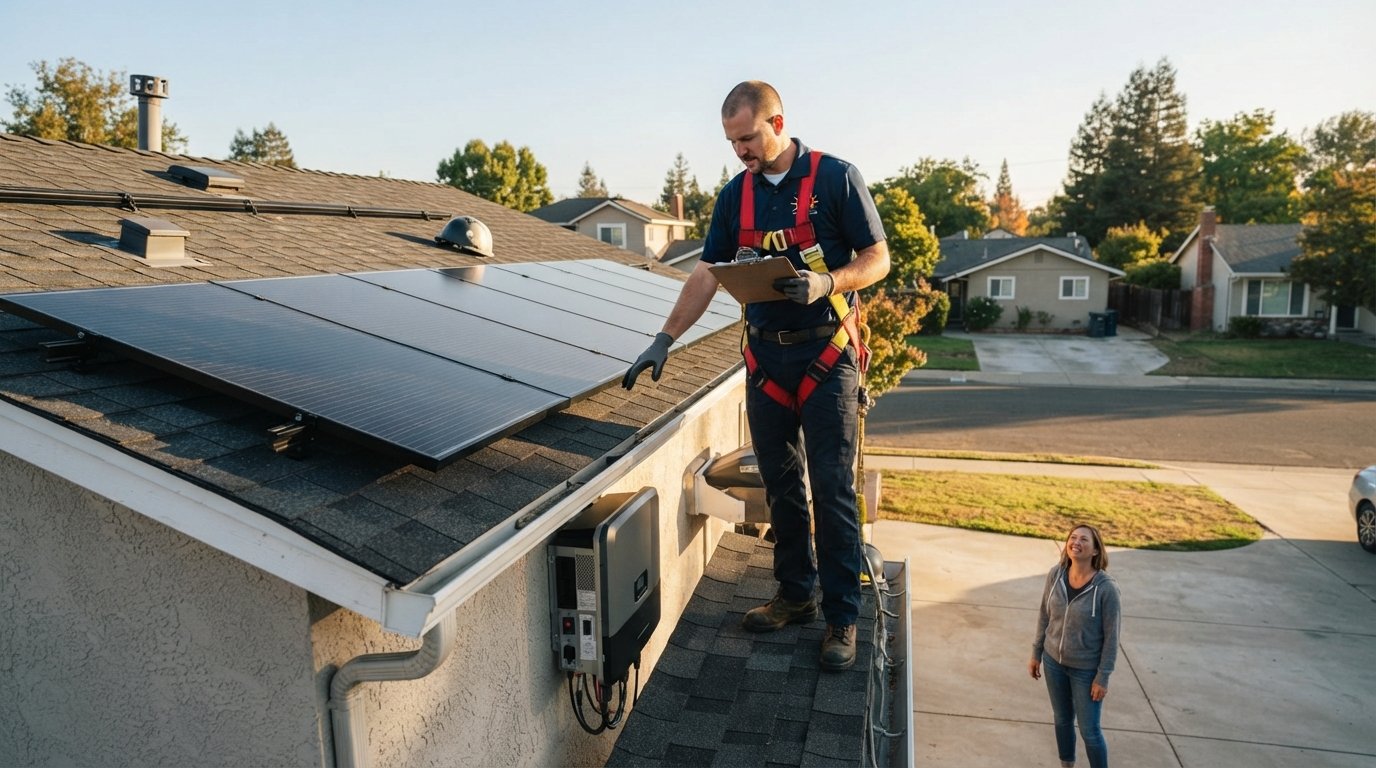
Solar System Warranties: Equipment, Performance, Workmanship
Solar system warranties explained: equipment, performance, and workmanship coverage compared so you avoid surprise repair bills.

By Liam Parker
Learn more about Solar Panel Installation and Repair for guides, costs, and what to expect.
Compare Solar Panel Installation and Repair Pros Near You

Enter your ZIP code to compare top-rated local professionals and request free quotes.
When you sign a solar contract, you are not just buying panels and an inverter. You are buying a stack of promises that stretch across decades, and those promises live inside your warranties. Most homeowners focus on the sticker price and the projected savings, then skim the warranty section in the final minutes of signing. That is a costly mistake. A solar system is a 25 to 30 year investment, and the difference between a strong warranty package and a weak one can mean thousands of dollars in repair bills, lost production, and paperwork headaches down the road. This guide breaks down solar system warranties, equipment, performance, and workmanship explained in plain language, so you know exactly what you are covered for, what you are not, and how to protect your investment from day one.
The Three Pillars of Solar Warranties
Almost every residential solar installation comes with three distinct types of coverage. They are often bundled together in a single contract, which is why so many homeowners treat them as one thing. In reality, each pillar covers a different risk, comes from a different party, and runs on a different clock. Understanding the boundaries between them is the first step toward reading your contract like a professional instead of a spectator.
The first pillar is equipment coverage, which protects the physical hardware against defects and premature failure. The second is performance coverage, which guarantees a minimum level of electricity production over time. The third is workmanship coverage, which protects you against installation errors, roof penetrations, and wiring mistakes made by the crew that put the system together. If any one of these pillars is missing or weak, your overall protection has a hole in it.
Here is a quick way to visualize the three pillars before we go deeper:
- Equipment warranty: Covers manufacturing defects in panels, inverters, and racking.
- Performance warranty: Guarantees your panels will produce at or above a stated output for 25 to 30 years.
- Workmanship warranty: Covers the quality of the installation itself, including labor and roof sealing.
Notice that each pillar is provided by a different entity. Equipment warranties come from manufacturers. Performance warranties also come from manufacturers, usually panel makers. Workmanship warranties come from your installer, which means their financial stability matters as much as their technical skill. When you request quotes through a service like a solar quote request form, you can compare these three layers side by side across multiple installers before you commit, which is far better than trying to decode a single contract in isolation.
Equipment Warranties: What Hardware Coverage Really Means
Equipment warranties are the most straightforward of the three, at least on the surface. They cover defects in materials and workmanship from the factory. If a diode fails inside a panel, if an inverter stops converting DC to AC, or if a racking component corrodes prematurely, the manufacturer is on the hook to repair or replace it. The catch is that the clock starts on the manufacture date, not the installation date, which can shave months or even a year off your effective coverage if your equipment sat in a warehouse before it was installed.
Standard equipment warranty terms vary widely by component. Most Tier 1 solar panels carry a 12 to 25 year product warranty against defects, with premium brands pushing toward 25 years. String inverters typically come with 10 to 12 year warranties, while microinverters and power optimizers often carry 25 years. Racking systems usually land somewhere between 10 and 25 years depending on the manufacturer and the materials used. Battery storage is the outlier: most home batteries carry a 10 year warranty, and some manufacturers tie coverage to a throughput limit measured in megawatt hours rather than a simple calendar.
What most homeowners miss is that equipment warranties cover the part, not the labor to diagnose and replace it. If your inverter fails in year eight, you may get a free replacement unit, but you could pay several hundred dollars for a technician to climb on your roof, remove the old unit, and wire in the new one. Some manufacturers reimburse labor during the first few years, and some do not reimburse it at all. Always ask who pays for labor and shipping before you sign.
Another subtlety: equipment warranties are only as strong as the manufacturer behind them. Solar manufacturers have gone bankrupt before, and when they do, their warranties become worthless paper. This is why sticking with established, bankable brands matters more than chasing the lowest price per watt. A slightly higher upfront cost for a manufacturer with a 20 year track record is often the smarter financial decision over the life of the system.
Performance Warranties: The Production Guarantee
Performance warranties work differently from equipment warranties. Instead of covering a failed part, they guarantee that your panels will produce a minimum percentage of their original rated output over time. Solar panels degrade slowly, and every manufacturer publishes a degradation curve. A typical performance warranty promises no more than 2 percent degradation in year one, then around 0.5 percent per year after that, ending with roughly 85 to 87 percent of original output at year 25. Some premium manufacturers guarantee 92 percent or higher at year 25.
The key distinction is that performance warranties cover gradual underperformance, not sudden failure. If a panel cracks or a junction box fails, that is an equipment warranty claim. If your system simply produces less than the guaranteed curve over a full year, that is a performance warranty claim. Proving a performance claim requires measured data, which is why monitoring systems matter. Without a monitoring platform that logs daily and monthly production, you have no evidence to support a claim.
There is one important limitation: performance warranties typically cover the panels only, not the entire system. If your inverter is undersized, if your panels are shaded by a new tree, or if your system was designed with a suboptimal tilt, the performance warranty will not rescue you. It guarantees panel output under standard test conditions, not real world output from your specific roof. This is why system design quality matters as much as the warranty document itself.
To file a performance warranty claim successfully, you generally need to:
- Document at least 12 months of production data from your monitoring platform.
- Compare actual output against the warranted degradation curve for the same period.
- Rule out external causes such as shading, soiling, or inverter faults.
- Submit a claim through the manufacturer or your installer with the data attached.
Manufacturers rarely pay cash for underperformance. Most will ship replacement panels instead, and you are usually responsible for labor unless your installer offers a labor rider. That is another reason to read the fine print before you assume a performance warranty is a financial safety net.
Workmanship Warranties: The Installer's Promise
Workmanship warranties are the most variable and, in many ways, the most important for the first decade of ownership. They cover the quality of the installation: roof penetrations, flashing, conduit runs, wire management, torque specifications, and the general craftsmanship of the crew that bolted everything together. A workmanship warranty does not cover the equipment itself. It covers the human side of the installation, which is where a surprising number of problems originate.
Industry standard workmanship coverage runs 5 to 10 years, though some installers offer 25 years, and a few offer lifetime coverage on labor. Longer is generally better, but only if the installer will still be in business when you file a claim. Solar installation companies consolidate, rebrand, and close regularly. A 25 year workmanship warranty from a company that might not exist in five years is worth less than a 10 year warranty from a well capitalized regional installer with a long track record.
What does a workmanship warranty actually cover? Common claims include roof leaks around penetration points, loose racking, failed flashing, faulty wiring connections, and inverter mounting failures. What it usually does not cover: damage from extreme weather, homeowner modifications, rodent damage, or pre-existing roof conditions. Some installers also exclude labor for equipment swaps, even if the equipment itself is under warranty, which can leave you paying for the removal and reinstallation of a failed unit.
Before signing, ask your installer three specific questions. First, does the workmanship warranty transfer to a new homeowner if you sell the house? Second, does it cover the labor to remove and reinstall equipment that fails under a manufacturer warranty? Third, is the warranty backed by the company's balance sheet or by a third party insurance product? The answers will tell you more about your real protection than the headline number of years.
How the Warranties Interact and Where Gaps Appear
The real risk in solar ownership is not that one warranty is weak. It is that the three warranties do not overlap cleanly, leaving gaps where no one is responsible. A common example: your inverter fails in year nine. The manufacturer covers the replacement unit under its 10 year equipment warranty. Your installer's workmanship warranty expired in year five. The manufacturer does not cover labor after year five. You now pay a few hundred dollars out of pocket for a job that felt like it should have been free.
Another gap appears at the roof. If a leak develops around a penetration, the workmanship warranty should cover it. But if the leak is caused by a pre-existing roof defect that the installer documented before the job, the claim may be denied. If the leak appears after the workmanship warranty expires, your homeowner's insurance may or may not cover it depending on how the policy treats solar attachments. This is why documenting roof condition before installation and understanding your insurance policy are both part of protecting your investment.
Transferability is the third common gap. Most equipment and performance warranties transfer to a new owner automatically or with a simple notification. Workmanship warranties sometimes do not transfer at all, or they transfer with a fee and a shortened term. If you plan to sell your home within 10 years, transferability is a real financial feature, not a footnote. Buyers and their agents will ask about it during due diligence.
To close these gaps, look for installers who offer a labor rider that matches the equipment warranty term, or who bundle workmanship and equipment labor coverage into a single 25 year package. Some premium installers now offer what is effectively a full system warranty, where one company is responsible for parts, labor, and performance for the entire term. These packages cost more upfront, but they eliminate the finger pointing that can happen when a manufacturer and an installer disagree about who pays.
Reading a Solar Warranty Like a Pro
When you sit down with a solar contract, the warranty section is often buried behind production estimates and financing terms. Do not let it stay buried. Read it with a pen in hand, and highlight every place where the document says "excludes," "does not cover," or "subject to." Those phrases are where your protection shrinks. If a warranty document is shorter than two pages, it is probably thin. If it is written in dense legalese with no plain language summary, ask for clarification in writing.
Compare warranty terms across at least three quotes before you decide. This is where an independent quote matching service helps. Instead of calling installers one by one and trying to remember who said what, you can request multiple quotes at once and compare the warranty packages side by side. FreeSolarPowerQuotes connects homeowners with vetted local installers and provides educational resources so you can evaluate those quotes on equal footing. You can also explore broader guidance on federal incentives and system sizing through independent resources like NewSolarQuotes, which publishes cost calculators and savings analysis for US homeowners.
A practical checklist for evaluating any warranty package:
- Who provides each warranty (manufacturer, installer, or third party) and how long has that entity been in business?
- Does the equipment warranty cover labor, shipping, and diagnostics, or just the replacement part?
- Is the performance warranty based on panel output only, or does it account for real world system losses?
- Does the workmanship warranty transfer to a new homeowner, and does it cover roof penetrations explicitly?
- Are there exclusions for weather, rodents, shading, or homeowner modifications that could void coverage?
Once you have answers to those questions, you can assign a rough dollar value to each warranty. A 25 year workmanship warranty from a stable installer might be worth several thousand dollars in avoided future repairs. A performance warranty with a strong degradation curve might be worth more than a slightly cheaper panel with a weaker guarantee. Warranties are not marketing fluff. They are financial instruments, and they should be compared the same way you compare interest rates.
Common Mistakes That Weaken Your Coverage
The most common mistake homeowners make is failing to register their equipment after installation. Many manufacturers require product registration within a set window, often 30 to 60 days, to activate the full warranty term. If you skip that step, you may be left with a shorter default warranty or no coverage at all. Your installer should handle registration, but verify that they did. Ask for a copy of the registration confirmation.
The second mistake is ignoring monitoring. A performance warranty claim is nearly impossible to win without production data. If your monitoring system is offline for months and you do not notice, you lose the evidence you need. Check your monitoring app monthly, and investigate any unexplained drop in production immediately. Small dips often signal larger problems that are cheaper to fix early.
The third mistake is making unauthorized modifications. Adding a third party battery, moving panels, or rewiring a circuit without the original installer's involvement can void your workmanship warranty and sometimes your equipment warranty too. If you want to expand your system later, go through the original installer or a certified professional who can document the work properly. Warranties reward homeowners who keep clean records and avoid do it yourself shortcuts.
Finally, keep every document in one place: the original contract, the warranty certificates, the registration confirmations, the monitoring login credentials, and the contact information for each manufacturer. When something fails in year 12, you do not want to be digging through email archives. A simple folder, physical or digital, can save you hours and hundreds of dollars when you need to file a claim.
Frequently Asked Questions
How long do solar warranties typically last?
Equipment warranties run 10 to 25 years depending on the component, with panels usually at 25 years and inverters at 10 to 12 years. Performance warranties run 25 to 30 years. Workmanship warranties run 5 to 25 years, with 10 years being the most common.
Do solar warranties transfer when I sell my home?
Equipment and performance warranties usually transfer automatically or with a simple notification. Workmanship warranties vary by installer and may not transfer, or may transfer with a fee and shortened term. Always confirm transferability before you sell.
What is not covered by a solar warranty?
Typical exclusions include weather damage, rodent damage, shading from new construction or trees, homeowner modifications, pre-existing roof defects, and labor costs after the labor coverage period ends. Read the exclusions section carefully.
Who pays for labor when equipment fails?
It depends on the warranty. Some manufacturers reimburse labor during the first few years, some do not reimburse it at all, and some installers include a labor rider that covers the full term. Ask specifically who pays for removal, shipping, and reinstallation.
Can I file a performance warranty claim myself?
Yes, but you need production data from your monitoring system and a clear comparison against the warranted degradation curve. Most manufacturers require at least 12 months of data before reviewing a claim.
Solar warranties are not the most exciting part of going solar, but they are the part that determines whether your investment pays off over 25 years or becomes a source of unexpected bills. Take the time to understand equipment, performance, and workmanship coverage before you sign, compare quotes from multiple installers, register your equipment, and keep your records organized. Do those things, and your warranty package will do exactly what it is supposed to do: protect your savings, your roof, and your peace of mind for decades.