
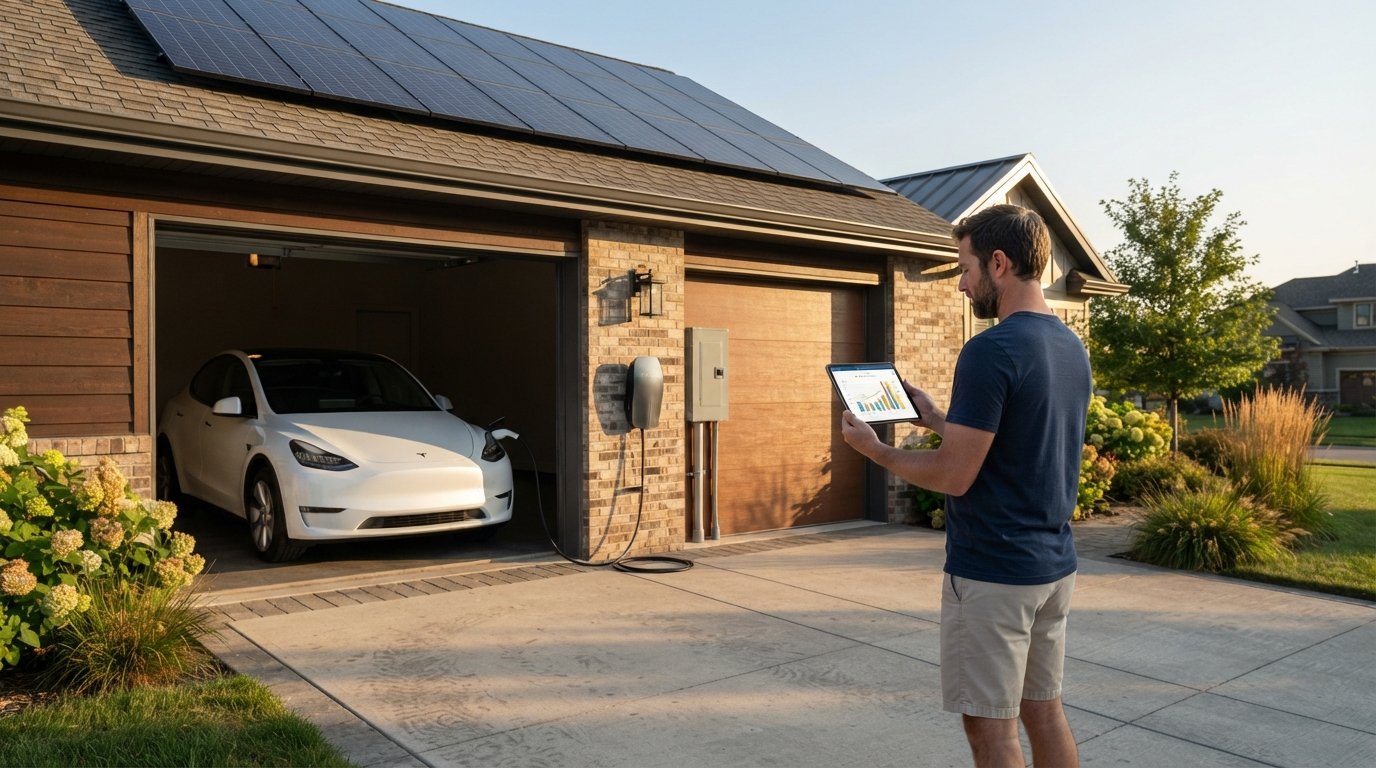
Solar Plus EV Charger Sizing: Panel Count Guide
Size your solar plus EV charger right. Estimate panel count, inverter needs, and charging schedules for real savings. Call (833)-793-7166 for expert help.

By Benjamin Taylor
Learn more about Solar Panel Installation and Repair for guides, costs, and what to expect.
Compare Solar Panel Installation and Repair Pros Near You

Enter your ZIP code to compare top-rated local professionals and request free quotes.
Adding an electric vehicle to your home changes everything about how you use electricity, and if you already have solar panels or are planning to install them, the stakes get even higher. You are no longer just offsetting your refrigerator, air conditioner, and lights; now you are powering a second major energy consumer that can add thousands of miles of driving to your annual electricity demand. The question is no longer whether solar plus an EV charger makes sense, but how many panels you actually need to keep both running without breaking the bank or your roof space. This guide breaks down the sizing math, panel count, inverter considerations, and charging strategies so you can plan with confidence and avoid the costly mistake of undersizing your system.
How Much Extra Solar Capacity Does an EV Charger Need?
The first step in sizing any solar plus EV charger system is to quantify how much electricity your vehicle will consume. Unlike a predictable appliance, an EV's energy use depends entirely on how far you drive, how efficiently your car converts electricity to miles, and how much charging you do at home versus on the road. Start by estimating your annual mileage. The average American driver travels about 13,500 miles per year, but your commute, road trips, and weekend errands will dictate your actual number. Once you have that figure, divide it by your EV's efficiency, typically expressed in miles per kWh. Most modern EVs achieve between 3 and 4 miles per kWh, though larger trucks and SUVs may fall closer to 2.5 miles per kWh.
For a concrete example, assume you drive 12,000 miles per year and your EV gets 3.5 miles per kWh. That works out to roughly 3,429 kWh of electricity needed annually just for driving. If you charge 80 percent of that at home (the rest at work or public stations), your home charging load is about 2,743 kWh per year. That number is the foundation for everything that follows: panel count, inverter size, and even whether your current electrical panel can handle the added load. Without this estimate, any sizing recommendation is just a guess.
It also helps to translate that annual kWh into a daily average. In this example, 2,743 kWh divided by 365 days is about 7.5 kWh per day. That is roughly equivalent to running a central air conditioner for three to four hours, which gives you a sense of how much additional solar capacity you need to add. The daily figure matters because solar production varies by season and weather, and your system must be sized to cover the EV load on an annual basis, not necessarily every single day.
Calculating Panel Count for Your EV's Energy Needs
Once you know your annual EV charging load, you can translate that into additional solar panels. The formula is straightforward: divide the annual kWh needed by the annual kWh produced per panel in your location, then adjust for system losses and shading. A typical residential solar panel in the 400-watt range produces about 500 to 600 kWh per year in a sunny climate like Arizona or Texas, and closer to 400 to 500 kWh in less sunny regions like the Northeast or Pacific Northwest. These figures assume a south-facing roof with minimal shading and a standard inverter setup.
Using the earlier example of 2,743 kWh per year for home EV charging, and assuming 550 kWh per panel annually, you would need about five additional panels to cover the EV load. If you live in a cloudier region where each panel produces 450 kWh per year, you would need closer to six panels. That is a manageable addition for most roofs, but it is important to remember that panel count is only part of the equation. Inverter capacity, electrical panel capacity, and roof space all play a role in whether those panels can actually be installed and whether they will perform as expected.
Here is a quick reference for how many panels different driving profiles might require, assuming 550 kWh per panel per year and 80 percent home charging:
- Low mileage (8,000 miles/year, 3.5 miles/kWh): About 3 to 4 extra panels, or roughly 1,600 kWh annually.
- Average mileage (12,000 miles/year, 3.5 miles/kWh): About 5 extra panels, or roughly 2,750 kWh annually.
- High mileage (18,000 miles/year, 3.0 miles/kWh): About 8 to 9 extra panels, or roughly 4,800 kWh annually.
- Very high mileage or inefficient EV (25,000 miles/year, 2.5 miles/kWh): About 14 to 15 extra panels, or roughly 8,000 kWh annually.
These estimates are a starting point, not a final answer. A professional site assessment will account for your specific roof orientation, local weather patterns, and utility net metering rules, which can change the economics of oversizing or undersizing your system. If you are also considering a ground-mounted array to accommodate the extra panels, our guide on efficient solar panel ground mount solutions explains how to evaluate that option when roof space is tight.
Inverter and Electrical Panel Considerations
Panel count is the most visible part of solar plus EV charger sizing, but the inverter and electrical panel are where many projects run into trouble. Your inverter must be sized to handle the combined output of your solar array and the added load of your EV charger. If you are adding panels to an existing system, you may need to upgrade your inverter or add a second unit, especially if your original inverter was sized close to your pre-EV usage. String inverters, microinverters, and hybrid inverters each have different sizing rules, and your installer will need to confirm that the new configuration stays within the inverter's maximum input and output ratings.
The electrical panel is another common bottleneck. A Level 2 EV charger typically requires a 40 to 60 amp dedicated circuit, which can push an older 100-amp service panel to its limit, especially when you add solar backfeed. Many utilities and local codes require a load calculation to confirm that your panel can safely handle the added demand. If your panel is already near capacity, you may need a service upgrade, which can add several thousand dollars to your project. Planning for this early, ideally before you finalize your solar design, can save you from costly change orders later.
It is also worth thinking about future loads. If you plan to add a heat pump, a hot tub, or a second EV in the next few years, sizing your electrical panel and inverter for those possibilities now is far cheaper than upgrading twice. A licensed electrician can perform a load calculation and recommend the right service size for your long-term plans. For homeowners who want to compare vetted local professionals for this kind of work, Contractor.Homes connects you with pre-screened contractors for solar, electrical, and home improvement projects, which can simplify the process of finding qualified help.
Level 1 vs. Level 2 Charging and Solar Scheduling
The type of charger you install has a direct impact on how much solar capacity you need and how effectively you can use it. Level 1 charging uses a standard 120-volt outlet and adds about 3 to 5 miles of range per hour, which is often enough for low-mileage drivers who charge overnight. Level 2 charging uses a 240-volt circuit and adds 20 to 30 miles of range per hour, making it the better choice for higher-mileage drivers or households with two EVs. From a solar perspective, Level 2 charging gives you more flexibility to schedule charging during peak solar production hours, which maximizes the value of your own generated electricity.
Scheduling is where solar plus EV charger sizing really pays off. If you work from home or have a flexible schedule, you can set your EV to charge during the middle of the day when your solar system is producing at its peak. That reduces the amount of electricity you pull from the grid and can lower your reliance on net metering, which is especially important in areas where export rates are lower than retail rates. Many modern EV chargers and solar inverters offer smart scheduling features that automatically align charging with solar production, and some utilities offer time-of-use rates that make midday charging even more economical.
For drivers who commute and charge mostly at night, the calculus is different. Overnight charging means you are drawing from the grid unless you have a home battery, so the solar panels you add will primarily offset your daytime usage and export surplus to the grid. In that case, the value of your extra panels depends heavily on your utility's net metering policy. Before you finalize your panel count, check your utility's current net metering rules and consider whether a battery would help you shift solar production to nighttime charging. Sizing decisions should always be made with your charging habits and your utility's rate structure in mind.
Incentives and Utility Programs for Home EV Charging
The financial case for solar plus EV charging is stronger than ever, thanks to a mix of federal, state, and utility incentives. The federal Investment Tax Credit (ITC) covers 30 percent of the cost of your solar system, and in many cases, the cost of installing an EV charger can be included if it is part of the same renewable energy project. Some states and utilities offer additional rebates for Level 2 charger installation, and a few offer discounted or off-peak electricity rates for EV charging. These programs vary widely by location and can change from year to year, so always verify current details with official sources before you budget.
Here are some of the most common incentive categories to explore:
- Federal tax credit: 30 percent of solar installation costs, including eligible EV charger expenses when installed as part of the project.
- State rebates: Several states offer cash rebates for Level 2 charger installation, often in the range of $250 to $1,000.
- Utility programs: Many utilities offer discounted charger prices, off-peak EV rates, or rebates for smart chargers that can be scheduled around solar production.
- Net metering policies: These determine how much credit you receive for surplus solar electricity exported to the grid, which affects the value of extra panels.
Because these programs are subject to change and vary by utility and state, the best approach is to confirm your eligibility with your installer and your utility before you commit to a final system size. A well-designed solar plus EV charger system should account for the incentives you qualify for, your charging schedule, and your future energy needs, not just today's panel count.
Putting It All Together: A Practical Sizing Framework
Sizing a solar plus EV charger system is not a single calculation; it is a process of matching your driving habits, your roof and electrical capacity, and your financial goals. Start by estimating your annual EV miles and converting that to kWh, then add that load to your current household usage. From there, calculate the number of panels needed to cover the combined load, adjust for local sun hours and system losses, and confirm that your inverter and electrical panel can handle the new configuration. Finally, factor in your charging schedule and your utility's net metering policy, since those determine how much value you actually capture from the extra panels.
If you are early in the process, it helps to get a professional assessment before you buy. FreeSolarPowerQuotes connects homeowners with reputable third-party solar providers who can review your usage, roof, and electrical setup, and provide free, no-obligation quotes tailored to your EV charging needs. You can also call (833)-793-7166 to speak with a team member about your project. The goal is not to guess at panel count but to design a system that fits your life, your budget, and your long-term energy plans.
Solar plus EV charger sizing and panel count come down to a simple principle: measure your driving, match it with production, and plan for the electrical infrastructure that makes it all work. Get those three pieces right, and you will have a system that powers your home and your car for decades, with fewer surprises and more savings along the way.
Learn more about Solar Panel Installation and Repair for guides, costs, and what to expect.
Compare Solar Panel Installation and Repair Pros Near You
Enter your ZIP code to compare top-rated local professionals and request free quotes.