
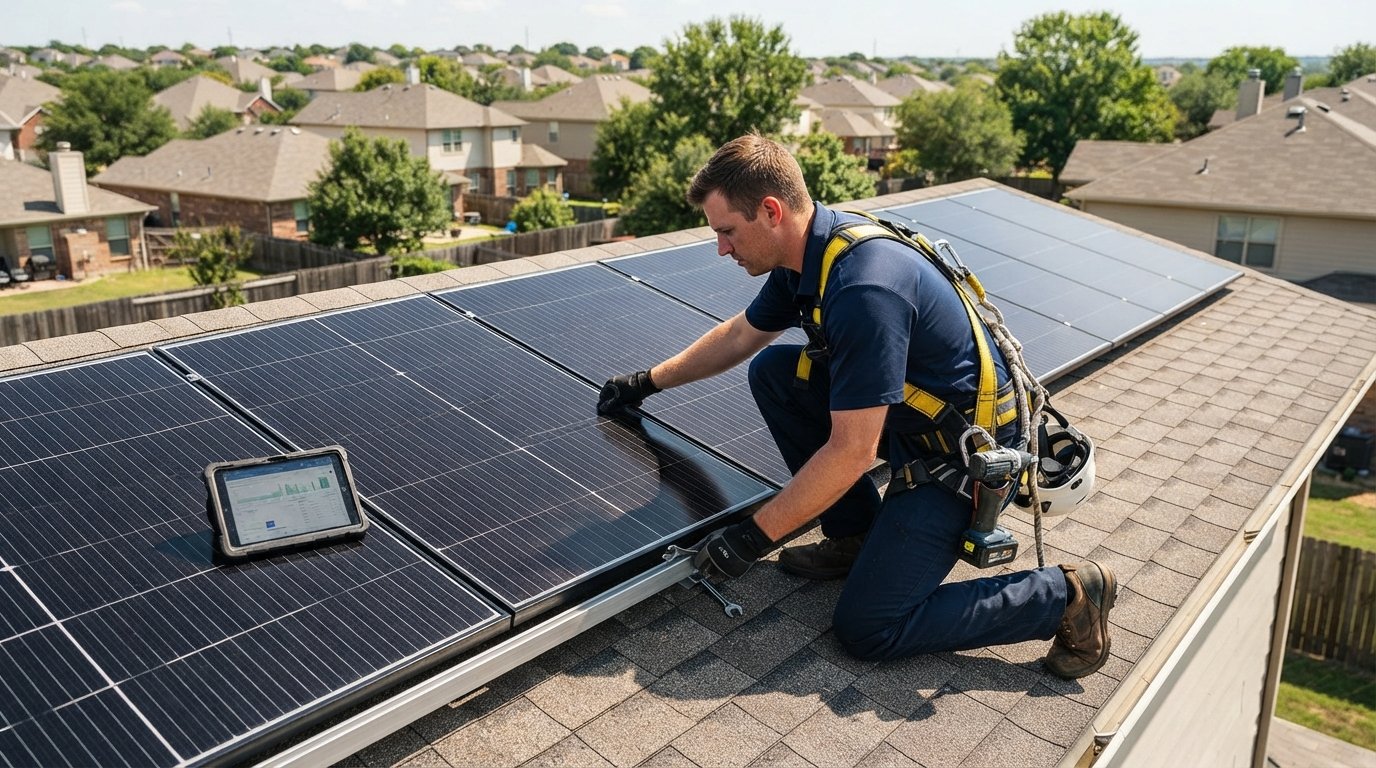
Solar Panel Technology Trends 2026: What to Watch
Solar panel technology trends 2026 what to watch: higher efficiency, smarter batteries, and bifacial panels that can cut your payback period.

By Benjamin Taylor
Learn more about Solar Panel Installation and Repair for guides, costs, and what to expect.
Compare Solar Panel Installation and Repair Pros Near You

Enter your ZIP code to compare top-rated local professionals and request free quotes.
The solar industry is moving faster than most homeowners realize. In 2026, the panels arriving on American rooftops are more efficient, more durable, and more flexible than the models sold just three years ago. If you are planning an installation, or simply watching your neighbors go solar, understanding where the technology is heading can mean the difference between a system that saves you money for decades and one that feels outdated before the warranty expires. This guide breaks down the solar panel technology trends 2026 what to watch, from record-breaking efficiency gains to the quiet revolution in battery storage and smart monitoring. Whether you are in Phoenix, Houston, or Charlotte, the shifts described here will shape your quotes, your payback period, and your long-term energy independence.
Efficiency Records Keep Falling: What It Means for Your Roof
Solar panel efficiency, the percentage of sunlight a panel converts into usable electricity, has climbed steadily for a decade. In 2026, mainstream residential panels routinely hit 22 to 24 percent efficiency, while premium models from manufacturers like Maxeon and REC approach 25 percent. That may sound like a small jump from the 18 to 20 percent panels common in 2020, but the practical impact is significant. A roof that could only fit a 6 kilowatt system five years ago can now host an 8 kilowatt system using the same number of panels. For homeowners with limited roof space or shading issues, that extra capacity often makes the difference between covering 80 percent of a power bill and covering 100 percent.
Behind the scenes, the gains come from better cell architectures. Tunnel oxide passivated contact, or TOPCon, has become the dominant technology for high-efficiency panels in 2026. Interdigitated back contact, or IBC, designs are also gaining ground because they eliminate front-side metal gridlines that block sunlight. Meanwhile, perovskite-silicon tandem cells are moving from laboratory breakthroughs to pilot production. These tandem cells stack two light-absorbing layers to capture more of the solar spectrum, and several manufacturers have announced commercial modules exceeding 28 percent efficiency for specialty applications. For the average homeowner, tandem panels are not yet the default choice, but they signal where the market is heading by 2028 or 2029.
What should you watch in 2026? Pay attention to the efficiency rating on your quotes, but do not chase the highest number at any cost. A slightly less efficient panel from a manufacturer with a strong 25-year warranty and a local service network often delivers better long-term value than a bleeding-edge model with limited support. The real winner in this trend is the homeowner with a small or complicated roof, because higher efficiency means more generating capacity in less space.
Bifacial Panels and Tracking Systems Move Into the Mainstream
Bifacial solar panels, which generate electricity from both the front and back sides, have been common in utility-scale farms for years. In 2026, they are increasingly showing up on residential and commercial rooftops. The concept is simple: light that reflects off a white roof membrane, gravel, or even snow can be captured by the back of the panel, adding 5 to 15 percent more energy production depending on the installation. For ground-mounted systems on reflective surfaces, the gains can be even higher. The catch is that bifacial panels need space behind them to catch that reflected light, so they perform best on elevated mounts or ground arrays rather than flush-mounted rooftops.
At the same time, tracking systems that tilt panels to follow the sun are becoming more affordable and more reliable. Single-axis trackers, which rotate east to west, can boost production by 15 to 25 percent compared to fixed mounts. Historically, trackers were reserved for large commercial projects because of their cost and maintenance needs. In 2026, smaller residential-grade trackers are entering the market, particularly for ground-mounted systems in sunny states like Arizona and Texas. If you have the land and the budget, a tracker paired with bifacial panels can dramatically increase your return on investment.
Here is what to watch: ask your installer whether bifacial panels make sense for your specific roof or ground mount. If your roof is dark asphalt shingles, the reflected light is minimal, and you may not see much benefit. If you have a white TPO roof or a ground mount over light-colored gravel, the numbers can be compelling. Similarly, trackers add moving parts, so weigh the extra production against potential maintenance costs over 25 years.
Battery Storage Becomes Smarter and More Affordable
The biggest story in solar technology for 2026 is not the panel itself but what happens to the electricity after it is generated. Battery storage has shifted from a luxury add-on to a core component of many residential systems. Lithium iron phosphate, or LFP, batteries now dominate the home storage market because they are safer, last longer, and cost less per kilowatt-hour than the nickel manganese cobalt chemistries used in earlier models. In 2026, a typical 10 kilowatt-hour home battery costs 20 to 30 percent less than it did in 2022, and many utilities offer rebates that bring the price down further.
What makes batteries smarter this year is the software. Modern battery systems from Tesla, Enphase, SunPower, and others now use machine learning to predict your home's energy usage patterns and optimize when to charge and discharge. If your utility offers time-of-use rates, the battery can charge from solar during the day and discharge during expensive peak hours, maximizing your savings without any manual input. Some systems can even participate in virtual power plant programs, where the utility pays you to discharge your battery during grid emergencies. That turns your battery from a cost center into a small revenue stream.
For homeowners in states with frequent outages, such as Texas and Florida, the backup power benefit remains the primary motivation. But even in states with stable grids, the financial case for batteries is strengthening. If you are comparing quotes, ask each installer how their battery integrates with your utility's rate structure and whether the system is eligible for any VPP or demand response programs. The right battery can add thousands of dollars in value over its lifetime.
Solar Shingles and Aesthetic Innovations Gain Traction
For years, solar shingles were a niche product with high costs and limited installation networks. In 2026, that is changing. Companies like GAF Energy and CertainTeed have expanded their solar roofing lines, and traditional solar manufacturers are partnering with roofing companies to offer integrated solutions. Solar shingles replace traditional roofing material, so you are paying for a roof and a solar system at the same time. The upfront cost is still higher than rack-mounted panels, but the aesthetic benefit is undeniable: your home looks like it has a normal roof, not a science experiment.
The technology behind solar shingles has also improved. Earlier versions were less efficient than standard panels, but new models are closing the gap. They are also easier to install because they use standard roofing techniques, which means more roofing contractors can offer them without specialized solar training. For homeowners in historic districts or neighborhoods with strict HOA rules, solar shingles are often the only viable option. The trend to watch in 2026 is the expansion of financing options for solar roofs, including loans that bundle the roof and solar into a single payment.
That said, solar shingles are not for everyone. If your roof is relatively new and in good shape, tearing it up to install shingles may not make financial sense. If you need a new roof anyway, however, the math can work in your favor. Talk to your installer about whether a solar roof or a traditional panel system is the better fit for your home's age, orientation, and architectural style.
Smart Monitoring and AI-Driven Optimization
Solar panels are only as good as the system that manages them. In 2026, monitoring platforms have become remarkably sophisticated. Instead of simply showing how much energy you produced, modern apps now diagnose underperformance at the panel level, predict maintenance needs, and even suggest when to schedule a cleaning. Some systems use artificial intelligence to detect anomalies, such as a single panel that is lagging because of debris or a loose connection, and send you an alert before the issue costs you significant production.
This matters because most solar systems lose 5 to 10 percent of their potential output over time due to unnoticed issues. A dirty panel, a shaded cell, or a failing microinverter can quietly erode your savings. AI-driven monitoring catches these problems early, often before you would notice a change in your utility bill. Many installers now include lifetime monitoring in their quotes, and some offer performance guarantees that pay you back if production falls below a certain threshold.
When you evaluate quotes, ask about the monitoring platform. Does it provide panel-level data? Does it integrate with your battery and EV charger? Can it alert you to issues automatically? A strong monitoring system is not a gimmick; it is a tool that protects your investment. If you want to estimate how much a well-monitored system could save you, a solar installation estimate request can lower your bills by connecting you with installers who offer transparent performance data.
Perovskite Tandems and the Next Efficiency Leap
While TOPCon and IBC panels dominate today's market, perovskite-silicon tandem cells are the most anticipated breakthrough in solar technology. Perovskites are a class of materials that can be tuned to absorb different wavelengths of light than silicon, and when stacked on top of a silicon cell, they can push efficiency beyond 30 percent in laboratory settings. In 2026, several manufacturers are piloting tandem modules for commercial and utility applications, with residential products expected in the next two to three years.
The challenge is durability. Perovskite materials are sensitive to moisture and heat, and early prototypes degraded faster than silicon panels. Researchers have made significant progress in encapsulation and stabilization, but the industry is still working to prove that tandem panels can last 25 years on a rooftop. When they do arrive in volume, they will likely command a premium price at first, similar to how high-efficiency panels did a decade ago. For now, the smart move is to watch this space but not wait for it. If you need solar in 2026, today's panels are already efficient enough to deliver strong returns.
For those who want to stay informed about emerging technologies and how they affect pricing and incentives, resources like SolarEnergy.ai provide ongoing analysis and tools that can help you compare options as the market evolves.
Financing and Incentives Shape Which Trends Matter to You
Technology trends do not exist in a vacuum. The 30 percent federal Investment Tax Credit remains in place for 2026, and many states offer additional rebates, tax exemptions, and net metering policies that dramatically affect your payback period. The trends that matter most to you depend on your financing approach. If you are paying cash, high-efficiency panels and batteries offer the best long-term return. If you are leasing or signing a power purchase agreement, the installer typically owns the equipment, so the latest technology may not be available to you at the same price point.
Here is a quick framework for deciding which 2026 trends to prioritize based on your situation:
- Limited roof space or heavy shading: Prioritize high-efficiency panels and microinverters to maximize production per square foot.
- Frequent power outages: Invest in a battery storage system with backup capability, and check for utility VPP incentives.
- Ground mount with open land: Consider bifacial panels and a tracking system to boost production by 20 percent or more.
- New roof needed soon: Evaluate solar shingles or a solar roof to bundle costs and improve aesthetics.
- Time-of-use rates: Pair solar with a smart battery that shifts energy to peak hours for maximum savings.
No matter which path you choose, the most important step is getting multiple quotes from reputable installers who can explain how these trends apply to your specific home. The solar panel technology trends 2026 what to watch are not just abstract ideas; they are the levers that determine how quickly your system pays for itself and how much control you have over your energy future. Take the time to understand them, ask the right questions, and choose a system that fits your roof, your budget, and your goals for the next 25 years.