
Solar Installation on Steep Roof Safety and Challenges
Steep roofs add safety risks and cost to solar projects. Learn how installers manage pitch, fall protection, and mounting challenges.

By Liam Parker
Learn more about Solar Panel Installation and Repair for guides, costs, and what to expect.
Compare Solar Panel Installation and Repair Pros Near You

Enter your ZIP code to compare top-rated local professionals and request free quotes.
A steep roof can turn a straightforward solar project into a high-stakes balancing act. Whether you own a Victorian home with a 12/12 pitch or a mountain cabin with an even sharper slope, the angle that gives your property character also introduces real risks for installers and real cost implications for you. Understanding the safety protocols and logistical hurdles behind solar installation on steep roof safety and challenges helps you ask better questions, vet contractors more effectively, and avoid nasty surprises on installation day.
Why Steep Roofs Change the Solar Equation
Roof pitch is measured as the ratio of vertical rise to horizontal run. A 4/12 roof rises 4 inches for every 12 inches of horizontal distance, which most crews consider walkable. Once you cross 6/12, and especially beyond 8/12, standard safety equipment and techniques no longer suffice. Steep roofs demand specialized fall protection, different anchoring methods, and often additional labor hours. The Occupational Safety and Health Administration (OSHA) classifies roofs with a pitch greater than 4/12 as steep and requires fall protection for any work at heights above 6 feet in construction. That regulation alone reshapes how installers plan your project.
The challenges multiply when you factor in roof material. Asphalt shingles, clay tiles, metal standing seam, and composite shakes each react differently to foot traffic and mounting hardware. On a steep roof, gravity constantly pulls tools, panels, and people downward, so every piece of equipment must be tethered or secured. Installers also face reduced traction, awkward body mechanics, and longer setup times. These factors translate directly into higher labor costs and longer project timelines, which is why some solar companies either decline steep-roof jobs or quote significantly higher prices.
For homeowners, the key takeaway is that a steep roof is not an automatic dealbreaker. Many steep-roof installations succeed beautifully and produce excellent energy yields because the angle often aligns well with the sun. The critical variable is whether your installer has the training, equipment, and experience to handle the job safely. If you are still weighing whether solar makes sense for your property, our guide on tile roof solar installation covers material-specific considerations that pair closely with pitch-related planning.
Core Safety Risks on Steep Roofs
Falls remain the leading cause of serious injury and death in the construction industry, and steep-roof solar work sits squarely in the danger zone. Installers must navigate three primary hazard categories: fall hazards, material-handling hazards, and electrical hazards. Each requires distinct mitigation strategies.
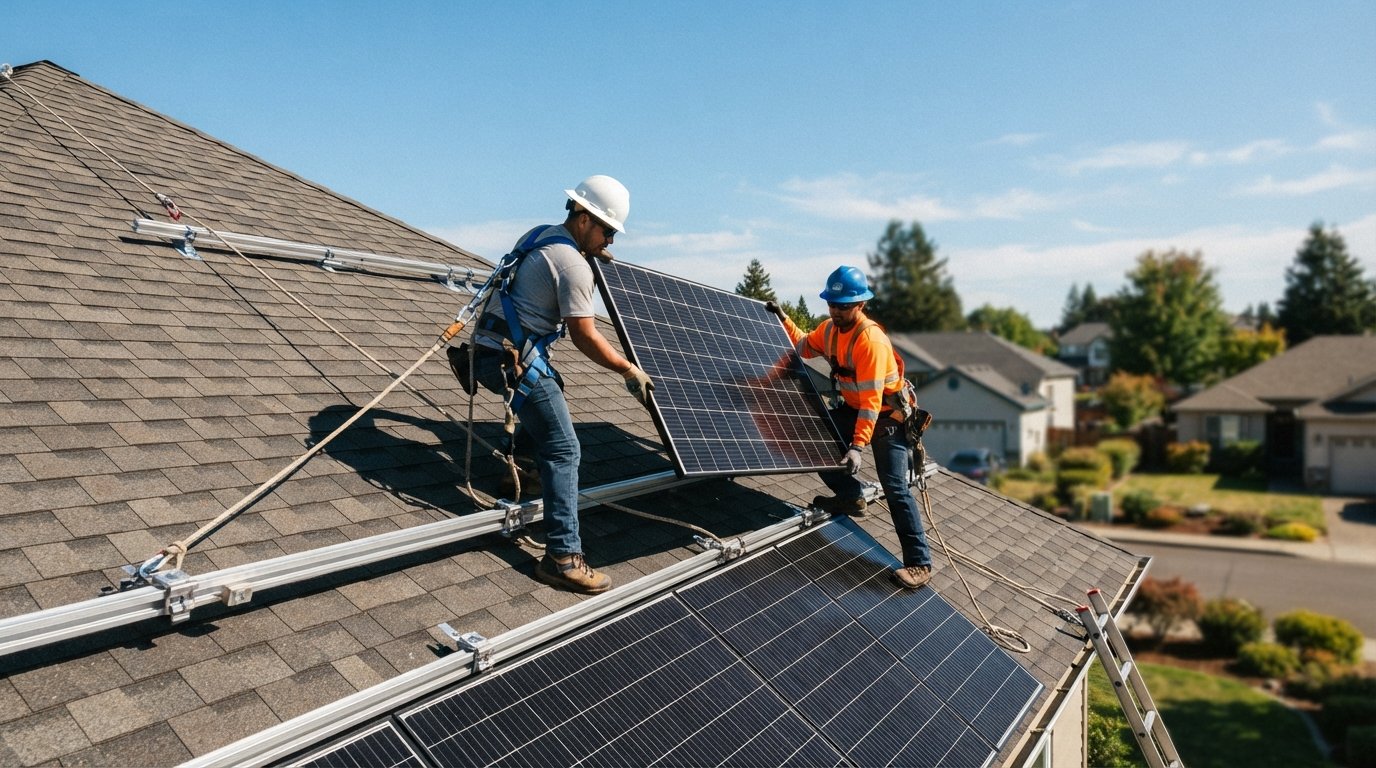
Fall hazards are the most obvious. On a steep pitch, a slip can become a slide and then a freefall within seconds. OSHA-compliant fall protection typically includes personal fall arrest systems (PFAS), guardrails, safety nets, or a combination. A PFAS consists of a full-body harness, a shock-absorbing lanyard, and an anchor point rated to at least 5,000 pounds. On steep roofs, anchor points must be installed before workers step onto the surface, which adds prep time and cost.
Material-handling hazards involve panels, rails, and tools sliding down the slope. A single solar panel can weigh 40 to 50 pounds, and a bundle of mounting rails can exceed 100 pounds. On a steep roof, these items become projectiles if dropped. Crews use rope-and-pulley systems, roof carts with brakes, and staging areas at the ridge to control movement. Some teams build temporary toe boards or cleats to create footholds and prevent tools from sliding off the edge.
Electrical hazards are amplified on steep roofs because workers may be in awkward positions while handling live wiring. DC circuits from solar panels can carry high voltage, and arc faults or ground faults pose fire and shock risks. Proper lockout/tagout procedures, insulated tools, and thorough training are non-negotiable. The following list summarizes the primary safety controls that reputable installers deploy on steep pitches:
- Personal fall arrest systems with anchored harnesses and shock absorbers
- Roof jacks and staging platforms to create level working surfaces
- Rope-and-pulley or hoist systems for lifting panels and equipment
- Non-slip footwear and roof cleats for improved traction
- Electrical safety protocols including insulated gloves and arc-fault protection
Beyond equipment, crew training and communication matter enormously. A team that has worked together on steep roofs develops the muscle memory and trust needed to move safely. Ask your installer how many steep-roof projects they complete annually and whether their crew holds relevant certifications such as OSHA 10 or OSHA 30. A contractor who hesitates or gives vague answers may not be the right fit for your home.
How Steep Pitch Affects Mounting and Layout
Mounting hardware must accommodate both the roof angle and the roof material. Standard flush-mount rails work on most pitches, but steep roofs may require additional standoffs or tilted mounting systems to optimize panel angle. Interestingly, a steep roof often provides a near-ideal tilt for solar production, especially in northern latitudes. The trade-off is that panels mounted on steep slopes can be harder to clean and may accumulate more debris at the bottom edge.
Layout also becomes more complex. On a low-slope roof, installers can walk freely and adjust panel positions easily. On a steep roof, every movement is deliberate, and repositioning a panel mid-installation is time-consuming and risky. Crews often pre-assemble rail sections and panel groups on the ground or on a staging platform before lifting them into place. This prefabrication reduces time on the steep surface and lowers exposure to fall hazards.
Setbacks and clearances deserve extra attention. Fire codes in many jurisdictions require a 3-foot setback from roof edges and ridges to allow emergency access. On a steep roof, these setbacks can consume a significant portion of usable area, limiting system size. Your installer should calculate usable square footage carefully and explain any trade-offs between code compliance and energy production. If your roof also has dormers, valleys, or chimneys, the complexity increases further. In some cases, ground-mounted or carport systems may deliver better returns than forcing panels onto a difficult roof.
Cost and Timeline Implications
Steep-roof solar installations typically cost 10 to 30 percent more than comparable low-slope projects. The premium covers additional labor hours, specialized safety equipment, and sometimes engineering reviews. On a 10-kilowatt system that might cost $25,000 on a walkable roof, the steep-roof version could run $28,000 to $32,000 before incentives. The federal Investment Tax Credit (ITC) currently covers 30 percent of the total project cost, which softens the impact, but you should still budget for the premium.
Timelines stretch as well. A one-day install on a low-slope roof might become a two- or three-day project on a steep pitch. Weather delays hit harder because crews cannot safely work on wet or icy steep surfaces. Scheduling flexibility helps: if you can wait for a dry stretch in spring or fall, you reduce the risk of repeated rescheduling.
Financing options can offset the higher upfront cost. Solar loans, leases, and power purchase agreements (PPAs) spread payments over time, and some lenders offer specific products for complex installations. Comparing multiple quotes remains the single most effective way to find a fair price. An independent resource like NewSolarQuotes can help you gather and compare offers from vetted providers, which is especially valuable when your project falls outside the cookie-cutter category.
Choosing the Right Installer for a Steep Roof
Not every solar company has the appetite or expertise for steep-roof work. When vetting contractors, prioritize experience over the lowest bid. A cheap quote from a crew that rarely handles steep pitches can lead to safety shortcuts, roof damage, or leaks that cost far more than the savings. Ask directly about their steep-roof portfolio, safety record, and insurance coverage.
Verification steps matter. Request proof of general liability insurance and workers compensation coverage. Check licensing through your state contractor board. Ask for references from at least two steep-roof customers and follow up with those homeowners. A reputable installer will welcome these questions because they know that transparency builds trust.
Contract terms deserve close reading. Look for language that specifies who handles roof repairs if damage occurs, how leaks are addressed, and what warranties cover workmanship versus equipment. A strong workmanship warranty of 10 years or more signals confidence. Also confirm that the installer will pull all necessary permits and schedule inspections, because steep-roof projects sometimes trigger additional structural reviews.
Finally, consider the crew size. Steep-roof jobs often require more workers to manage safety lines, stage materials, and rotate tasks. A two-person crew may struggle to maintain safety standards on a steep pitch, while a four- or five-person team can divide responsibilities effectively. Ask how many workers will be on site and whether a dedicated safety monitor will be present.
When a Steep Roof Might Not Be Worth It
In some situations, the numbers simply do not work. If your steep roof is small, heavily shaded, or in poor condition, the cost of reinforcement and safety measures may outweigh the energy benefits. Aging roofs are a particular concern: installing solar on a roof that needs replacement within a few years means paying for removal and reinstallation later. Address roof condition first.
Alternative configurations can capture solar value without the steep-roof premium. Ground-mounted arrays work well on properties with open land, and they are easier to maintain and expand. Solar carports or pergolas offer dual-purpose structures that shade vehicles or patios while generating power. Community solar programs let you subscribe to a shared array and receive credits on your utility bill without any roof work at all.
If you decide to proceed with a steep-roof installation, get at least three quotes and compare not just price but also safety plans, timelines, and warranty terms. The lowest bid is rarely the best value when safety and quality are on the line. A well-executed steep-roof installation can deliver decades of reliable energy, but only if the crew treats safety as the foundation of every decision.
Steep roofs are not obstacles to solar success; they are simply variables that demand respect, planning, and skilled execution. By understanding the safety protocols, cost factors, and installer qualifications involved, you position yourself to make a confident decision. Whether you ultimately choose a roof-mounted system or an alternative, the goal remains the same: clean, affordable energy that works for your home and your budget.