
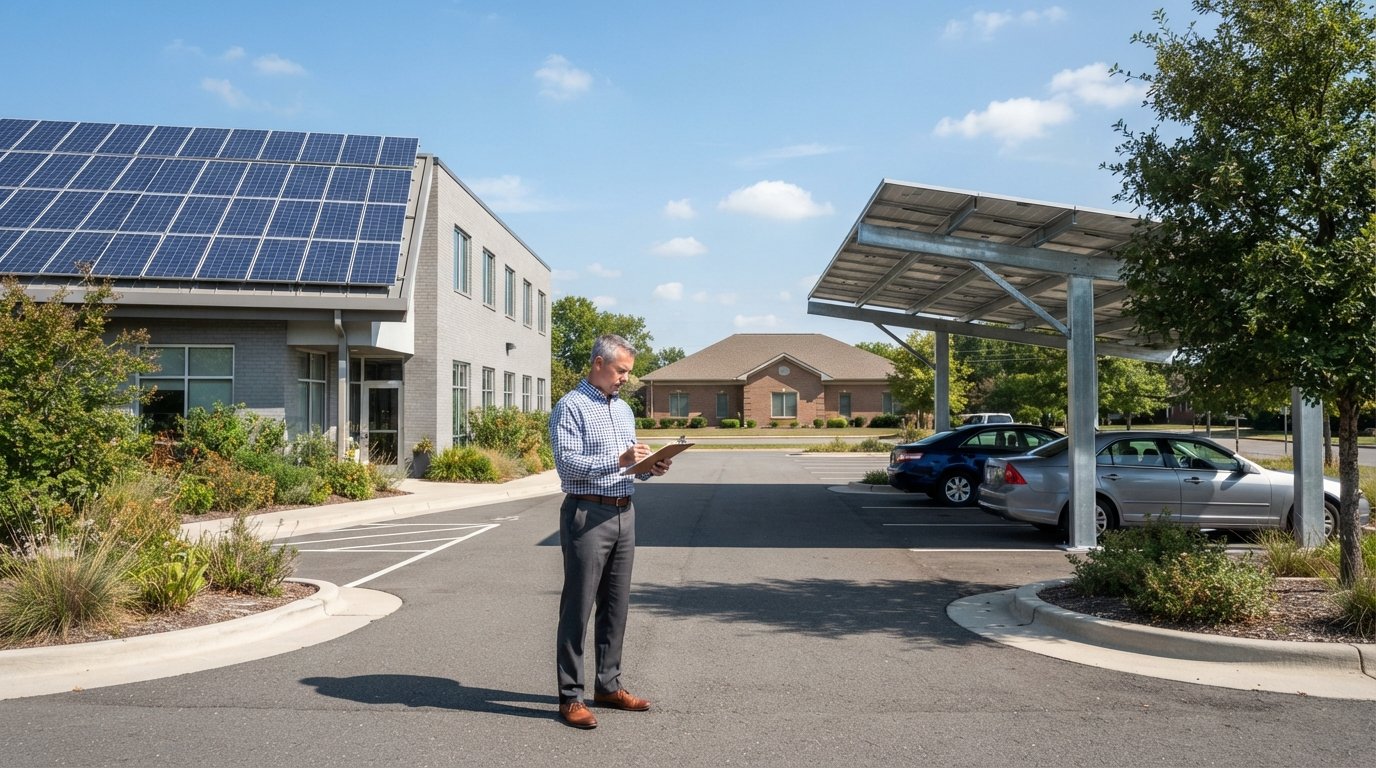
Solar Carport vs Rooftop Solar for Small Business
Compare solar carport vs rooftop solar for small business. See costs, ROI, and incentives to find the best fit for your property.

By Benjamin Taylor
Learn more about Solar Panel Installation and Repair for guides, costs, and what to expect.
Compare Solar Panel Installation and Repair Pros Near You

Enter your ZIP code to compare top-rated local professionals and request free quotes.
For small business owners watching electricity rates climb, the choice between a solar carport and a rooftop solar array can feel like a bet on the future of your property. One uses the roof you already have. The other adds a dual-purpose structure over your parking lot. Both can slash operating costs, but they perform very differently depending on your building, your land, and your long-term plans. This comparison breaks down cost, ROI, incentives, and practical trade-offs so you can decide which configuration actually fits your business.
How Solar Carports and Rooftop Systems Work
A rooftop solar system mounts panels directly to your existing roof structure. The building itself provides the support, so you avoid spending money on new foundations or steel. Installers typically use ballasted or penetrating mounts, depending on your roof type and local wind codes. For many small businesses with a large, unobstructed roof, this is the fastest and least expensive path to solar.
A solar carport, by contrast, is a standalone structure that shades vehicles while holding solar panels on top. It requires steel columns, footings, and often engineering stamps for wind and snow loads. Because it sits over parking spaces, it does not compete for roof space and can be scaled independently of your building. That flexibility comes at a price: carports cost more per watt than rooftop systems because you are paying for the structure, not just the panels.
The key difference is where the solar array lives. Rooftop solar uses an asset you already own. Solar carports create a new asset that produces electricity and shade. That distinction drives nearly every other comparison, from cost to maintenance to how quickly the system pays for itself.
Cost Comparison: What You Actually Pay
Upfront cost is usually the first question. Rooftop solar for a small business typically ranges from $2.50 to $3.50 per watt before incentives, depending on roof complexity and local labor rates. A 50 kW system might land between $125,000 and $175,000. Solar carports often run $4.00 to $6.50 per watt because of the added steel and foundation work, pushing a comparable 50 kW carport to $200,000 or more.
Those numbers can shift based on soil conditions, permitting, and whether you need lighting, EV chargers, or drainage improvements under the carport. Rooftop systems also require a roof in good condition. If your roof needs replacement within five years, you may need to factor that into the project or choose a carport instead.
Financing changes the picture. Many small businesses use the federal Investment Tax Credit (ITC), which covers 30% of the system cost, plus accelerated depreciation. Commercial solar loans, PPAs, and leases can reduce or eliminate upfront cash. The same incentives apply to carports, but the higher basis means a larger tax credit in dollar terms. To see how different financing structures affect your monthly cash flow, you can run scenarios through a solar estimate comparison tool that models both options side by side.
Here is a quick cost snapshot for a typical 50 kW small business system:
- Rooftop solar: $125,000 to $175,000 before incentives; $87,500 to $122,500 after 30% ITC.
- Solar carport: $200,000 to $325,000 before incentives; $140,000 to $227,500 after 30% ITC.
- Financing: Loans, leases, and PPAs available for both, with carports sometimes requiring longer terms due to higher basis.
The gap narrows if you place a high value on covered parking or if your roof cannot support solar. It widens if your roof is new and structurally sound. Either way, the ITC and depreciation often make the net cost far more manageable than the sticker price suggests.
Energy Production and Efficiency
Rooftop solar production depends on roof orientation, pitch, and shading. A south-facing roof with minimal obstructions can perform very well. But many small businesses have HVAC units, vents, or skylights that reduce usable area. North-facing roofs or heavy tree cover can cut production significantly.
Solar carports offer more control over tilt and orientation. You can design the structure to face true south at an optimal angle, which often yields higher production per panel than a compromised roof. Carports also benefit from cooler temperatures underneath, and cooler panels produce more electricity. That said, carports can suffer from shading if tall vehicles or nearby buildings block the sun, and they may need more frequent cleaning due to bird droppings and dust.
In terms of raw output, a well-designed carport can outperform a mediocre rooftop array. But a clean, south-facing rooftop system will usually beat a carport that is shaded or poorly angled. The lesson is simple: site conditions matter more than the type of mount. A solar energy platform like SolarEnergy.ai can help you compare production estimates for both configurations using local weather and shading data.
Incentives, Tax Credits, and Financing
The federal ITC applies to both rooftop and carport solar at 30% through 2032, assuming current law holds. Businesses can also use Modified Accelerated Cost Recovery System (MACRS) depreciation, which lets you write off the system over five to seven years. Some states and utilities offer additional rebates, grants, or performance-based incentives, especially for carports that include EV charging.
Financing options are similar for both. You can pay cash, take a commercial solar loan, or sign a lease or PPA. Leases and PPAs shift ownership to a third party, which means the third party claims the ITC, but you get lower monthly payments. Carports sometimes qualify for property-assessed clean energy (PACE) financing, which ties repayment to your property tax bill.
One often-overlooked benefit of carports is that they can be depreciated as a structure, potentially qualifying for bonus depreciation. That can improve after-tax returns compared to a rooftop system, where the entire cost is treated as equipment. Always confirm details with a tax professional, because incentive rules can change.
Space, Structural, and Site Considerations
Rooftop solar requires a roof that can handle the added load. Most commercial roofs can, but older or lightweight roofs may need reinforcement. You also need clear access for installation and maintenance. If your roof is shaded by trees or nearby buildings, production will suffer.
Solar carports need land. You need enough parking spaces to make the structure worthwhile, and the soil must support footings. Zoning and permitting can be more complex because you are adding a structure, not just equipment. But carports do not interfere with your roof, so you can replace the roof later without touching the solar array.
Consider these site factors when choosing:
- Roof age and condition: If your roof is near end of life, carport solar avoids a costly re-roof.
- Available land: Carports need parking area; rooftop solar needs none.
- Shading: Both are vulnerable, but carports can be repositioned during design.
- Future expansion: Carports are easier to expand incrementally.
- Aesthetics: Carports can enhance customer experience with covered parking; rooftop panels are mostly hidden.
For many small businesses, the decision comes down to whether covered parking adds value for employees or customers. If it does, the carport premium may be justified. If not, rooftop solar usually wins on pure economics.
Maintenance and Durability
Rooftop solar is relatively low maintenance. Rain often cleans the panels, and you may only need to hose them down a few times a year. The main risk is roof leaks if mounting is done poorly. Regular inspections can catch issues early.
Solar carports require more attention. The structure itself needs periodic inspection for rust, loose bolts, or foundation issues. Panels are easier to access, which simplifies cleaning and repairs, but the underside may collect debris or bird nests. Snow and ice can slide off in large sheets, creating a safety hazard for people below.
In terms of lifespan, both types of panels typically carry 25-year performance warranties. Carport steel can last 30 years or more with proper coating. Rooftop mounts often last as long as the roof. The key is to budget for occasional maintenance and to keep gutters and drainage clear.
Which Option Fits Your Small Business?
If your roof is in good shape, unshaded, and large enough, rooftop solar usually delivers the best return on investment. It is cheaper, faster to install, and requires less structural work. You can often get a system running in a few months.
Choose a solar carport if your roof is unsuitable, you want to add covered parking, or you plan to expand solar without touching the building. Carports also make sense if you want to integrate EV charging or if your business values sustainability visibility. The higher upfront cost can be offset by incentives and the dual benefit of shade and power.
Before you decide, gather quotes for both options. FreeSolarPowerQuotes connects you with pre-screened local installers who can assess your site and provide no-obligation proposals. Compare production estimates, financing terms, and net costs after incentives. The right choice is the one that maximizes savings while fitting your operational needs.
Solar is not a one-size-fits-all purchase. Whether you go with a carport or rooftop, the goal is the same: lower energy bills, greater independence, and a stronger bottom line. With the 30% ITC still available, 2026 is a strong year to move forward. Take the time to evaluate both paths, and you will end up with a system that works for your business for decades.