
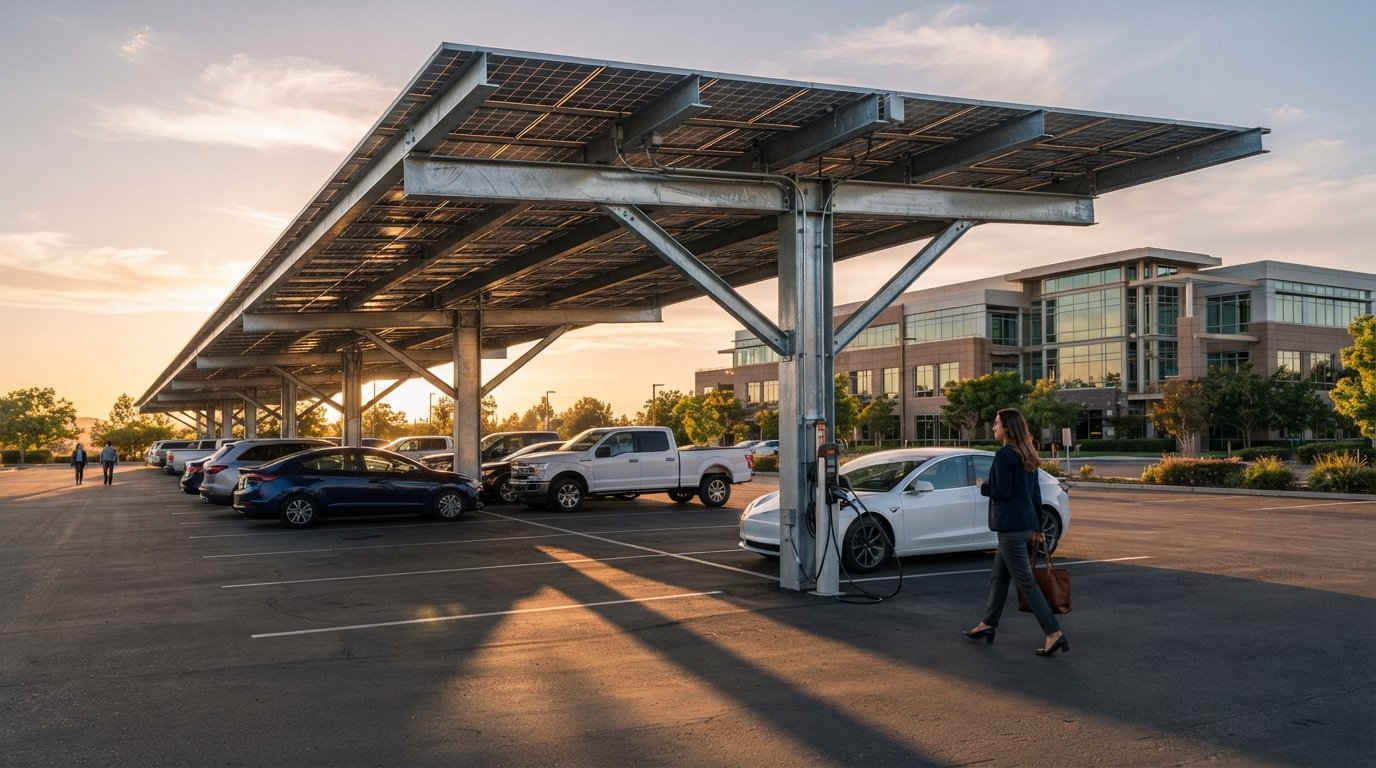
Solar Carport Installation Cost for Businesses: Pricing Guide
Solar carport installation cost for businesses ranges from $2.50 to $4.50 per watt. Learn how to cut costs with incentives and financing.

By Ethan Whitaker
Learn more about Solar Panel Installation and Repair for guides, costs, and what to expect.
Compare Solar Panel Installation and Repair Pros Near You

Enter your ZIP code to compare top-rated local professionals and request free quotes.
Businesses searching for a solar carport installation cost for businesses quickly discover that the price tag is not a single number. It depends on the number of parking spaces, the structural design, local labor rates, and whether you add battery storage or EV charging. According to industry data from the Solar Energy Industries Association and Wood Mackenzie, commercial solar prices have stabilized in recent years, yet carports still cost significantly more than rooftop systems because of the steel and engineering required. A typical single-space carport can run between $4,000 and $8,000 installed, while a 100-space parking lot project may reach $500,000 to $800,000 before incentives. In this guide, we break down every line item, explain how to calculate your return on investment, and show you how to get competitive quotes from vetted installers. If you want to compare offers side by side, start by using a trusted platform to compare solar offers and see what local providers are charging.
What Drives the Solar Carport Installation Cost for Businesses?
Solar carports are not just panels on a roof. They are elevated steel structures that must withstand wind, snow, and seismic loads while supporting photovoltaic modules. That engineering and material cost is the main reason carports cost more per watt than rooftop solar. On average, commercial rooftop solar runs $1.50 to $2.50 per watt, while carports range from $2.50 to $4.50 per watt. For a 100 kW system, that difference can mean $100,000 or more. But carports offer dual benefits: they generate electricity and provide covered parking, which can increase property value and tenant satisfaction. The cost also varies by region; labor rates in California and New York are higher than in Texas or Florida. Understanding these drivers helps you budget accurately and negotiate with installers.
Another critical factor is the foundation. Carports require concrete footings or helical piles, and soil conditions can add cost. If your parking lot has poor drainage or requires grading, that adds to the civil work. Many businesses overlook permitting fees, which can range from $1,000 to $10,000 depending on the jurisdiction. Utility interconnection studies may also be required, especially for systems over 100 kW. These soft costs can add 15 to 25 percent to the total. To avoid surprises, ask installers for a detailed breakdown that separates structural steel, panels, inverters, wiring, and labor.
Finally, the type of carport matters. A standard cantilever design (single column) costs less than a T-span or arched design. Pre-engineered kits from manufacturers like Baja Carports or Orion can reduce engineering time, but custom designs for irregular lots increase costs. If you need EV charging stations integrated, add $2,000 to $5,000 per port. Battery storage adds $500 to $1,000 per kWh. These add-ons can boost your total investment but may also increase tax incentives and utility rebates.
Average Cost Breakdown by System Size
To give you a realistic budget, here are ballpark figures for common commercial carport sizes. These estimates include materials, labor, permits, and standard interconnection, but not battery storage or EV chargers. Prices vary by state and installer.
- 10-space carport (about 30 kW): $75,000 to $120,000, or $2.50 to $4.00 per watt.
- 50-space carport (about 150 kW): $300,000 to $500,000, with economies of scale lowering the per-watt cost.
- 100-space carport (about 300 kW): $600,000 to $900,000, often the sweet spot for businesses with large lots.
- 200-space carport (about 600 kW): $1.1 million to $1.8 million, requiring utility coordination and possibly a substation upgrade.
These numbers are before the 30 percent federal Investment Tax Credit (ITC) and any state or utility incentives. After the ITC, a 100-space carport could net out to $420,000 to $630,000. That is still a significant investment, but the payback period often ranges from 5 to 10 years depending on your electricity rate and net metering policies. In high-rate states like California or Massachusetts, payback can be as short as 4 years. In low-rate states like Texas, it may stretch to 8 or 10 years. Always verify current incentives with a tax professional, as programs can change.
It is also important to consider the cost of electricity offset. If your business pays $0.15 per kWh, a 300 kW carport in a sunny state can generate about 450,000 kWh per year, saving $67,500 annually. Over 25 years, that is nearly $1.7 million in avoided electricity costs, not counting utility rate increases. That is why many businesses see carports as a long-term hedge against rising energy prices. To get a personalized estimate, you can use a solar cost calculator or request quotes from multiple installers.
Financing Options That Reduce Upfront Cost
Many businesses hesitate because of the upfront capital required. Fortunately, several financing structures can make solar carports cash-flow positive from day one. The most common are power purchase agreements (PPAs), solar leases, and commercial property assessed clean energy (C-PACE) loans. With a PPA, a third-party developer owns the system and sells you electricity at a fixed rate lower than your utility. You pay $0 upfront, and the developer claims the tax credits. This is ideal for businesses that cannot use the ITC themselves. A solar lease is similar but you pay a fixed monthly rent instead of per-kWh. C-PACE allows you to finance the system through a property tax assessment, with payments spread over 20 years.
If you want to own the system and capture the full ITC, a commercial solar loan is often the best route. Banks and credit unions offer secured loans with 5 to 15 year terms and interest rates ranging from 5 to 9 percent. Some lenders specialize in solar and offer no-money-down options. The loan payments are often lower than your current electricity bill, creating immediate positive cash flow. Additionally, you can depreciate the system using MACRS, which provides a significant tax shield. When you combine the ITC, depreciation, and utility rebates, the net cost can drop by 50 percent or more. Always consult your CPA to model the exact tax benefits for your business.
Another option is to work with a solar developer who offers a carport as a service. You lease your parking lot space to the developer, who installs and maintains the carport. You get covered parking and possibly a lease payment or discounted electricity. This works well for retail centers and office buildings with high electricity demand. However, you give up the tax credits and long-term savings. The best choice depends on your tax appetite, available capital, and how long you plan to own the property. If you are unsure, request quotes for both ownership and PPA models to compare.
How to Get Accurate Quotes and Avoid Overpaying
Getting a fair price requires shopping around. Solar carport installation costs vary by 30 to 50 percent between installers, even for identical systems. The best way to find the right price is to solicit at least three bids from reputable commercial solar contractors. Before you contact them, gather your utility bills for the past 12 months, a site plan of your parking lot, and your federal tax ID. This information helps installers size the system correctly and identify available incentives. When you receive quotes, do not just compare the bottom line. Ask for a line-item breakdown that includes structural engineering, steel, modules, inverters, labor, permitting, and interconnection. A low bid may cut corners on structural steel or use inferior inverters, leading to higher maintenance costs later.
Also, check whether the installer is licensed and insured in your state. Ask for references from similar commercial projects and visit a completed site if possible. Look for certifications like NABCEP for the lead installer. A reputable installer will provide a production guarantee and a workmanship warranty of at least 10 years. They should also handle all permitting and utility paperwork. If an installer asks for a large deposit upfront, that is a red flag. Most commercial projects require only a 10 to 20 percent deposit, with the balance due after installation and inspection.
To streamline the process, consider using an independent platform that connects you with pre-screened solar providers. FreeSolarPowerQuotes.com is one such resource; it offers free, no-obligation quotes from multiple installers, helping you compare prices and financing options in one place. You can also read guides on incentives and financing to educate yourself before speaking with salespeople. For general solar information and industry insights, SolarEnergy.ai provides a comprehensive library of tools and articles that can help you understand the technology and market trends. Remember, the goal is to maximize your return on investment, not just minimize the upfront cost.
Tax Incentives and Rebates for Commercial Solar Carports
The federal Investment Tax Credit (ITC) is the biggest incentive for businesses. As of 2026, it remains at 30 percent for commercial solar systems, including carports. If your business is a tax-exempt entity, you may be eligible for the elective pay (direct pay) option, which allows you to receive the credit as a cash payment. Additionally, you can take advantage of accelerated depreciation under MACRS, which allows you to deduct the system's cost over 5 years instead of 25. This can effectively reduce the net cost by another 20 to 30 percent. Some states offer additional rebates or tax credits. For example, California has the Self-Generation Incentive Program (SGIP) for battery storage, and New York offers the NY-Sun Commercial/Industrial Incentive. Utility companies may also offer rebates for demand reduction or EV charging.
It is crucial to verify current incentive programs because they can change annually. The Database of State Incentives for Renewables and Efficiency (DSIRE) is a good starting point. However, always confirm details with your tax advisor and the relevant government agency. Some incentives require prevailing wage and apprenticeship requirements, so make sure your installer complies. If you are working with a tax equity investor or a PPA provider, they will handle the incentives, but you may still benefit from lower electricity rates. In many cases, the combination of ITC, depreciation, and state rebates can cover 40 to 60 percent of the total system cost, making the net investment much more attractive.
Another often-overlooked incentive is the Renewable Energy Production Incentive (REPI) or state-level production incentives. These pay you per kilowatt-hour generated, providing a steady revenue stream. Some utilities also offer net metering or feed-in tariffs for excess generation. If your carport produces more than your building consumes, you may be able to sell the excess back to the grid. However, policies vary widely. In states with net metering, you get credit at the retail rate; in others, you get a lower avoided cost rate. Understanding these details is essential for accurate ROI modeling. Your installer should provide a production estimate and a financial analysis that includes all applicable incentives.
Maintenance and Long-Term Costs
Solar carports are durable and require minimal maintenance, but you should budget for occasional cleaning and inverter replacement. The solar panels typically have a 25-year performance warranty, and the structural steel can last 40 years or more. Inverters, however, usually need replacement after 10 to 15 years, costing $0.10 to $0.20 per watt. For a 300 kW system, that is $30,000 to $60,000. You should also set aside funds for annual inspections and cleaning, especially in dusty or snowy regions. Many installers offer operations and maintenance (O&M) contracts that cover these costs for a fixed annual fee, typically 1 to 2 percent of the system cost. While O&M adds to the ongoing expense, it helps ensure your system produces as expected and protects your warranty.
Insurance is another consideration. Your existing property insurance may cover the carport, but you should notify your insurer and possibly increase coverage. Some insurers offer discounts for solar because it reduces risk of power outages. However, if you lease the system or have a PPA, the developer usually carries insurance. In any case, review your policy to avoid gaps. Finally, consider the end-of-life disposal or recycling of panels. While not an immediate cost, it is good to plan for it. Some manufacturers offer recycling programs. By factoring in these long-term costs, you can calculate a more accurate total cost of ownership and compare it to the savings.
In summary, the solar carport installation cost for businesses is a complex figure that depends on many variables. By understanding the components, leveraging incentives, and obtaining multiple quotes, you can make an informed decision that benefits your bottom line and your sustainability goals. Whether you choose to own the system or enter a PPA, a solar carport can be a smart investment for your property.