
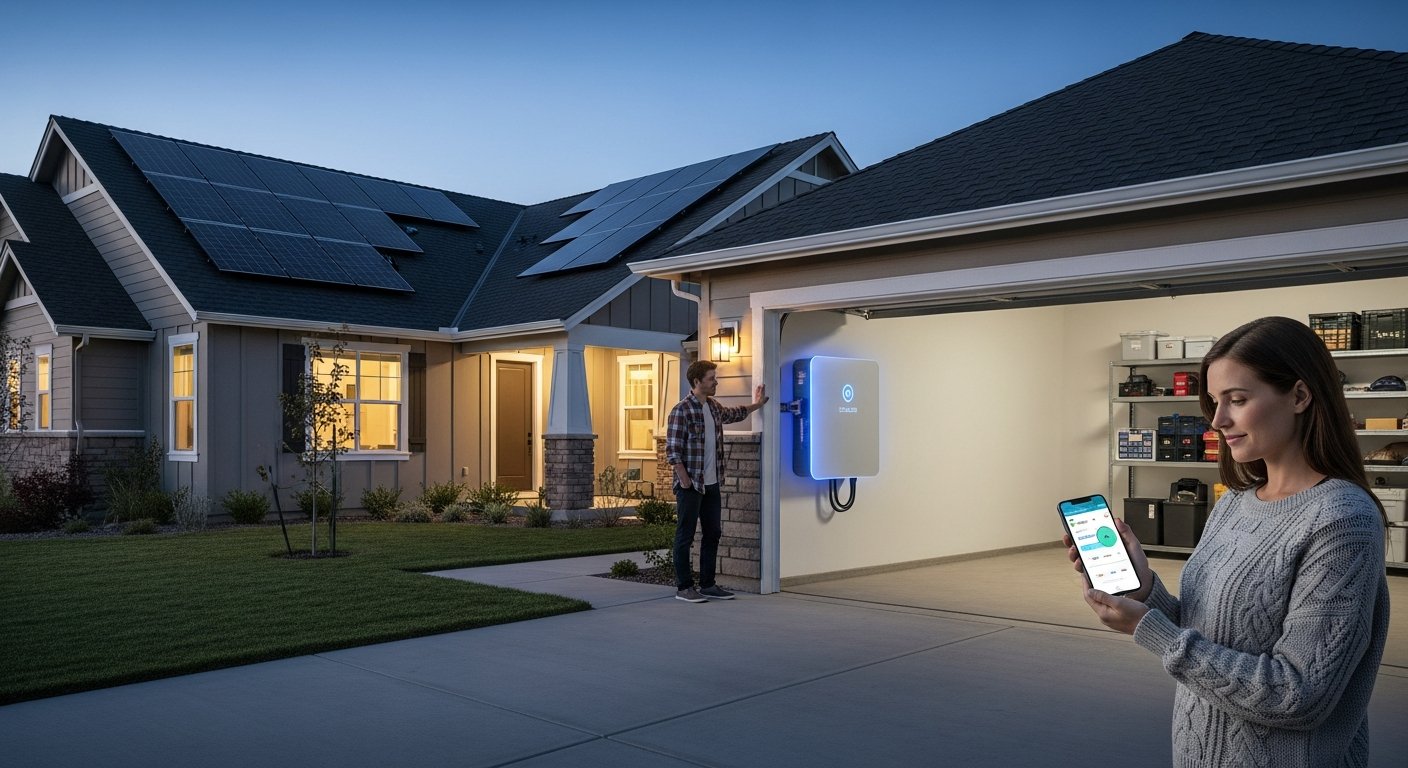
Solar Batteries: Do You Really Need One in 2026?
Solar batteries can cut your electric bill and keep the lights on during outages. Learn if you need one and how to choose the right system.

By Nathan Russell
Learn more about Solar Panel Installation and Repair for guides, costs, and what to expect.
Compare Solar Panel Installation and Repair Pros Near You

Enter your ZIP code to compare top-rated local professionals and request free quotes.
You have likely seen the ads: solar panels on a roof, a sleek battery box on the wall, and the promise of never paying an electric bill again. The pitch sounds perfect, but the reality is more nuanced. Solar batteries have become one of the most talked-about additions to home solar systems, yet many homeowners are unsure if the investment makes sense for their specific situation. This guide cuts through the marketing noise to explain what solar batteries actually do, when they pay off, and how to decide if one belongs in your home energy plan.
Before we dive into the technical details, understand this: a solar battery is not a solar panel. Panels generate electricity during daylight hours. A battery stores that electricity for later use. That simple distinction changes everything about how you consume energy, how you handle power outages, and how much money you save on your utility bills. The decision to add a battery should be based on your goals, your local utility rates, and your tolerance for complexity.
How Solar Batteries Work: A Simple Explanation
Solar batteries store direct current (DC) electricity produced by your solar panels. When your panels generate more power than your home needs, the excess energy flows into the battery instead of back to the grid. Later, when your panels are not producing (at night or on cloudy days), the battery discharges that stored energy to power your home.
Most modern solar batteries use lithium-ion chemistry, similar to what powers your smartphone but scaled up significantly. They are typically wall-mounted, about the size of a large water heater, and can be installed indoors or outdoors. The battery connects to your solar inverter, which converts the DC power into alternating current (AC) that your appliances can use. Some systems use a single hybrid inverter that manages both solar and battery, while others use separate inverters for each component.
The key metric for any solar battery is its capacity, measured in kilowatt-hours (kWh). A typical home battery holds between 10 and 15 kWh of usable energy. That is enough to run essential appliances for several hours during an outage, but it will not power a large home with electric heating or air conditioning for a full day. To understand what a battery can do for you, think of it as a reservoir: it only holds as much water as its size allows.
The Real Benefits of Adding a Solar Battery
Solar batteries offer more than just backup power. They can change how you interact with the electric grid and unlock financial advantages that panels alone cannot provide. Here are the main reasons homeowners choose to add a battery to their solar system:
- Backup power during outages: When the grid goes down, a battery keeps your lights on, your refrigerator running, and your phone charged. You can even power medical devices or a well pump.
- Time-of-use (TOU) rate optimization: Many utilities charge more for electricity during peak hours (usually late afternoon and evening). With a battery, you can store cheap solar energy during the day and use it during expensive peak times, avoiding high rates.
- Self-consumption increase: Without a battery, solar panels typically send 20% to 40% of their generated energy back to the grid. A battery lets you use that energy yourself, which matters if your utility pays low or no export rates.
- Energy independence: A battery reduces your reliance on the grid, protecting you from rising electricity rates and potential grid instability.
These benefits are real, but they are not automatic. A battery only delivers value if your utility rates, incentives, and personal needs align. For example, if your utility has net metering that credits you for every kWh you send to the grid, a battery may not provide much financial benefit. In that scenario, the grid itself acts as your battery, and you can draw from it at night for the same rate you were credited during the day.
However, net metering policies are changing across the United States. Many utilities are reducing export credits or introducing demand charges, which makes batteries more attractive. If you live in California, Texas, or Florida, where time-of-use rates and outage risks are common, a battery can be a smart addition.
When a Solar Battery Makes Financial Sense
The financial case for a solar battery depends heavily on your local electricity rates and the incentives available to you. Let’s break down the math with a few scenarios.
Scenario 1: High Time-of-Use Rates Suppose your utility charges $0.30 per kWh during peak hours (4 p.m. to 9 p.m.) and $0.10 per kWh during off-peak hours. A 10 kWh battery can shift your energy usage from peak to off-peak. If you use the battery fully each day, you save $0.20 per kWh times 10 kWh, which is $2.00 per day. Over a year, that is $730 in savings. If the battery costs $10,000 installed (before incentives), your payback period is about 13.7 years, which may be longer than the battery’s warranty.
Scenario 2: Low Export Rates If your utility only pays $0.03 per kWh for excess solar energy, you are better off storing that energy for your own use. A battery can increase your self-consumption from 60% to 90%, meaning you buy less electricity from the grid. If you currently spend $150 per month on electricity, a battery might reduce that to $50, saving $1,200 per year. That improves your payback period to about 8 years.
Scenario 3: Frequent Outages If you experience multiple outages per year, a battery provides peace of mind that is hard to quantify. The financial value of never losing power to your refrigerator, internet, or medical equipment can be significant, even if you never calculate it in dollars. Many homeowners in Texas and Florida, where storm-related outages are common, find this benefit alone justifies the cost.
To maximize your savings, you should also consider the federal Investment Tax Credit (ITC). In 2026, the ITC remains at 30% for solar battery installations, provided they are charged by solar panels. That means a $10,000 battery effectively costs $7,000 after the credit. State and local incentives may further reduce the upfront cost.
How to Choose the Right Solar Battery
Not all solar batteries are created equal. Choosing the right one requires understanding your energy needs, your budget, and the technical specifications that matter most. Here is a step-by-step process to guide you.
Step 1: Calculate your backup load. Decide which appliances you must power during an outage. Add up their wattage and estimate how many hours you need them to run. For example, a refrigerator uses about 600 watts, lights use 300 watts, and a Wi-Fi router uses 50 watts. If you want to run these for 10 hours, you need about 9.5 kWh of usable capacity.
Step 2: Determine your daily energy usage. Look at your electricity bills for the last 12 months to find your average daily kWh usage. A typical American home uses about 30 kWh per day. If you want to go off-grid, you would need a battery bank of at least 30 kWh, which is very expensive. Most homeowners choose a smaller battery (10 to 15 kWh) to cover partial loads.
Step 3: Compare battery specifications. Key specifications include:
- Usable capacity: The amount of energy you can actually draw from the battery, usually less than the total capacity.
- Power rating: The maximum amount of power the battery can deliver at once, measured in kilowatts (kW). A 5 kW rating can run a 5,000 watt appliance, but not a 7,000 watt AC unit.
- Round-trip efficiency: The percentage of energy that comes out of the battery compared to what goes in. Higher is better (usually 90% or more).
- Warranty: Most batteries come with a 10-year warranty that guarantees a certain number of cycles (e.g., 6,000 cycles or 70% capacity retention).
Step 4: Get multiple quotes. Solar battery prices vary widely by brand, installer, and your location. Always obtain at least three quotes from reputable installers. Use a service like FreeSolarPowerQuotes to compare offers from vetted solar providers in your area, which can save you time and ensure you are not overpaying.
Solar Battery Costs and Incentives in 2026
The cost of solar batteries has dropped significantly over the past decade, but they remain a substantial investment. As of 2026, the average installed cost for a 10 kWh battery ranges from $8,000 to $15,000 before incentives. The price depends on the brand, the complexity of installation, and whether you are adding the battery to an existing solar system or installing both together.
Here are the key incentives available in 2026:
- Federal Investment Tax Credit (ITC): A 30% tax credit on the total cost of your battery system (including installation) if the battery is charged by solar panels. This credit is available through 2032, with a step-down to 26% in 2033 and 22% in 2034.
- State and local rebates: Many states offer additional rebates or tax credits. For example, California’s Self-Generation Incentive Program (SGIP) provides rebates for battery storage, especially for low-income households. Texas and Florida have some utility-specific programs.
- Utility demand response programs: Some utilities pay you to allow them to draw from your battery during peak demand events. This can provide an annual payment or a discount on your electricity rate.
Before you commit, verify the current incentives with official sources, as policies change frequently. The Database of State Incentives for Renewables & Efficiency (DSIRE) is a reliable resource.
Solar Battery vs. Generator: Which Is Better?
If your primary goal is backup power, you might be weighing a solar battery against a standby generator. Both have pros and cons, and the right choice depends on your priorities.
Solar batteries provide silent, emissions-free backup power with no fuel to store or maintain. They also integrate seamlessly with your solar system, allowing you to use renewable energy even during an outage. However, they have limited capacity, so you cannot run heavy loads like a central air conditioner for long periods. Batteries also require a larger upfront investment.
Generators, on the other hand, can provide unlimited power as long as you have fuel (natural gas, propane, or diesel). They are generally cheaper to install for high-power needs, but they are noisy, produce emissions, and require regular maintenance. You also need to ensure you have enough fuel during an extended outage, which can be challenging.
For most homeowners, a solar battery is the better choice for moderate backup needs and daily energy savings. If you live in an area with frequent, long-duration outages and need to power high-wattage appliances, a generator might be more practical. Some homeowners choose a hybrid approach: a battery for daily savings and a small generator for emergencies.
Installation: What to Expect When Adding a Solar Battery
Adding a solar battery to your home is not a DIY project. It requires a licensed electrician and, in most jurisdictions, a building permit. The installation process typically takes one to two days, depending on the complexity of your existing system.
Here is what you can expect:
- Site assessment: The installer will evaluate your electrical panel, your solar inverter, and the location where the battery will be mounted. They will also check local building codes and utility interconnection requirements.
- Permitting: The installer will pull the necessary permits and submit paperwork to your utility for interconnection approval. This can take a few weeks.
- Physical installation: The battery is mounted on a wall or on a floor stand. The installer will connect it to your solar system and your electrical panel, ensuring proper wiring and safety disconnects.
- System configuration: The installer will configure the battery’s software to match your energy goals, such as prioritizing backup power or time-of-use savings.
- Inspection and activation: A local inspector will verify the installation meets code, and then your utility will give the final go-ahead to turn the system on.
When hiring an installer, always check their credentials. Look for NABCEP certification, read customer reviews, and ensure they have experience with the specific battery brand you are purchasing. A reputable installer will also help you understand your warranty and provide maintenance guidance.
Maintenance and Lifespan of Solar Batteries
Solar batteries are designed to be low-maintenance, but they are not maintenance-free. Here is what you need to know to keep your battery healthy for as long as possible.
Most lithium-ion batteries have a lifespan of 10 to 15 years, which is slightly shorter than the 25-year lifespan of solar panels. Over time, a battery’s capacity gradually degrades. You will notice that it holds less charge and delivers less power. Most warranties guarantee that the battery will retain at least 70% of its original capacity after 10 years or 6,000 cycles, whichever comes first.
To maximize your battery’s lifespan, follow these tips:
- Avoid extreme temperatures: Most batteries have an operating range of 32°F to 104°F. Install them in a climate-controlled space if possible, or choose a model with active thermal management.
- Keep the battery partially charged: Lithium-ion batteries last longer when they are kept between 20% and 80% state of charge. Many smart systems manage this automatically.
- Limit deep discharges: Regularly draining the battery to 0% can accelerate degradation. Use the battery for daily savings, but leave a reserve for outages.
- Monitor performance: Use the manufacturer’s app to track your battery’s output and health. If you notice a significant drop in capacity, contact your installer.
In terms of maintenance, you do not need to do much. Keep the area around the battery clean and free of debris. Check the manufacturer’s app periodically for error messages. Your installer should perform an annual inspection to ensure all connections are secure and the system is operating correctly.
Making the Final Decision: Is a Solar Battery Right for You?
Solar batteries are not for everyone. They are a significant investment, and their financial benefits depend on your utility rates, your energy usage, and the incentives available in your area. However, for many homeowners, a battery provides valuable backup power, reduces reliance on the grid, and can even save money on electricity bills.
To make an informed decision, start by gathering data. Look at your electricity bills, note your utility’s rate structure, and research your state’s incentives. Then, get quotes from multiple solar installers. A reputable installer will help you run the numbers and recommend a battery size that matches your goals.
If you are already considering solar panels, adding a battery at the same time can simplify installation and reduce costs. If you already have panels, you can retrofit a battery, but you may need to upgrade your inverter or electrical panel, which adds to the total cost.
Ultimately, the right choice is the one that fits your budget, your energy needs, and your peace of mind. If you live in an area with frequent outages, high electricity rates, or weak net metering, a solar battery is likely a wise investment. If you have stable grid access and generous export credits, you might be better off saving the money for other home improvements.
Ready to explore your options? Visit FreeSolarPowerQuotes to compare solar and battery quotes from trusted installers in your region. You will get a free, no-obligation estimate that helps you understand your costs and savings before you commit.