
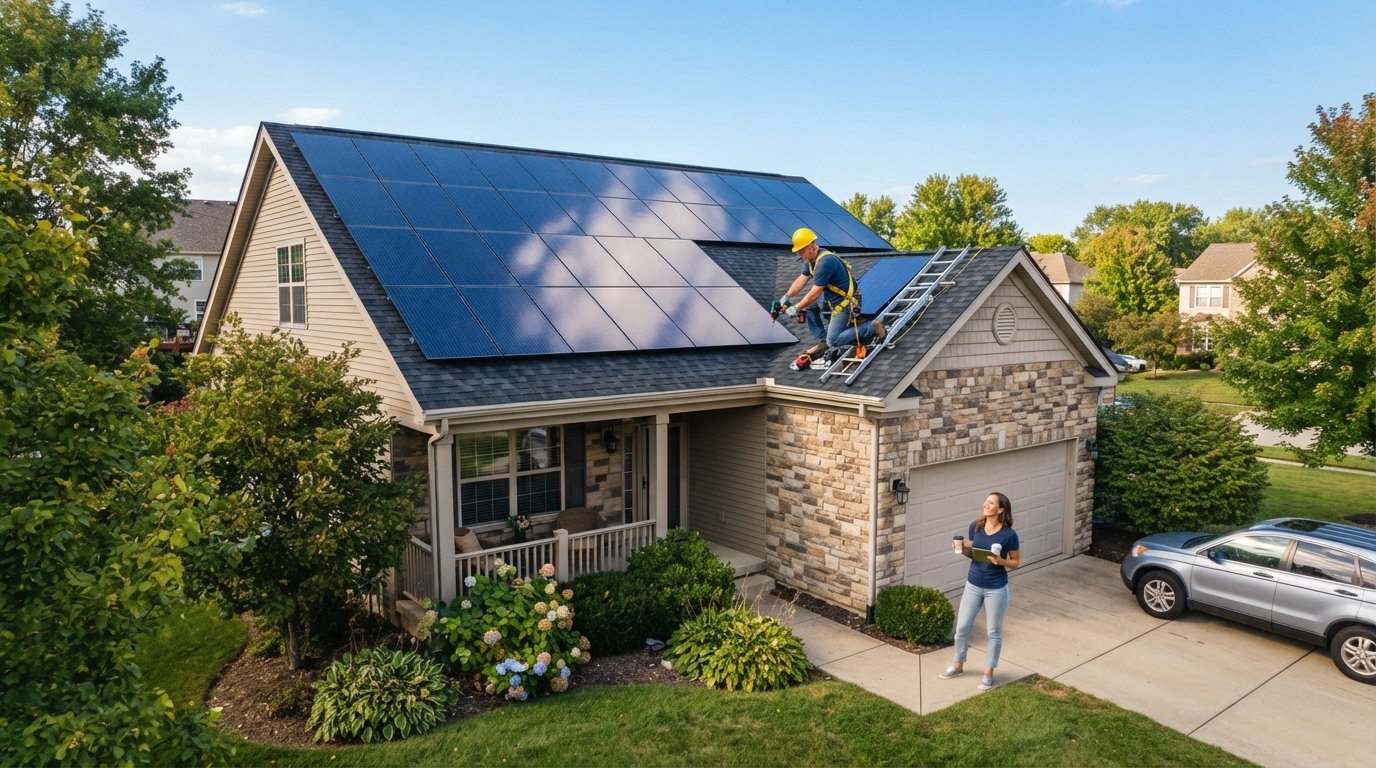
Roof Solar Panels: Costs, Savings, and Hidden Benefits
Roof solar panels can cut your electricity bills by up to 90% and boost your home's value. Learn how to get the best system with no upfront cost.

By Ethan Whitaker
Learn more about Solar Panel Installation and Repair for guides, costs, and what to expect.
Compare Solar Panel Installation and Repair Pros Near You

Enter your ZIP code to compare top-rated local professionals and request free quotes.
When you picture solar energy, you probably imagine rows of shiny panels sitting on a roof, soaking up the sun. That image is not just a stereotype, it is the most practical way for most homeowners to generate their own electricity. Roof solar panels have become a mainstream choice for cutting monthly bills, protecting against rising utility rates, and increasing property value. Yet many homeowners hesitate because they are unsure about the upfront cost, the installation process, or whether their roof is even suitable.
This guide breaks down everything you need to know about roof solar panels in clear, plain language. You will learn how they work, what they really cost, how to maximize your savings with federal and state incentives, and how to avoid common mistakes. By the end, you will know exactly how to get a free, no-obligation quote from vetted solar installers in your area, so you can make a confident decision.
How Roof Solar Panels Work and Why They Matter
Roof solar panels, also called photovoltaic (PV) panels, convert sunlight into direct current (DC) electricity. An inverter then converts that DC power into alternating current (AC), which is what your home uses. When your panels produce more electricity than you consume, the excess is sent back to the grid, and you earn credits through a process called net metering. Those credits offset the power you draw when the sun is not shining, like at night or on cloudy days.
This simple mechanism delivers three major benefits. First, you slash your electricity bills, often by 50 to 90 percent or even eliminate them entirely depending on your system size and usage. Second, you protect yourself from future rate hikes, because you are generating your own power instead of buying every kilowatt-hour from the utility. Third, you increase your home's resale value, as studies show homes with solar panels sell faster and for more money than comparable homes without them.
The financial case is even stronger in 2026 because of the federal solar investment tax credit (ITC), which currently covers 30 percent of your total system cost. Many states and utilities add their own rebates, performance-based incentives, or property tax exemptions. Combined, these incentives can cut your net cost by thousands of dollars, shortening your payback period to as little as six to eight years in sunny states like Texas, Florida, and Arizona.
Types of Roof Solar Panels: Which Is Best for Your Home?
Not all solar panels are created equal. The three main types are monocrystalline, polycrystalline, and thin-film. Each has its own trade-offs in efficiency, cost, and appearance.
- Monocrystalline panels are the most efficient and popular choice for homes. They are made from a single silicon crystal, so they perform better in high heat and low light, and they have a sleek black appearance. They cost a bit more, but they deliver the most power per square foot, making them ideal if you have limited roof space.
- Polycrystalline panels are made from melted silicon fragments, which gives them a blue, speckled look. They are slightly less efficient than monocrystalline, but they are also cheaper, making them a budget-friendly option if you have plenty of roof area.
- Thin-film panels are lightweight and flexible, but they are rarely used on residential roofs because they require much more space to produce the same power. They are more common on large commercial buildings or ground-mounted systems.
For most homeowners, monocrystalline panels offer the best balance of performance and value. In our guide on best monocrystalline solar panels, we break down the top models and what makes them stand out. If you are curious about the less common alternatives, our comparison of best thin-film solar panels for homes explains where they make sense and where they do not.
Your installer will help you choose the right panel type based on your roof size, shading, and energy goals. The important thing is to get a system that fits your specific situation, not just the cheapest option per panel.
The True Cost of Roof Solar Panels in 2026
The biggest question on every homeowner's mind is, "How much will this cost?" The answer varies widely based on where you live, your roof's condition, your energy usage, and the equipment you choose. However, a typical residential system in the United States ranges from 5 to 10 kilowatts (kW), and the average cost is between $2.50 and $3.50 per watt before incentives. That translates to a total price of roughly $12,500 to $35,000 for a standard installation.
Those numbers sound high, but they are not the final price. The federal ITC reduces your tax bill by 30 percent of the system cost, which immediately lowers your effective price. For example, a $20,000 system becomes $14,000 after the credit. Many states and utilities add their own incentives, which can save you an additional $1,000 to $5,000. Some local programs even offer performance-based payments that pay you for every kilowatt-hour your system produces over several years.
You also have several financing options that eliminate the large upfront payment:
- Cash purchase: You pay the full cost upfront and own the system outright. This gives you the fastest payback and the highest long-term savings, because you avoid interest charges.
- Solar loan: You finance the system with a solar-specific loan, often with $0 down and low-interest rates. You own the panels and claim the tax credit, but your monthly savings may be partially offset by loan payments.
- Solar lease or PPA: You do not own the system; instead, you pay a fixed monthly lease payment or purchase the power at a set rate. This requires no upfront cost, but you do not qualify for the tax credit, and your long-term savings are lower.
If you are interested in exploring these options, our guide on cleaning solar panels on pitched roofs is a good resource, but the more relevant step is to get multiple quotes from vetted installers. They will give you a precise cost estimate and help you compare financing plans. The key is to never pay the sticker price without a professional assessment.
How to Maximize Your Savings with Roof Solar Panels
Getting the best return on your solar investment is not just about choosing the cheapest system. It is about designing a system that matches your actual electricity usage, taking full advantage of incentives, and maintaining your panels properly. Here are the most effective strategies to boost your savings:
- Right-size your system. A system that is too small will not cover your usage, while one that is too large may waste money on unused capacity. Review your past 12 months of electricity bills to understand your average daily usage, then ask your installer to design a system that covers 100 to 110 percent of that amount.
- Claim every incentive. The federal ITC is automatic, but many state and local rebates have deadlines and limited funding. Work with your installer to identify all available incentives in your area, and file the paperwork promptly to secure them.
- Optimize your roof orientation. South-facing roofs with a 30 to 40 degree tilt capture the most sunlight in the northern hemisphere. If your roof faces east or west, you may need more panels to produce the same power, but you can still achieve excellent savings.
- Monitor your system's performance. Most modern inverters come with an app that tracks your production in real time. If you notice a sudden drop, it could indicate a panel issue or shading problem. Addressing these early prevents lost production.
- Keep your panels clean. Dust, leaves, and bird droppings can reduce output by 5 to 15 percent. In most areas, rain will wash away light debris, but in dry or dusty climates, an occasional gentle rinse with a hose can restore full performance.
Following these steps can increase your annual savings by hundreds of dollars. For example, a homeowner in Houston who rightsizes a 7 kW system and claims the ITC plus local rebates could see a payback period of just seven years, then enjoy 20-plus years of nearly free electricity. The key is to treat solar as a long-term investment, not a quick purchase.
The Installation Process: What to Expect
Once you decide to go solar, the installation process is surprisingly smooth. It typically takes one to three days, depending on the complexity of your roof and the size of the system. Here is a step-by-step breakdown of what happens:
- Site assessment: A solar installer inspects your roof's condition, angle, and shading, and reviews your electrical panel to ensure it can handle the new system.
- System design: The installer designs a layout that maximizes sun exposure and meets your energy needs. You approve the design before any work begins.
- Permitting: The installer obtains the necessary permits from your local government and utility. This can take a few weeks, but the installer handles all the paperwork.
- Installation: Crews mount the racking, attach the panels, wire the inverter, and connect the system to your electrical panel. They also install a production meter if required by your utility.
- Inspection and interconnection: A local inspector checks the work, and your utility installs a net meter. Once approved, you can switch on your system and start generating power.
Most installers handle the entire process from start to finish, so you do not need to manage permits or utility paperwork. The day of installation, the crew will protect your roof and clean up after themselves. Afterward, they will walk you through how to monitor your system and answer any questions.
One important note: if your roof is old or damaged, you should repair it before installing solar. Panels last 25 to 30 years, so you do not want to remove and reinstall them to fix a roof that fails in five years. Your installer can advise you on whether your roof needs work.
Common Myths About Roof Solar Panels
Despite the growing popularity of solar, several myths still hold people back. Let us clear up the most common ones:
- Myth: Solar panels do not work in cloudy or cold climates. In reality, panels produce electricity from daylight, not direct heat. They actually perform better in cooler temperatures, and even overcast skies generate meaningful power. Germany, which is not known for sunshine, is a global leader in solar.
- Myth: Solar panels will damage my roof. When installed correctly by professionals, solar panels protect the roof underneath them by shielding it from weather. Installers use flashing and sealants to ensure a watertight seal, and most offer a 25-year workmanship warranty.
- Myth: Solar is too expensive. With the 30 percent federal credit, state incentives, and $0-down loans, solar is more affordable than ever. In many cases, your monthly loan payment is lower than your previous electricity bill, so you start saving from day one.
- Myth: I need a battery backup to go solar. Batteries are optional. With net metering, your grid connection acts as your storage system. Batteries are worth adding if you want backup power during outages or if your utility limits net metering, but they are not required.
These myths often stem from outdated information or bad experiences with unqualified installers. The best way to avoid problems is to work with reputable, certified professionals and to get multiple quotes before signing anything.
Getting Your Free Solar Quotes
The easiest way to see what roof solar panels will cost for your specific home is to get free, no-obligation quotes from vetted solar providers. At FreeSolarPowerQuotes, we simplify that process by connecting you with up to four reputable installers in your area. You provide basic information about your home and electricity usage, and we match you with providers who will assess your roof, answer your questions, and give you a detailed proposal.
These quotes are completely free, and there is no pressure to commit. You can compare prices, equipment, warranties, and financing options side by side. This transparency is essential because the best deal is not always the lowest price; it is the system that gives you the best performance and support for the long term.
When you receive your quotes, ask each installer about their experience with your roof type, their warranty terms, and their process for handling permits and interconnection. The more informed you are, the better your decision will be. And once you sign, you can look forward to years of lower bills and the satisfaction of producing your own clean energy.
The time to act is now. Solar incentives are generous, but they can change, and electricity rates are only going up. By getting your free quotes today, you take the first step toward energy independence and long-term savings. There is no risk, and the potential payoff is enormous: a home that is more valuable, a monthly bill that shrinks, and a planet that benefits from every kilowatt-hour you generate.