
Off Grid Solar vs Grid Tied: Pros and Cons for 2026
Compare off grid solar vs grid tied pros and cons, from costs to outage protection. Call 8337937166 for free quotes on the right system for your home.

By Ethan Whitaker
Learn more about Solar Panel Installation and Repair for guides, costs, and what to expect.
Compare Solar Panel Installation and Repair Pros Near You

Enter your ZIP code to compare top-rated local professionals and request free quotes.
Choosing between an off grid solar system and a grid tied solar system is one of the most consequential decisions a homeowner or business owner can make when going solar. The choice affects everything from your upfront costs and long term savings to your energy independence and whether you can keep the lights on during a blackout. While both approaches use the same photovoltaic panels to convert sunlight into electricity, they differ dramatically in how that power is stored, distributed, and valued. Understanding the off grid solar vs grid tied pros and cons before you sign a contract can save you thousands of dollars and years of frustration.
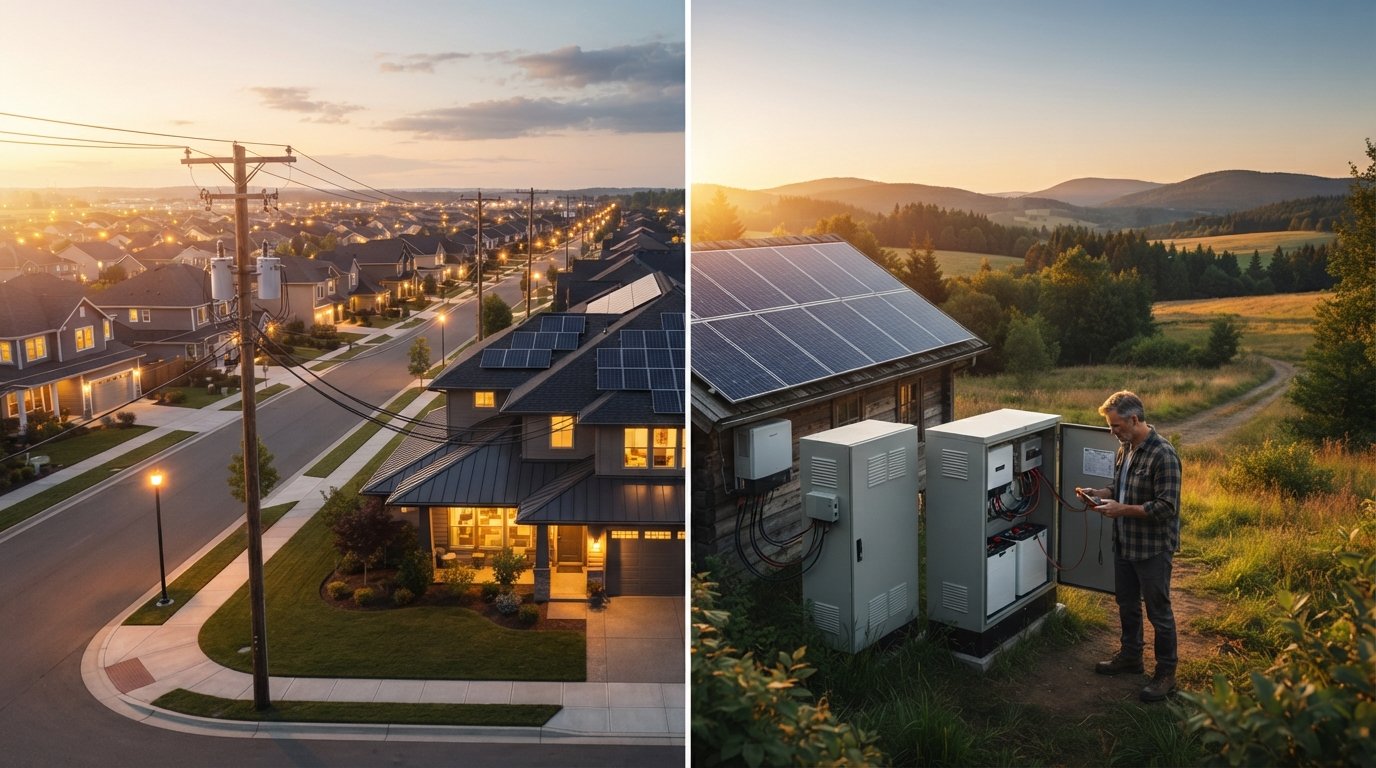
At its core, the difference comes down to one question: do you want a physical connection to your local utility, or do you want to stand alone? A grid tied system stays connected to the electric grid and uses it like a giant battery, exporting excess power when the sun shines and pulling power at night. An off grid system severs that connection entirely and relies on a bank of solar batteries to store every kilowatt hour you need. Each path carries distinct financial, technical, and lifestyle implications that we will break down in detail below.
How Grid Tied Solar Systems Work
A grid tied solar system, sometimes called a grid connected or on grid system, is the most common configuration in the United States. Solar panels generate direct current electricity, a string inverter or microinverters convert it to alternating current, and that power flows first to your home's electrical panel. Any surplus electricity is sent back to the utility grid through a bidirectional meter. When your panels produce less than your home consumes, such as at night or on cloudy days, the grid seamlessly supplies the difference.
The financial engine behind most grid tied systems is net metering. Under a typical net metering policy, every kilowatt hour you export earns a credit that offsets a kilowatt hour you draw later. In effect, the grid becomes your battery at no additional hardware cost. This is why grid tied systems usually deliver the fastest payback period of any solar configuration. Homeowners in states with strong net metering rules, including much of Texas and Florida, often see payback in seven to ten years before incentives are even applied.
Grid tied systems also tend to be simpler and cheaper to install. You do not need a large battery bank, charge controller, or backup generator, so equipment costs and labor hours drop significantly. A typical residential grid tied installation might cost $18,000 to $25,000 before the 30 percent federal Investment Tax Credit, while a comparable off grid system with adequate battery storage can easily exceed $40,000. That gap narrows only when you live far from existing power lines and would otherwise pay tens of thousands of dollars for a utility connection.
However, grid tied systems have one glaring weakness: when the grid goes down, your solar panels shut off too. This is not a design flaw but a safety requirement called anti islanding, which prevents your system from back feeding electricity onto downed lines and endangering utility workers. Unless you add a dedicated battery backup or a special inverter with backup capability, a grid tied home has no power during an outage, even on a sunny day.
How Off Grid Solar Systems Work
An off grid solar system operates independently of any utility. Solar panels charge a battery bank through a charge controller, and an inverter converts the stored DC power into household AC power. Because there is no grid to fall back on, every component must be sized to handle your worst case energy demand, including several consecutive cloudy days. This requirement drives up both the cost and the complexity of the system.
Battery capacity is the defining constraint of off grid living. A typical off grid home might need 20 to 40 kilowatt hours of usable storage, which translates to a substantial lithium iron phosphate or lead acid battery bank. If you want to understand how these components fit together, our guide on essential off grid solar system parts walks through panels, charge controllers, inverters, and battery banks step by step. Sizing mistakes are common and expensive, so most off grid homeowners work with an experienced designer rather than guessing.
The upside of off grid solar is total energy independence. You are immune to utility rate hikes, rolling blackouts, and grid failures. For remote properties, cabins, and rural homesteads where connecting to the grid would cost $30,000 or more, off grid solar is often the only practical and affordable option. It also appeals to people who value self reliance and want their energy footprint to be entirely their own.
The downsides are equally real. Off grid systems require diligent energy management, regular battery maintenance, and a willingness to adjust your lifestyle to the weather. A week of heavy clouds can drain a battery bank if you have not sized it generously. You may need a backup generator for extended periods of low production. And when batteries reach the end of their useful life, typically eight to fifteen years, replacement costs can run into the thousands of dollars.
Off Grid Solar vs Grid Tied Pros and Cons: A Side by Side Comparison
To make the tradeoffs concrete, here is how the two approaches stack up across the factors that matter most to homeowners and business owners. Use this list as a quick reference before diving into the detailed analysis that follows.
- Upfront cost: Grid tied is significantly cheaper because it skips batteries; off grid can cost two to three times more for equivalent panel capacity.
- Energy independence: Off grid offers complete independence; grid tied depends on the utility for nighttime and outage power.
- Outage protection: Off grid keeps running during blackouts; grid tied shuts down unless paired with battery backup.
- Maintenance: Grid tied needs only occasional panel cleaning and inverter checks; off grid adds battery watering, replacement, and monitoring.
- Payback and ROI: Grid tied typically pays back faster thanks to net metering; off grid payback depends on avoided connection costs and generator fuel savings.
Notice that no single column wins across the board. The right choice depends on where you live, how much you value resilience, and what your utility would charge to bring power to your property. A suburban homeowner with reliable grid service and favorable net metering will almost always come out ahead with a grid tied system. A rural landowner five miles from the nearest transformer may find that off grid solar is cheaper than a utility extension, even with a large battery bank.
Cost and Financial Considerations
Cost is usually the first filter homeowners apply, and it is where the two systems diverge most sharply. Grid tied solar leverages the grid as free storage, which means you can invest your budget in more panels rather than batteries. That produces more kilowatt hours per dollar and a faster return on investment. With the 30 percent federal Investment Tax Credit still available in 2026 for eligible installations, the effective cost of a grid tied system drops considerably.
Off grid solar inverts that logic. Because you must store every kilowatt hour you consume, batteries can account for 40 to 60 percent of total system cost. Lithium iron phosphate batteries have come down in price, but a bank large enough to run a modern home for three days of autonomy remains a major expense. You also need a larger array to recharge that bank quickly during short winter days, plus a backup generator in many cases. The result is a system that can cost $40,000 to $70,000 or more before incentives.
There is one scenario where off grid wins on pure economics: remote properties where the utility quotes an extension fee of $20,000 to $100,000 or more. In those cases, the avoided connection cost can offset much or all of the battery premium. It is also worth noting that some utilities charge monthly minimums or demand charges that grid tied customers cannot escape, while off grid homeowners pay nothing to the utility at all. For a deeper look at how solar economics play out across different markets, SolarEnergy.ai publishes cost analyses and savings calculators that can help you run your own numbers.
Reliability, Resilience, and Energy Independence
Reliability is where off grid solar shines brightest in the public imagination, and for good reason. When a hurricane knocks out power for a week, an off grid home with a well sized battery bank keeps the refrigerator running, the well pump operating, and the lights on. There is no dependency on a utility crew, no restoration timeline, and no risk that a fallen tree three miles away will leave you in the dark.
Grid tied systems can achieve similar resilience, but only with added equipment. A grid tied system paired with a home battery such as a Tesla Powerwall or Enphase IQ Battery can provide backup power during outages. This hybrid approach is increasingly popular because it preserves net metering benefits while adding outage protection. The tradeoff is cost: adding a battery to a grid tied system can add $10,000 to $20,000, narrowing the price gap with off grid configurations.
Energy independence is a spectrum rather than a binary. A grid tied home with a battery is partially independent, able to ride out short outages but still reliant on the grid for winter heating or extended cloudy spells. A true off grid home is fully independent but must manage its own energy budget carefully. Most homeowners find that a grid tied system with battery backup offers the best balance of cost, convenience, and resilience, while off grid remains the right answer for remote locations and those who prioritize complete self sufficiency.
Installation, Maintenance, and Practical Tradeoffs
Installation complexity differs substantially between the two approaches. Grid tied systems require coordination with the utility for interconnection approval, a process that can take weeks but is usually straightforward. The physical installation involves mounting panels, running conduit, and commissioning the inverter. Most installations are completed in one to three days for a typical home.
Off grid installations are more involved. You need space for a battery bank, often a dedicated shed or insulated room, plus ventilation and temperature control to maximize battery life. Wiring runs between the array, charge controller, battery bank, and inverter must be carefully planned to minimize voltage drop. Many off grid homeowners also install a backup generator and an automatic transfer switch, adding another layer of equipment to maintain.
Ongoing maintenance favors grid tied systems. Panels need occasional cleaning, inverters may need replacement after ten to fifteen years, and that is largely it. Off grid systems add battery maintenance to the list. Flooded lead acid batteries require periodic watering and equalization, while lithium batteries need monitoring to ensure they are not over discharged. Battery replacement every eight to fifteen years is a recurring cost that grid tied owners never face. For homeowners who want solar without the hands on upkeep, grid tied is the lower maintenance path.
Which System Fits Your Situation?
The decision ultimately comes down to your location, your budget, and your priorities. If you live in a suburban or urban area with reliable grid service and access to net metering, a grid tied system will almost always deliver better financial returns and simpler operation. You can add battery backup later if outage protection becomes important. If you live far from power lines, value complete independence, or face frequent and prolonged outages, an off grid system may be worth the premium.
Before committing, gather quotes from multiple installers and ask each one to model both scenarios for your specific property. A reputable installer will run the numbers on your actual consumption, local utility rates, and available incentives rather than relying on rules of thumb. FreeSolarPowerQuotes connects homeowners and businesses with pre screened local solar providers who can provide no obligation quotes tailored to your situation, so you can compare grid tied and off grid proposals side by side without pressure.
Whichever path you choose, the off grid solar vs grid tied pros and cons come down to a simple tradeoff: grid tied solar maximizes savings and convenience, while off grid solar maximizes independence and resilience. Matching that tradeoff to your own priorities, rather than chasing a one size fits all answer, is the surest way to end up with a solar investment you are happy with for decades.