
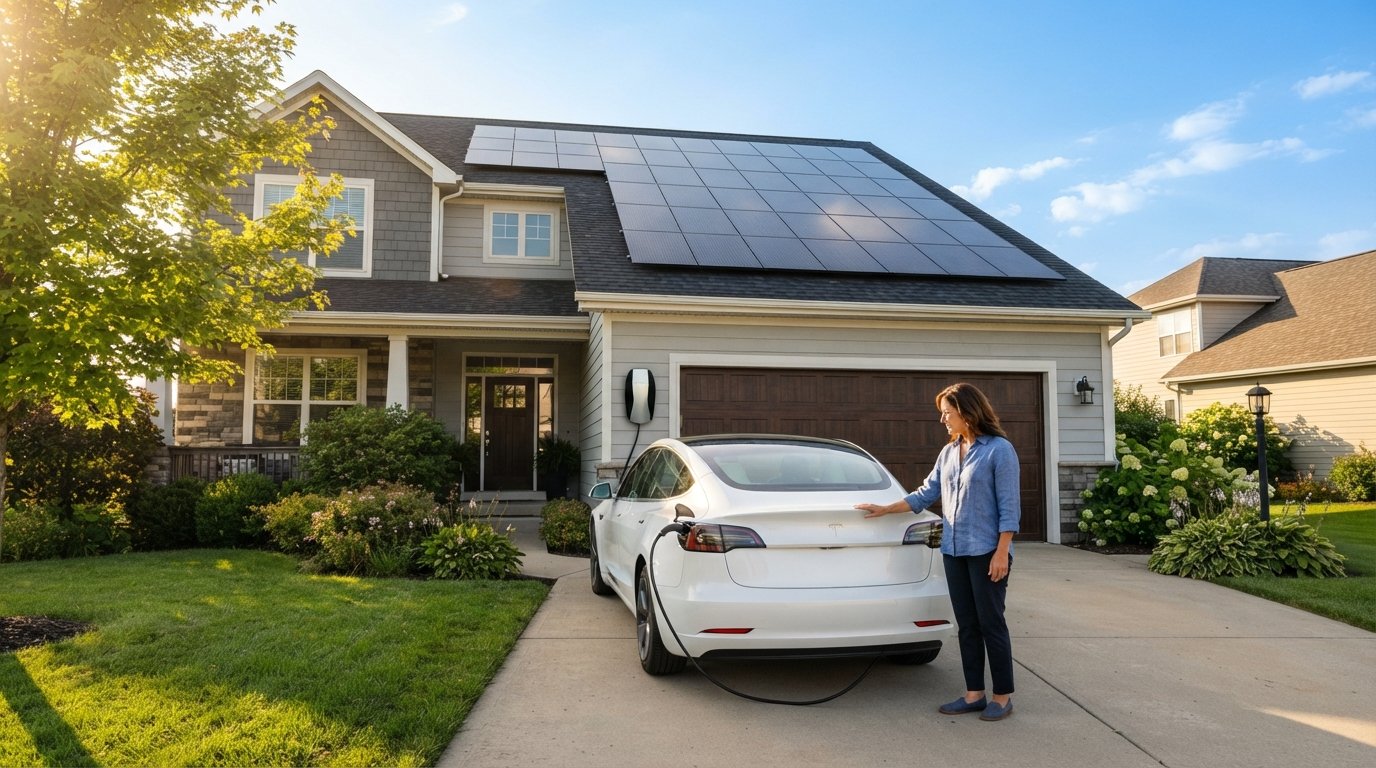
How to Charge Your EV With Solar Panels at Home
Charging an EV with solar panels at home cuts fuel costs to nearly zero. Call 8337937166 to explore your solar options today.

By Nathan Russell
Learn more about Solar Panel Installation and Repair for guides, costs, and what to expect.
Compare Solar Panel Installation and Repair Pros Near You

Enter your ZIP code to compare top-rated local professionals and request free quotes.
Charging an electric vehicle with solar panels at home is one of the smartest ways to cut your transportation costs while reducing your carbon footprint. Instead of paying a utility company for every mile you drive, you can generate your own clean electricity and funnel it directly into your car's battery. The concept sounds simple, but the execution involves a few important decisions about system sizing, charging equipment, and timing. This guide walks you through the entire process, from evaluating your current energy usage to selecting the right inverter and charger combination, so you can drive on sunshine instead of fossil fuels.
Why Solar EV Charging Makes Financial Sense
The average American household spends thousands of dollars per year on gasoline. When you switch to an electric vehicle, you trade that gasoline bill for an electricity bill. If you charge that EV from the grid, you are still paying your utility for every mile. But when you pair an EV with a home solar panel system, you essentially become your own power plant. The electricity you generate is free after the initial installation cost, and every kilowatt-hour you put into your car is a kilowatt-hour you do not have to buy from the utility.
Consider the numbers. A typical EV consumes about 0.3 kilowatt-hours per mile. If you drive 12,000 miles per year, that is roughly 3,600 kilowatt-hours of electricity. At an average US residential rate of 16 cents per kilowatt-hour, that is about $576 per year just to charge your car. With solar panels, that cost drops to zero for the portion of charging you cover with your own generation. Over a ten-year period, that is nearly $6,000 in savings, not counting the avoided gasoline costs or the federal tax incentives available for solar installations.
Beyond the direct savings, solar EV charging also insulates you from volatile utility rates and gasoline price spikes. Once your system is paid off, your fuel cost is essentially fixed at zero. That kind of predictability is valuable for any household budget. If you want to explore how solar can power both your home and your vehicle, a good starting point is understanding the full scope of solar energy solutions available to homeowners.
Assessing Your Home's Solar Potential for EV Charging
Not every home is ideal for solar, but many are. Before you commit to charging your EV with solar panels, you need to evaluate your roof or property for sun exposure, available space, and structural integrity. The key factors are shading, orientation, and the condition of your roof. South-facing roofs in the northern hemisphere get the most sun, but east and west orientations can also work well, especially if you have a time-of-use rate plan that rewards afternoon or evening charging.
You also need to calculate how much electricity your EV will require and how much your home already uses. A typical home consumes about 10,000 to 12,000 kilowatt-hours per year. Adding an EV that drives 12,000 miles annually adds roughly 3,600 kilowatt-hours. That is a 30 to 36 percent increase in total electricity demand. Your solar system must be sized to cover both your home and your car to maximize savings. If you undersize the system, you will still pull from the grid, reducing the benefit of your investment.
To get a precise estimate, you can use a solar cost calculator or consult with a professional installer. Many companies offer free assessments that use satellite imagery to measure your roof's solar potential. They will also factor in local weather patterns, utility rates, and available incentives. If your roof is not suitable, you might consider a ground-mounted system or a community solar subscription, though the latter may not allow direct EV charging.
Choosing the Right Solar System Size for Your EV
Sizing a solar system for EV charging is not dramatically different from sizing it for a home, but you must account for the additional load. The goal is to produce enough electricity over the course of a year to cover both your household consumption and your vehicle's needs. Because solar production varies by season, you will likely generate a surplus in summer and a deficit in winter, which net metering can help balance.
Here is a simple framework to estimate the number of panels you need. First, determine your total annual electricity consumption in kilowatt-hours, including the EV. Second, find the average daily sun hours for your location. Third, divide total annual consumption by the product of daily sun hours and 365, then divide by the panel wattage. For example, if you need 15,000 kilowatt-hours per year and your area gets 4.5 sun hours per day, you need about 9.1 kilowatts of solar capacity. With 400-watt panels, that is roughly 23 panels. A professional installer can refine this calculation based on your specific roof and equipment.
It is also wise to slightly oversize your system if you plan to add a second EV or increase your driving. Solar panels have a 25-year lifespan, and your energy needs may grow. Oversizing by 10 to 20 percent can provide a buffer without dramatically increasing cost, especially if you can claim the 30 percent federal Investment Tax Credit on the entire system.
Solar Equipment: Inverters, Chargers, and Compatibility
The equipment you choose determines how efficiently you can convert sunlight into miles. The main components are solar panels, an inverter, and an EV charger. The inverter converts direct current (DC) electricity from the panels into alternating current (AC) electricity for your home and car. There are two main types: string inverters and microinverters. String inverters are cheaper but less efficient in shaded conditions. Microinverters are more expensive but offer panel-level optimization and better performance in complex roofs.
For EV charging, you have several options. The simplest is a standard Level 2 charger that pulls from your home's electrical panel. The solar system feeds the panel, and the charger draws from it. This setup works well if you have net metering, because you can charge at night using credits earned during the day. A more advanced option is a solar-aware charger that can modulate charging based on real-time solar production. These chargers communicate with your inverter or a monitoring system to ensure your car only charges when excess solar is available. This maximizes self-consumption and reduces reliance on the grid.
Another consideration is whether you want a DC-coupled system. In a DC-coupled setup, solar panels charge a battery bank directly, and the battery then charges the EV. This can be more efficient but is also more complex and expensive. For most homeowners, an AC-coupled system with a smart charger is the best balance of cost and performance. If you are installing solar panel mounting rails as part of your roof preparation, make sure they are compatible with your chosen panels and can support the weight and wind loads in your area.
Installation Steps for Solar EV Charging
Installing a solar system and an EV charger is a multi-step process that typically involves a licensed electrician and a solar installer. While you can DIY some parts, electrical work and roof penetrations are best left to professionals to ensure safety and code compliance. Here is a high-level overview of the steps.
- Evaluate your home's electrical panel: Most homes have a 200-amp panel, which is usually sufficient for both solar and an EV charger. If you have a smaller panel, you may need an upgrade.
- Design the solar system: Work with an installer to determine the optimal size, panel type, and inverter. They will also plan the conduit runs and mounting hardware.
- Install the solar panels and inverter: This involves mounting rails, attaching panels, and wiring them to the inverter. The inverter is usually installed near your main electrical panel.
- Install the EV charger: A licensed electrician runs a dedicated circuit from your panel to the charger location, typically in your garage or on an exterior wall.
- Connect and commission: The system is connected to the grid (if grid-tied), inspected by local authorities, and activated. You can then begin charging your EV with solar energy.
Permitting and inspection can take several weeks, so plan accordingly. Many installers handle the paperwork for you, including applications for rebates and tax credits. Once the system is live, you can monitor production and charging through a mobile app, often with real-time data on how much solar energy is going into your car.
Maximizing Savings With Net Metering and Time-of-Use Rates
Net metering is a billing mechanism that credits you for excess solar electricity you send to the grid. When your panels produce more than your home and EV need, the surplus flows to the grid, and your utility credits you at the retail rate. At night or on cloudy days, you draw from the grid and use those credits. This effectively lets you use the grid as a giant battery, storing your solar energy for later use. Not all states have full net metering, so check your local policies. Some utilities offer a lower export rate or a feed-in tariff instead.
Time-of-use (TOU) rates add another layer of strategy. Under TOU, electricity costs more during peak hours (usually late afternoon and evening) and less during off-peak hours (night and early morning). If you have TOU rates and net metering, you can charge your EV during off-peak hours using grid power, then export your solar production during peak hours for higher credits. This arbitrage can increase your savings significantly. Some solar-aware chargers can automate this process, ensuring you always charge at the cheapest times.
If you have a home battery, you can store excess solar during the day and use it to charge your EV at night, further reducing grid reliance. Batteries also provide backup power during outages, which is a nice bonus for EV owners who want to keep their cars charged during emergencies. However, batteries add cost, so weigh the benefits against your budget and energy goals.
Common Challenges and How to Overcome Them
Charging an EV with solar panels at home is not without challenges. One common issue is the mismatch between solar production and charging demand. Solar panels produce most of their energy during the day, but many people are at work and their cars are not home. To solve this, you can charge your EV on weekends or work from home days, or invest in a battery to store daytime solar for nighttime charging. Another option is to use a timer or smart charger that schedules charging for when you are home and the sun is still shining.
Another challenge is the upfront cost. A solar system plus an EV charger can cost $15,000 to $30,000 before incentives. While the federal tax credit covers 30 percent of the solar portion, it does not cover the EV charger itself unless it is part of the solar installation. Some states and utilities offer additional rebates for EV chargers. Financing options like solar loans can make the upfront cost manageable, and the monthly loan payment is often less than the electricity bill savings.
Finally, not all homes have the roof space or sun exposure for a large enough solar system. If your roof is shaded or too small, you might consider a ground-mounted array or a carport solar structure. Community solar is another option, but it typically does not allow you to charge your EV directly with the solar energy you subscribe to; you just get a credit on your bill. For direct charging, on-site solar is the best route.
Incentives and Tax Credits for Solar EV Charging
The federal government offers a 30 percent Investment Tax Credit (ITC) for solar installations, and it applies to the entire system cost, including panels, inverters, and labor. If you install a battery, it may also qualify. The ITC is available through 2032 and steps down in later years, so acting sooner is better. Some utilities and states offer additional rebates for solar and EV chargers. For example, California has the Self-Generation Incentive Program (SGIP) for batteries, and many states offer sales tax exemptions for solar equipment.
It is important to note that incentives and tax credits can change. Always verify current details with a tax professional or the relevant government agency. The Database of State Incentives for Renewables and Efficiency (DSIRE) is a good resource. Your solar installer can also help you identify and apply for applicable incentives. If you are considering solar and want to compare quotes from reputable installers, you can request free, no-obligation quotes from vetted providers to find the best fit for your home and budget.
Charging your EV with solar panels at home is a powerful way to take control of your energy costs and reduce your environmental impact. By carefully sizing your system, choosing the right equipment, and leveraging incentives, you can drive on sunshine for years to come. Whether you are a first-time solar shopper or a seasoned EV owner, the combination of solar and EV charging is a smart investment in your financial and energy future. SolarEnergy.ai