
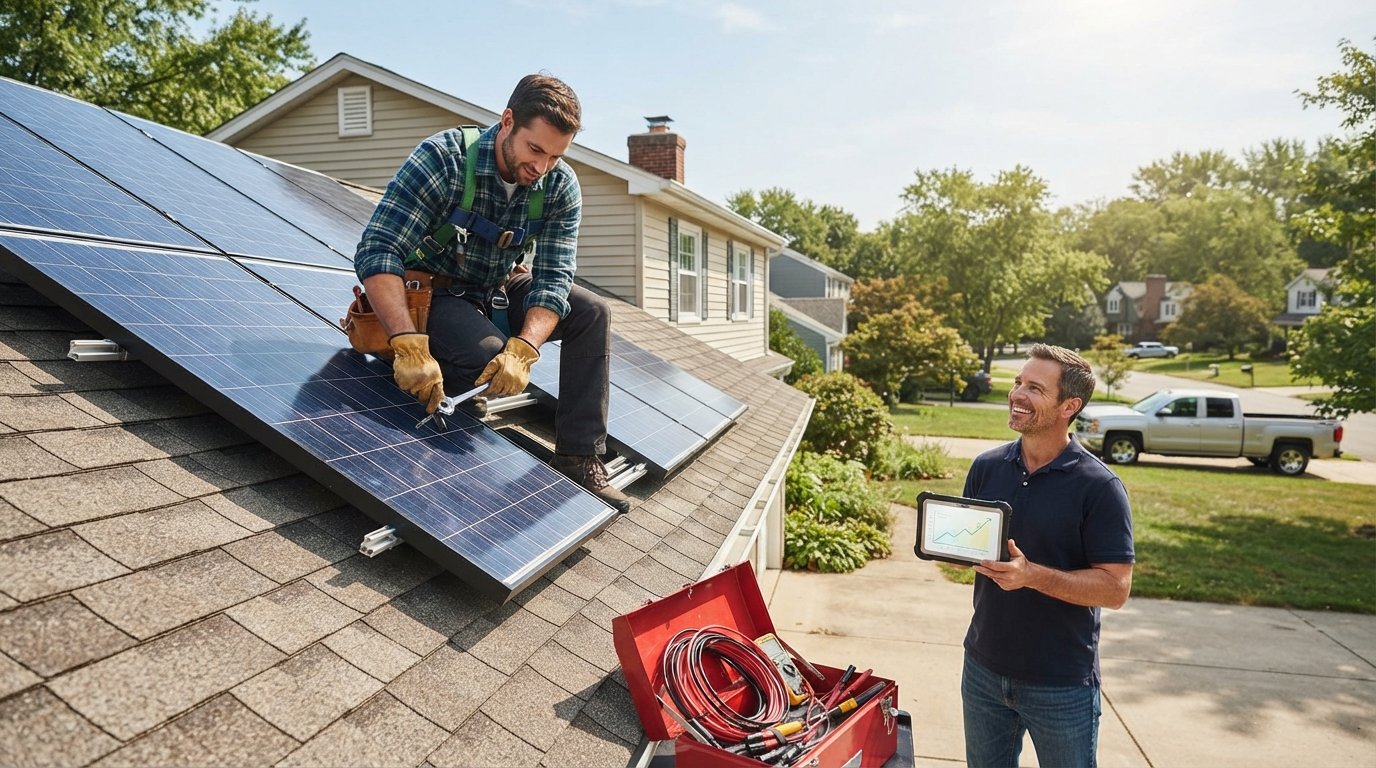
How Solar Panels Work: A Simple Homeowner's Guide
Learn how solar panels work, from the photovoltaic effect to net metering, and discover how this technology can cut your electricity bills.

By Brandon Moore
Learn more about Solar Panel Installation and Repair for guides, costs, and what to expect.
Compare Solar Panel Installation and Repair Pros Near You

Enter your ZIP code to compare top-rated local professionals and request free quotes.
Every hour, the sun bathes the Earth with enough energy to power the entire planet for a year. Yet most homeowners never tap into this abundant, free resource. The reason is simple: solar energy feels like a black box. You see panels on rooftops, hear about electricity bills dropping to near zero, but the actual process of converting sunlight into usable power remains a mystery to many. This guide will change that. By the end, you will understand exactly how solar panels work, from the physics of sunlight hitting a semiconductor to the moment your coffee maker draws power from your roof. And you will see why this knowledge matters: it helps you make smarter decisions about whether solar is right for your home, what equipment to choose, and how to maximize your savings.
The Core Science: Photovoltaic Effect Explained
At the heart of every solar panel is a phenomenon called the photovoltaic effect. Discovered in 1839 by French physicist Alexandre Edmond Becquerel, this effect describes how certain materials produce an electric current when exposed to light. In solar panels, that material is almost always silicon, the same element that powers computer chips. Silicon is a semiconductor, meaning its conductivity sits between a metal like copper and an insulator like rubber. By itself, silicon does not conduct electricity well. But when sunlight strikes it, the energy from photons (light particles) knocks electrons loose from their atoms. These freed electrons flow in a directed path, creating direct current (DC) electricity.
To make this process efficient, manufacturers treat silicon with other elements in a process called doping. One layer of silicon is doped with phosphorus, which has more electrons than silicon, creating an N-type (negative) layer. The other layer is doped with boron, which has fewer electrons, creating a P-type (positive) layer. Where these two layers meet, called the P-N junction, an electric field forms. When sunlight hits the panel, this field pushes the freed electrons toward the front surface and the holes (the absence of electrons) toward the back. This separation of charge creates voltage, and when you connect an external circuit, the electrons flow through it, generating usable electricity.
From Photons to Power: Step-by-Step Process
Now that you understand the basic principle, let us walk through the exact journey of a single photon from the sun to your toaster. This step-by-step breakdown will make you comfortable with the terminology installers use and help you ask better questions when comparing quotes.
- Sunlight hits the panel: Solar panels are made of many individual solar cells, typically 60 or 72 per panel. Each cell is about six inches square and produces roughly 5 to 6 watts of power. The panel's glass surface and anti-reflective coating maximize light absorption, while the frame protects the cells from weather.
- Photons knock electrons loose: When light particles hit the silicon cell, they transfer their energy to electrons, breaking them free from their atomic bonds. This is the photovoltaic effect in action.
- Electric field directs the flow: The P-N junction creates an internal electric field that pushes the freed electrons toward the front contact fingers and the holes toward the back contact. This creates a voltage difference across the cell.
- DC electricity is collected: The front and back metal contacts collect the electrons, and they flow into the panel's junction box. The panel's wiring routes this DC electricity out through a cable.
- Inverter converts DC to AC: Most homes run on alternating current (AC), not DC. The inverter, often mounted on your wall or attached to the back of the panels, converts the DC power into AC power that your appliances can use.
- Electricity flows to your home: The converted AC electricity travels from the inverter to your electrical panel (breaker box). From there, it is distributed to outlets, lights, and appliances just like grid power.
- Net metering handles the surplus: If your panels produce more electricity than you use, the excess is sent back to the grid. Through net metering, your utility credits you for that excess power, effectively spinning your meter backward and reducing your future bills.
This entire process happens in milliseconds, with no moving parts, no noise, and no emissions. That is why solar panels can last 25 to 30 years with minimal maintenance. The only thing that wears out over time is the inverter, which typically needs replacement after 10 to 15 years. Understanding this flow will help you see why panel orientation and inverter choice matter so much for system performance.
Key Components of a Complete Solar System
A solar panel alone cannot power your home. You need a complete system that works together to capture, convert, and deliver electricity. Here are the essential components, what they do, and why they matter for your savings.
- Solar panels: These are the visible star of the system. They capture sunlight and produce DC electricity. Panel efficiency, which typically ranges from 15% to 22%, determines how much sunlight is converted into usable power. Higher efficiency panels generate more electricity per square foot, which is ideal if you have limited roof space.
- Inverter: This device converts DC electricity from your panels into AC electricity for your home. There are three main types: string inverters (one central unit for all panels), microinverters (small units on each panel), and power optimizers (a hybrid that pairs with a string inverter). Each has trade-offs in cost, efficiency, and monitoring capability.
- Racking and mounting: These are the rails and clamps that secure panels to your roof. Proper mounting ensures your panels withstand high winds and heavy snow, and it allows for airflow underneath to keep them cool. Overheating reduces efficiency, so good racking matters.
- Electrical wiring and safety equipment: This includes conduit, cables, disconnects, and grounding equipment. A rapid shutdown system is required by code so that first responders can safely work on your roof during an emergency. These components ensure your system operates safely and reliably.
- Monitoring system: Most modern solar systems include a monitoring platform that shows your production in real time, often via a smartphone app. This helps you track performance and catch any issues early. If a panel underperforms, you will know immediately.
- Solar battery (optional): A battery, like the Tesla Powerwall or LG Chem RESU, stores excess electricity for use at night or during outages. While batteries add cost, they provide energy independence and protection against grid failures. They also let you maximize your solar consumption even when net metering rules change.
When you get a solar quote, the installer should specify the exact models and capacities of each component. Do not accept vague descriptions like "premium panels" or "standard inverter." You want specific brand and model numbers so you can compare apples to apples. The quality of these components directly affects your system's performance and lifespan, so it pays to research the options.
Why Panel Efficiency and Wattage Matter
Not all solar panels are created equal. Two panels can look identical from the street, but one might produce 30% more electricity than the other. This difference comes down to efficiency and wattage. Panel efficiency is the percentage of sunlight that the panel converts into electricity. A panel with 20% efficiency converts 20% of the light that hits it into usable power; the rest is reflected or lost as heat. Higher efficiency panels are made with more advanced silicon, such as monocrystalline cells, which have a uniform crystal structure that allows electrons to flow more freely. Polycrystalline panels, made from melted silicon fragments, are slightly less efficient but also cheaper.
Wattage, on the other hand, is the panel's power output under standard test conditions. A typical residential panel today produces between 350 and 450 watts. Higher wattage panels generate more power per square foot, which reduces the number of panels you need and the amount of roof space required. This is especially important for smaller roofs or homes with complex rooflines. For example, if you have a 500 square foot roof, you could fit 12 panels at 400 watts each, giving you a 4.8 kW system. With 450-watt panels, you could fit 10 panels and still get 4.5 kW, freeing up space for future expansion. In our guide on 440W solar panels, we explain how choosing the right wattage can optimize your roof's potential.
When comparing panels, look at both efficiency and temperature coefficient. The temperature coefficient tells you how much output drops as the panel heats up. Panels with a lower coefficient (e.g., -0.35% per degree Celsius) perform better in hot climates like Texas and Florida. A panel that loses less output in heat will generate more electricity over the year, especially in summer months when you need it most. This is one of those details that separates a good solar installer from a mediocre one, so do not hesitate to ask for it.
The Inverter's Role: DC to AC Conversion
Your home runs on alternating current (AC), where the flow of electricity reverses direction periodically. The grid delivers AC because it is easier to transform to higher or lower voltages. Solar panels, however, produce direct current (DC), where electrons flow in one direction. The inverter is the bridge between these two worlds. Without it, your panels would produce useless power that your appliances could not use. The inverter also performs critical safety functions, such as detecting grid outages and shutting down to prevent feeding electricity into a dead line (a hazard for utility workers).
There are three main inverter technologies, each with its own pros and cons. String inverters are the most common and the most affordable. They connect all your panels in a series (a "string"), and the combined DC power flows to a single inverter. The downside is that if one panel is shaded or underperforming, it drags down the entire string. Microinverters, on the other hand, are small inverters mounted on each panel. They optimize each panel independently, so shading on one panel does not affect the others. Microinverters also offer panel-level monitoring, making it easier to detect issues. Power optimizers are a middle ground: they are attached to each panel like microinverters, but they still send DC power to a central string inverter. The optimizers condition the DC power to minimize losses, and the central inverter handles the conversion. This hybrid approach often provides the best of both worlds: per-panel optimization and lower cost than full microinverters.
Your choice of inverter affects your system's reliability and monitoring capabilities. Microinverters and power optimizers typically come with 25-year warranties, while string inverters often carry only 10 to 12 years. However, string inverters are easier to service because they are located on your wall rather than on the roof. If a microinverter fails, you need to access the roof to replace it. In our article on 360W solar panels, we discuss how panel-level electronics can improve performance in partial shade. When you receive quotes, ask each installer which inverter they recommend and why, and compare the warranties carefully.
How Weather and Shading Affect Performance
Solar panels do not need direct sunlight to generate electricity, but they produce significantly more on sunny days. Cloud cover can reduce output by 60% to 80%, depending on the thickness of the clouds. Rain actually helps by washing away dust and pollen that accumulate on the panels, which can block sunlight. Snow, on the other hand, can completely cover panels and stop production until it melts. That said, panels are designed to withstand harsh weather. Most are rated to handle hail up to 1 inch in diameter and wind speeds up to 140 mph. This means they can survive a typical Texas hailstorm or a Florida hurricane, though flying debris could still cause damage.
Shading is the biggest enemy of solar production. Even a small shadow from a chimney or a nearby tree can disproportionately reduce output. This is because solar cells in a panel are connected in series. If one cell is shaded, it acts like a bottleneck, restricting current flow through the entire panel. With a string inverter, that bottleneck can also affect other panels in the same string. This is where microinverters and power optimizers shine: they isolate the impact of shading to just the affected panel. If you have trees on your property, you have three options: trim them regularly, choose a system with panel-level optimization, or accept the production loss and size your system larger to compensate. A good installer will perform a shade analysis using tools like Solmetric SunEye to estimate the impact on your specific roof.
Temperature also plays a role. Solar panels are tested at 25 degrees Celsius (77 degrees Fahrenheit). As temperatures rise above that, output drops. In a hot climate like Phoenix, panels can easily reach 60 degrees Celsius (140 degrees Fahrenheit) on the roof surface, which reduces output by 10% to 15%. This is why panel temperature coefficient matters. A panel with a lower temperature coefficient will lose less power in the heat. If you live in a hot region, it is worth paying a little more for panels with better heat tolerance. Conversely, cold sunny days are actually ideal for solar production. The cold keeps the panels at a lower temperature while the sun provides plenty of light, so you may see your highest production days in winter, not summer.
Financial Benefits: Net Metering, Tax Credits, and Payback
Understanding how solar panels work is one thing, but the real question for most homeowners is: what does it mean for my wallet? The answer depends on three key financial mechanisms: net metering, federal tax credits, and the payback period. Net metering is a billing arrangement where your utility credits you for excess electricity you send to the grid. During sunny hours, your panels may produce more than you use, and that surplus is exported. Your utility gives you a credit at the retail rate (in most states), which you can use to offset the electricity you draw from the grid at night or on cloudy days. This effectively makes your utility your battery, and it is the single most valuable financial feature of solar for most homeowners.
The federal Investment Tax Credit (ITC) is another major benefit. As of 2026, the ITC offers a 30% credit on the total cost of your solar system, with no upper limit. This means if your system costs $20,000, you get a $6,000 credit on your federal taxes. This credit is available for both residential and commercial systems, and it applies to solar panels, inverters, racking, and even battery storage if it is charged by solar. Many states also offer additional incentives, such as rebates, performance payments, or property tax exemptions. For example, Texas has a property tax exemption for the added home value from solar, and Florida offers a sales tax exemption on solar equipment. These incentives can stack, reducing your out-of-pocket cost significantly. To get a personalized estimate of your savings, you can use a solar cost calculator that factors in your location, utility rates, and system size.
The payback period is the time it takes for your cumulative savings to equal your upfront cost. In most parts of the US, this ranges from 6 to 12 years. Given that panels last 25 to 30 years, that means you could enjoy 15 to 20 years of virtually free electricity. For example, if your average monthly electric bill is $150, and your solar system eliminates it, you save $1,800 per year. On a $15,000 system (after tax credits), your payback period would be about 8.3 years. After that, every kilowatt-hour your panels produce is pure savings. This is why solar is often described as a financial investment with a guaranteed return. But the exact numbers depend on your utility rates, your sun exposure, and how much of your bill you can offset. To maximize your savings, you want a system that covers as close to 100% of your annual usage as possible, which is why it is critical to work with a reputable installer who performs a thorough energy audit.
Common Myths About Solar Panels
Despite the growing popularity of solar, several myths still discourage homeowners from exploring it. Let us debunk the most common ones with facts.
- Myth: Solar panels do not work on cloudy days. They do, just at reduced efficiency. Germany, one of the cloudiest countries in Europe, is a global leader in solar power. Modern panels can generate electricity from diffuse light, though output drops by 60% to 80% on overcast days.
- Myth: Solar panels require constant maintenance. Actually, they have no moving parts. Cleaning them a couple of times a year, usually by rain, is often enough. The main maintenance task is inverter replacement after 10 to 15 years, which costs $1,000 to $2,000.
- Myth: Solar panels will damage my roof. A properly installed system uses flashing and sealants to protect your roof. In fact, panels can protect the roof area they cover from weather and UV damage. The key is hiring a certified installer who follows manufacturer guidelines.
- Myth: Solar is too expensive. With the 30% federal tax credit and average system prices dropping by more than 50% over the past decade, most homeowners pay $10,000 to $20,000 before incentives. Financing options like solar loans allow $0-down starts, and the monthly payment is often less than your electric bill.
- Myth: I need a battery for solar to be worth it. No. Net metering provides most of the financial benefit without a battery. Batteries only become necessary if you want backup power or if your utility changes net metering rules. You can always add a battery later.
These myths persist because solar technology has evolved faster than public knowledge. The best way to get accurate, personalized information is to consult a reputable solar installer. They can assess your roof, your energy usage, and your local incentives to give you a realistic picture of what solar can do for you.
How to Choose the Right Solar System for Your Home
Now that you understand the mechanics, you are ready to make an informed decision. The first step is to determine your energy needs. Look at your past 12 months of electric bills to find your average monthly and annual kilowatt-hour (kWh) usage. A typical US home uses about 10,000 to 11,000 kWh per year. To offset that with solar, you need a system sized in kilowatts (kW). A 1 kW system produces about 1,200 to 1,500 kWh per year in a sunny state like Texas, but only 900 to 1,100 kWh in a cloudy state like Washington. Your installer will use your roof's sun exposure and your utility rates to calculate the ideal system size.
Next, get multiple quotes from different installers. Do not settle for the first one. Compare not just the price per watt, but also the equipment brand, warranty terms, and the company's reputation. A good installation is worth more than a cheap panel. Look for installers who are certified by the North American Board of Certified Energy Practitioners (NABCEP) and who have been in business for at least five years. Check online reviews and ask for references. Also, ask about the monitoring system and whether you can track your production in real time. A reputable installer will be happy to explain their process and answer your questions.
Finally, consider your financing options. You can pay cash, take out a solar loan, lease the system, or sign a power purchase agreement (PPA). Each has its pros and cons. Cash gives you the fastest payback and highest ROI. Solar loans let you go solar with little or no money down, and your monthly loan payment is often less than your old electric bill. Leases and PPAs require no upfront cost but you do not own the system, so you miss out on tax credits and long-term savings. If you are considering solar, the best way to get started is to get free, no-obligation quotes from vetted installers in your area. That way, you can see real numbers for your home and make a decision based on facts, not guesswork.
Solar energy is no longer a futuristic concept; it is a practical, proven technology that can lower your bills, increase your home's value, and reduce your carbon footprint. When you know exactly how solar panels work, you gain the confidence to compare quotes, choose the right equipment, and maximize your return. Every sunny day is an opportunity to generate clean, free electricity for decades to come. If you are ready to explore solar for your home, start by getting a few quotes from reputable installers and see what your roof can do.