
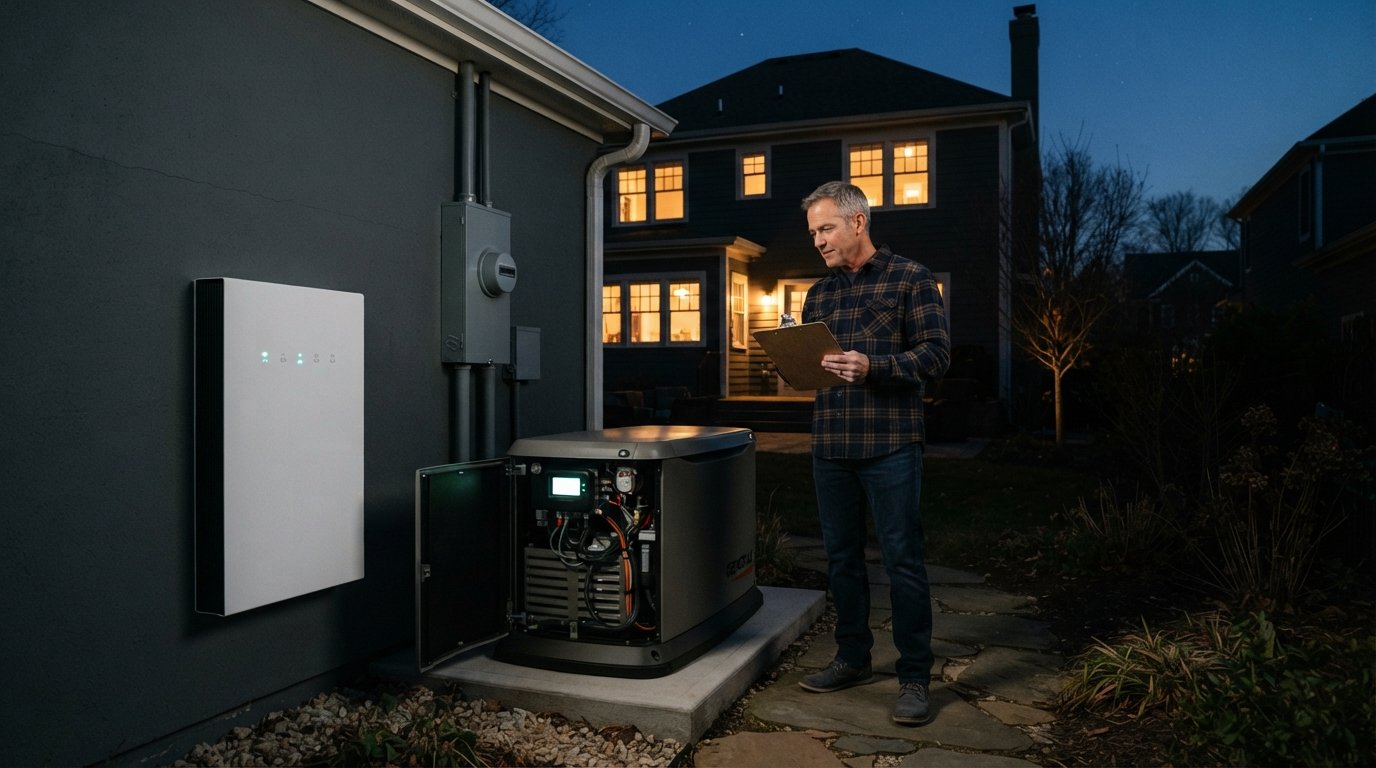
Generator vs Solar Battery for Home Backup: A 2026 Guide
Compare generator vs solar battery for home backup on cost, noise, and reliability. Call 8337937166 for free installer quotes and clear guidance.

By Benjamin Taylor
Learn more about Solar Panel Installation and Repair for guides, costs, and what to expect.
Compare Solar Panel Installation and Repair Pros Near You

Enter your ZIP code to compare top-rated local professionals and request free quotes.
When a storm knocks out the grid, the difference between a dark, silent house and a lit, comfortable home comes down to one decision: how you store and supply backup power. Homeowners across the United States are weighing the generator vs solar battery for home backup tradeoff more seriously than ever, driven by rising outage frequency, volatile fuel prices, and a growing desire for clean, quiet, and automatic energy resilience. The choice is not just about watts and watt-hours. It is about noise, maintenance, fuel storage, carbon emissions, long-term costs, and how seamlessly your home returns to normal life when the utility goes down.
This guide breaks down both options in practical terms. You will see how each system works, what it costs, where each one shines, and how to decide which fits your household, your budget, and your long-term energy goals. Along the way, we will connect the dots to broader solar economics so you can make a decision that pays off whether or not the grid ever fails.
How Generators and Solar Batteries Actually Work
A standby generator is essentially a small power plant parked next to your home. It runs on propane, natural gas, or diesel, and when the utility power drops, an automatic transfer switch starts the engine and routes electricity to your home's electrical panel. Portable generators work similarly but require manual setup, extension cords, and refueling. The appeal is straightforward: as long as you have fuel, you have power, and you can size a generator to carry your entire home, including central air conditioning and electric ranges.
A solar battery, by contrast, stores electricity that your solar panels produce during the day and releases it when you need it. During an outage, the battery pairs with an inverter to form what is often called a microgrid, islanding your home from the grid and keeping selected circuits energized. Modern batteries like the Tesla Powerwall, Enphase IQ Battery, and FranklinWH system switch over in milliseconds, often before your clocks even reset. The catch is capacity: most residential batteries store between 10 and 20 kilowatt-hours, enough to run essentials for a day or more, but not enough to power every appliance indefinitely unless you add panels or additional batteries.
The two technologies solve the same problem through opposite philosophies. Generators create electricity on demand from fuel. Batteries store electricity from an existing source, typically solar. That difference drives everything else, from cost structure to maintenance to how you feel about the system ten years from now.
Cost Comparison: Upfront Price vs Lifetime Expense
The sticker price is where generators often win, at least at first glance. A professionally installed 22 kW whole-home standby generator typically runs between $10,000 and $18,000, depending on fuel type, site work, and local permits. Portable generators cost far less, often $800 to $3,000, but they cannot power a whole house automatically and require manual operation.
Solar batteries sit at a higher entry point. A single 13.5 kWh battery installed usually costs $12,000 to $18,000 before incentives. However, the 30 percent federal Investment Tax Credit (ITC) applies to battery storage when it is charged by solar, which can reduce the net cost by thousands of dollars. If you already have solar panels, adding a battery can be a straightforward upgrade. If you are starting from scratch, the combined solar-plus-storage system is a larger investment, but it also produces ongoing savings every month, not just during outages.
Operating costs tell a different story over time. Generators need fuel, and fuel is not free. A whole-home generator under load can burn $30 to $80 per day in propane or natural gas during an extended outage. They also require annual maintenance, oil changes, filter replacements, and periodic exercise runs, typically $200 to $500 per year. Solar batteries have virtually no fuel cost and minimal maintenance, though some homeowners add a service plan for monitoring and warranty support.
Consider the ten-year math for a typical household facing a few multi-day outages per year:
- Standby generator: $14,000 installed, plus $3,000 in maintenance, plus $2,000 to $6,000 in fuel over a decade, totaling roughly $19,000 to $23,000.
- Solar battery: $15,000 installed, minus a $4,500 federal tax credit, plus near-zero fuel and minimal maintenance, totaling roughly $10,500 to $12,000 net.
Those numbers shift depending on outage frequency, local fuel prices, and whether you already own solar. But the pattern is consistent: generators cost less up front and more over time, while batteries cost more initially and then quietly pay you back through avoided fuel, lower electric bills, and incentive savings. For a deeper dive into how storage changes your monthly bill, see this guide on solar battery storage savings, which walks through the math in plain language.
Reliability, Noise, and Maintenance Realities
Reliability is where the generator vs solar battery for home backup debate gets interesting, because each system fails in different ways. A generator depends on a fuel supply chain. If a winter storm closes roads for a week, propane trucks may not reach your home, and a generator with an empty tank is just a heavy lawn ornament. Generators also have mechanical parts that wear out: engines, belts, alternators, and transfer switches. They need exercise runs to stay ready, and they can fail to start precisely when you need them most, often due to a dead battery or stale fuel.
Solar batteries are solid-state devices with far fewer moving parts. They do not need fuel deliveries, they do not produce exhaust, and they do not require oil changes. Their main vulnerabilities are capacity limits and sunlight dependency. If an outage stretches for several cloudy days and your battery is undersized, you may need to ration power or rely on a small generator as a backup to your backup. Pairing a battery with a properly sized solar array largely solves this, because the array recharges the battery every sunny day, effectively turning your roof into a personal power plant.
Noise and emissions matter more than many homeowners expect. A standby generator typically runs at 60 to 70 decibels, roughly the volume of a vacuum cleaner or a busy restaurant. In a quiet neighborhood at 2 a.m., that sound carries. Generators also emit carbon monoxide, which is why they must be placed well away from windows and vents. Solar batteries are silent and produce zero emissions, which makes them the only backup option you can run indoors, in a garage, or on a living room wall without disturbing anyone.
Maintenance expectations differ just as sharply:
- Generator: Annual professional service, regular oil and filter changes, fuel stabilizer or propane monitoring, battery replacement every few years, and periodic load testing.
- Solar battery: Occasional software updates, monitoring app checks, and a warranty inspection if performance drops. Most modern batteries carry 10-year warranties and are designed to be maintenance-free.
For homeowners who travel, have mobility limitations, or simply do not want another engine to manage, the battery's hands-off nature is a significant quality-of-life advantage. For those who want maximum uptime regardless of weather and are willing to handle fuel logistics, a generator remains a proven workhorse.
Powering Your Home: Capacity, Loads, and Runtime
Generators win on raw capacity. A 22 kW standby unit can run central air, electric ovens, well pumps, and multiple large appliances simultaneously. If your goal is to keep the entire house exactly as it was before the outage, a generator sized to your service panel is the simplest path. Runtime depends on fuel: a 500-gallon propane tank can keep a whole-home generator running for several days to a week under moderate load.
Solar batteries require a more thoughtful approach. Rather than powering everything, most systems are designed around critical loads: refrigerators, freezers, internet routers, lights, medical devices, sump pumps, and a few outlets. A single 13.5 kWh battery can typically run these essentials for 12 to 24 hours. Add a second battery, and you can include a well pump, a gas furnace, or a mini-split heat pump. With three or more batteries, some homeowners approach whole-home coverage, though at a cost that often exceeds a comparable generator.
The practical question is not which system can power more, but how much power you actually need during an outage. Most outages last hours, not weeks. For a family that wants lights, Wi-Fi, refrigeration, and a comfortable bedroom, a single battery is often enough. For a household with medical equipment, a home office, or electric heating in a cold climate, a larger battery bank or a generator may be necessary. A reputable installer can perform a load analysis and recommend a size that matches your real usage rather than a worst-case fantasy.
Environmental Impact and Long-Term Value
Generators burn fossil fuels and emit carbon dioxide, nitrogen oxides, and carbon monoxide. A whole-home generator running for a week can produce as much emissions as a car driven for months. Solar batteries store clean energy from your roof and produce no emissions during operation. If environmental impact is part of your decision, the battery is the clear winner, and it also avoids the health and safety risks of exhaust exposure.
Long-term value extends beyond emissions. Batteries can participate in utility demand response programs, earn credits for sending power back to the grid in some markets, and increase home resale appeal as buyers increasingly look for resilience and lower operating costs. Generators add backup capability but do not reduce your monthly electric bill, and they depreciate like any engine-driven equipment. Batteries, especially when paired with solar, are part of an energy asset that can improve your home's efficiency and financial profile.
Incentives also favor storage. The federal ITC covers 30 percent of battery costs when the battery is charged by solar, and many states and utilities offer additional rebates. Some programs, like California's SGIP, have historically provided thousands of dollars for storage in high-fire-risk areas. Generator purchases rarely qualify for renewable energy incentives, though some states offer sales tax exemptions for emergency equipment. Always verify current incentives with official sources, since programs and caps change regularly.
Hybrid Solutions and How to Decide
You do not have to choose one or the other. A growing number of homeowners pair a solar battery for everyday outages with a portable or standby generator for extended events. The battery handles the first day or two silently and automatically, while the generator kicks in only if the outage drags on and the battery runs low. This hybrid approach reduces fuel consumption, noise, and wear on the generator, and it gives you a layered defense against the unexpected.
To decide, start with these questions:
- How long do your outages typically last? A few hours favors a battery. Multi-day, fuel-dependent events may favor a generator or hybrid setup.
- Do you already have solar or plan to add it? If yes, a battery unlocks bill savings and incentives that a generator cannot match.
- What is your tolerance for noise, maintenance, and fuel storage? Lower tolerance points to batteries.
- What is your budget and financing preference? Generators have lower upfront costs; batteries have better lifetime economics with incentives.
- Do you need to power every appliance, or just essentials? Whole-home coverage favors generators; essential-circuit coverage favors batteries.
Once you have answers, gather quotes from multiple providers. Pricing varies widely by region, and a good installer will explain load calculations, permitting, and warranty terms in plain language. If you want to explore how solar and storage fit together for your specific home, resources like NewSolarQuotes offer educational guides and cost calculators that help you compare scenarios before you commit. FreeSolarPowerQuotes also connects homeowners with vetted local installers for no-obligation quotes, which is often the fastest way to see real numbers for your address.
Whichever path you choose, the goal is the same: a home that stays safe, comfortable, and functional when the grid fails. Generators deliver brute-force reliability with fuel and maintenance strings attached. Solar batteries deliver quiet, clean, automatic resilience that compounds in value when paired with solar. For many homeowners in 2026, the smartest answer is not one or the other but a system designed around how they actually live, what they can afford, and how long they expect the lights to stay on.