
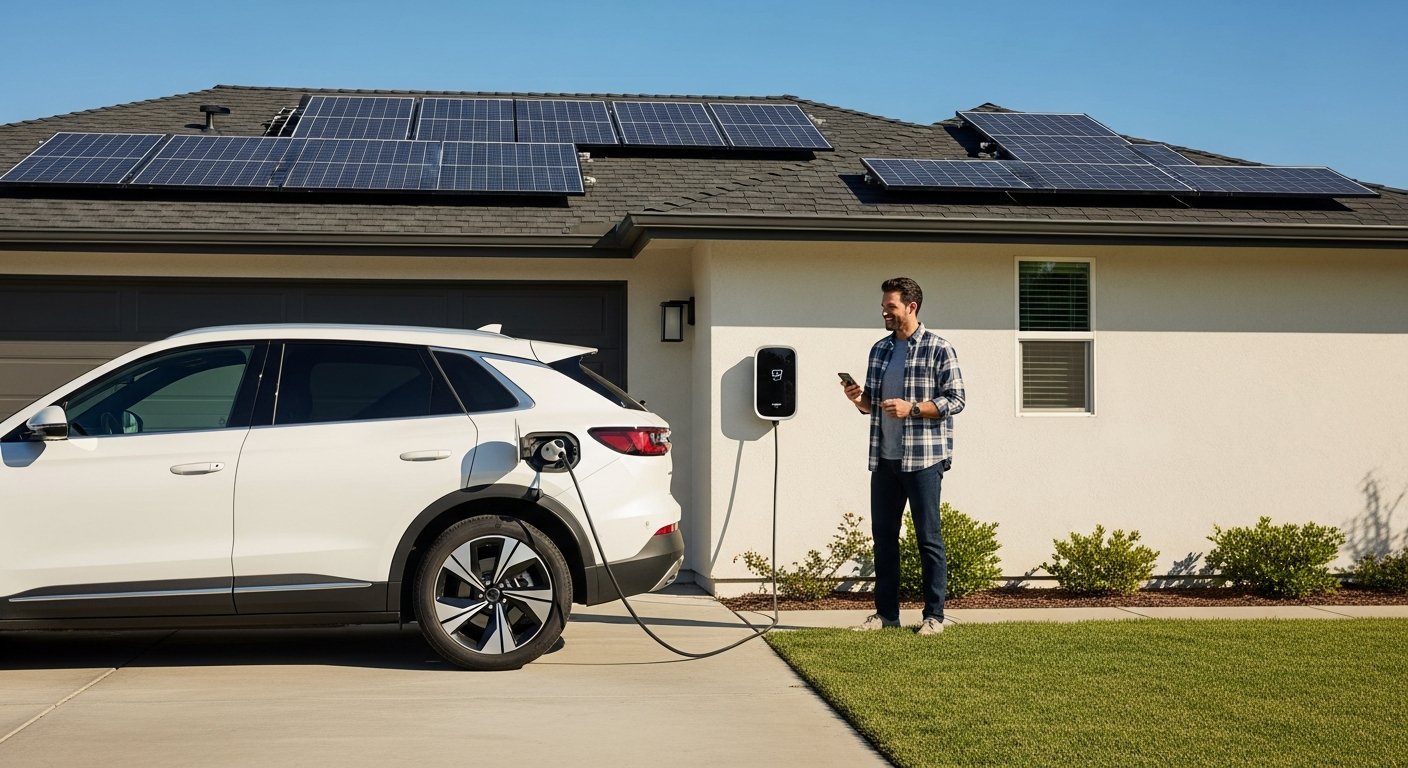
EV Charger With Solar: Cut Fuel Costs at Home
Pairing an EV charger with solar cuts fuel costs, speeds payback, and boosts home resilience. See how to size, install, and save.

By Brandon Moore
Learn more about Solar Panel Installation and Repair for guides, costs, and what to expect.
Compare Solar Panel Installation and Repair Pros Near You

Enter your ZIP code to compare top-rated local professionals and request free quotes.
For years, the dream of driving on sunshine felt just out of reach. You could install solar panels to power your home, and you could buy an electric vehicle, but the two systems rarely talked to each other. Today, that gap has closed. Pairing an EV charger with solar panels is one of the most practical and financially sound upgrades a homeowner can make. It transforms your car from a monthly fuel expense into a machine that runs on energy you generate yourself. This guide walks through how the technology works, what it costs, how to size the system, and the real-world savings you can expect.
The logic is simple. Solar panels produce electricity during daylight hours, often more than a home needs at that moment. Without a battery, that excess goes back to the grid, and you receive a credit. With an EV charger, that excess can go directly into your car's battery. Instead of selling your surplus power to the utility at a wholesale rate and later buying it back at a retail rate, you use it yourself. This is called self-consumption, and it is the key to maximizing the return on both your solar array and your electric vehicle.
Why an EV Charger With Solar Beats Grid-Only Charging
Charging an EV from the grid is still cheaper than buying gasoline in most parts of the United States. But grid power is increasingly expensive, and rates continue to climb. When you introduce solar, the economics shift dramatically. Your cost per mile drops to near zero during sunny hours. Over a year, a typical driver covering 12,000 miles might use around 3,500 to 4,500 kilowatt-hours (kWh) just for the car. At the national average residential rate of roughly 16 cents per kWh, that is $560 to $720 annually. Solar panels can offset that entire amount, and in many cases, they can also cover the rest of the home's usage.
There is also a resilience angle. A solar array paired with a battery and an EV charger creates a mini power plant. If the grid goes down, your car can even serve as a backup power source with the right bidirectional charger, though that technology is still emerging. For now, the main benefit is financial: you lock in your fuel price for the next 25 to 30 years. You are no longer subject to utility rate hikes or geopolitical oil price swings. That predictability is a powerful motivator for many homeowners.
Net Metering and Its Role in the Equation
Net metering policies vary by state and utility. In some places, you get a one-to-one credit for every kWh you send to the grid. In others, the credit is much lower, or it only applies to generation, not delivery charges. This matters because it changes how you should size your system. If your utility offers full retail net metering, you can treat the grid like a giant battery. You can charge your EV at night using credits earned during the day. If net metering is weak, you will want to charge your EV during solar production hours, which means a smart charger that can schedule charging when the sun is high.
Because net metering rules are so local, it is wise to check with your utility before committing to a system size. A good solar installer will run the numbers for you, but you can also use tools like PVWatts to estimate production. The goal is to cover your total annual usage, including the EV, without overbuilding. Overbuilding means you are giving away power at a low rate, which extends your payback period.
Hardware Options: From Simple to Fully Integrated
You have three main ways to combine solar and EV charging. The simplest is a standard Level 2 charger that plugs into your home's electrical panel, and your solar system simply offsets the total home usage. This works fine, but it does not guarantee the car is charged by solar. The second option is a smart charger that monitors your solar production through a CT clamp or Wi-Fi connection. It adjusts the charging speed so that you only draw power when the panels are producing. This is often called solar-aware charging, and it is a low-cost way to maximize self-consumption.
The third option is a fully integrated system with a home battery, like a Tesla Powerwall or an Enphase Ensemble. In this setup, the battery stores excess solar during the day, and the EV charger can draw from the battery at night. This gives you the most independence from the grid, but it also raises the upfront cost. Many homeowners start with a smart charger and add a battery later. The key is to choose equipment that is compatible with your solar inverter and your EV. Most modern chargers, such as the Emporia, Wallbox, or ChargePoint, work with any solar system because they operate on the home side of the meter.
Bidirectional Charging: The Next Frontier
Bidirectional chargers allow electricity to flow both ways. Your car can send power back to your home, or even to the grid. This is known as vehicle-to-home (V2H) or vehicle-to-grid (V2G). While the technology is exciting, it is still not mainstream. Only a few EVs, like the Nissan Leaf and the Ford F-150 Lightning, support it, and the chargers are expensive. If you are planning for the future, you might choose a charger that is bidirectional-ready, but do not pay a huge premium for it today. The practical benefits will grow as more cars support it and as utilities develop rate plans that reward V2G.
For most homeowners, the smart move is a Level 2 charger rated at 32 to 48 amps. This charges a typical EV in 6 to 10 hours, which is perfect for overnight or during the day. A 50-amp circuit is standard. If you have a very large battery, like a 100 kWh truck, you might want a 60-amp circuit to cut charging time. Your electrician can advise on what your panel can handle. Remember, the charger itself does not need to be the most expensive model. The smart features matter more than the brand.
How Many Solar Panels Do You Need?
This is the most common question. The answer depends on your driving habits, your home's electricity usage, and the amount of sun your roof gets. As a rule of thumb, a 1 kW solar system produces about 1,400 to 1,800 kWh per year in most U.S. regions. A typical EV uses about 4,000 kWh per year. So, you would need roughly 2.5 to 3 kW of extra solar capacity, or about 7 to 10 panels, to cover your car. If you also want to offset your home's usage, add that to the total.
For example, if your home uses 10,000 kWh per year and your car uses 4,000 kWh, you need a system that produces 14,000 kWh. In a sunny state like Arizona, that might be a 9 kW system. In a cloudier state like Washington, you might need 11 kW. A professional installer will do a site assessment, but you can get a rough estimate using online calculators. The important thing is to size for the future. If you plan to buy a second EV, or if you might switch to a heat pump for home heating, build in some headroom now. Adding panels later is more expensive and less convenient.
Battery Storage: Do You Need It?
Batteries are not required for an EV charger with solar, but they can improve the economics and resilience. Without a battery, you only charge your car when the sun is shining, unless you use net metering. With a battery, you can store the solar energy and charge at night, which is convenient if you drive during the day. Batteries also protect you from power outages. However, they add significant cost: a 10 kWh battery installed can run $10,000 to $15,000. The payback is slower than solar panels alone. Many homeowners skip the battery initially and add it later. If you live in an area with frequent outages or time-of-use rates, a battery might be worth it sooner.
Time-of-use (TOU) rates are another consideration. Many utilities charge more for electricity during peak hours, usually late afternoon and evening. A smart charger can be programmed to avoid those hours, charging in the middle of the day when solar production is highest and rates are lowest. This can save hundreds of dollars per year. If your utility has a TOU plan, make sure your charger supports scheduling. Some chargers even integrate with your solar inverter to automatically adjust based on production and rate signals.
Installation Cost and Financial Incentives
The cost of adding an EV charger is separate from the solar installation. A basic Level 2 charger costs $300 to $800 for the equipment, plus $500 to $1,500 for installation, depending on the distance from your panel and whether you need a new circuit. If you are installing solar at the same time, you can often bundle the work and save on labor. Some installers offer a discount if you combine both projects.
On the solar side, the federal Investment Tax Credit (ITC) covers 30% of the total solar system cost, including the panels, inverter, and installation. This credit applies to systems installed through 2032. The Inflation Reduction Act also offers a separate credit for EV chargers: up to 30% of the cost, capped at $1,000 for home installations. This applies to chargers purchased by individuals, and it can be claimed even if you do not have solar. State and utility incentives can further reduce costs. For example, some states offer rebates for EV chargers or additional solar incentives. The key is to research your local programs. You can find up-to-date information on the Database of State Incentives for Renewables & Efficiency (DSIRE).
When you get quotes, ask for a breakdown that separates the solar system cost from the charger cost. This makes it easier to apply for the different tax credits. Also, ask about any utility rebate for smart chargers or for participating in demand response programs. Some utilities pay you to allow them to pause your charging during peak events. These programs can put money back in your pocket while helping the grid.
Choosing the Right Equipment and Installer
Not all chargers are created equal. Look for a charger that is ENERGY STAR certified, which ensures efficiency. Also, consider the cable length, the connector type (J1772 is standard for most EVs, while Tesla uses NACS, but many Tesla owners can use an adapter, and new cars are adopting NACS), and the warranty. A good charger should have a 3-year warranty or longer. The installation should be done by a licensed electrician, ideally one who is familiar with solar systems. If you are already working with a solar installer, ask if they handle EV chargers. If not, they can often recommend a partner.
Before you commit, get at least three quotes from different providers. Compare not just the price, but the equipment brand, the warranty, and the company's reputation. Online reviews and the Better Business Bureau are useful resources. In our guide on online solar companies reliability, we explain how to vet providers and avoid common pitfalls. The same principles apply to charger installation.
Also, think about the physical location of the charger. If you park in a garage, a hardwired charger is cleaner. If you park outside, a plug-in model might be easier to replace. The charger should be within reach of your car's charge port. Consider future needs: if you might buy a second EV, install a dual-port charger or a larger circuit now. This can save you from a costly upgrade later.
Real-World Savings and Payback Period
Let's put numbers to this. Suppose you drive 12,000 miles per year, and your EV gets 3.5 miles per kWh. That is about 3,430 kWh per year. At the U.S. average residential rate of 16 cents per kWh, grid charging costs $549 per year. If you also pay for the solar system, the cost per kWh from solar is much lower. For a 7 kW system that costs $17,500 before the 30% tax credit, your net cost is $12,250. If that system produces 10,500 kWh per year, and you use 7,000 kWh for your home and 3,500 kWh for the car, the cost per kWh is about 11.7 cents over a 25-year life. That is cheaper than the grid, and the price is locked in. Your payback period is typically 7 to 10 years, depending on your utility rates and available incentives.
But the savings go beyond fuel. Many utility companies offer rebates for installing an EV charger, and some have special rates for EV owners that are even lower at night. You might also qualify for a higher solar production credit if you live in a state with strong net metering. In states like California, with its net billing tariff, the economics are different, but solar plus storage can still be a good investment. The key is to model your specific situation. Use a solar calculator, or ask an installer to provide a detailed financial analysis. Look at the 25-year net present value, not just the payback period.
Maintenance and Long-Term Performance
Solar panels and EV chargers are both low-maintenance. Panels need occasional cleaning to remove dust and debris, which can reduce output by 5% to 10%. You can do it yourself with a hose and a soft brush, or hire a professional. Our guide on the best equipment for solar panel cleaning has practical tips. The charger itself has no moving parts, but the cable can wear over time. Check it periodically for damage. The charging connector should be kept clean and dry. Most chargers have a built-in GFCI, but you should test it once a month by pressing the test button.
Your solar inverter will need replacement after 12 to 15 years, which is a cost to plan for. But the panels themselves are warrantied for 25 years and often last longer. The EV battery also degrades, but modern EVs lose only about 2% of capacity per year. If you are leasing or financing, factor in these long-term costs. A good installer will provide a maintenance schedule and explain the warranty terms.
Environmental Impact and Energy Independence
Beyond the financial benefits, pairing solar with an EV is one of the most effective ways to reduce your carbon footprint. Transportation is the largest source of greenhouse gas emissions in the U.S., and electricity generation is second. By driving on solar, you cut emissions from both. Over a year, a typical EV charged with solar avoids about 4 to 6 metric tons of CO2 compared to a gasoline car. That is like planting 100 trees. If you also export surplus solar to the grid, you help clean the grid for everyone.
Energy independence is harder to quantify but equally valuable. With a solar array and an EV, you are less vulnerable to fuel price spikes and grid failures. In a long outage, your car can even power your home if you have the right equipment. This resilience is a growing reason for homeowners to invest in solar plus storage. Even without a battery, the combination of solar and an EV gives you a measure of control over your energy future.
Before you start, it is wise to review your roof's condition. Solar panels last 25+ years, so you want a roof that will not need replacement soon. Our guide on the best roof types for solar panel installation explains what to look for. If your roof is older, consider replacing it before going solar. This adds cost, but it avoids the hassle of removing and reinstalling panels later.
Steps to Get Started
- Gather your data: Pull 12 months of electricity bills and note your annual kWh usage. Check your utility's net metering and TOU policies.
- Calculate your EV needs: Estimate your annual miles and your car's efficiency (kWh per mile). Multiply to get annual kWh.
- Get solar quotes: Contact at least three local installers. Ask for a system design that covers 100% of your home and EV usage. Compare prices, equipment, and warranties.
- Choose a charger: Decide between a standard, smart, or bidirectional charger. Get an electrician's quote for installation.
- Apply for incentives: Check the ITC, state rebates, and utility programs. Your installer should help with the paperwork.
Once your system is live, monitor your production and charging. Most solar systems come with an app, and smart chargers have their own. Track your savings monthly. Many owners are surprised at how quickly the numbers add up. You might even find that you produce more than you use, earning credits that carry over to winter months.
The decision to pair an EV charger with solar is not just about technology. It is about making a smart investment in your home, your wallet, and the planet. With the right planning, you can drive on sunshine for the next 25 years and never look back at the gas pump. If you are ready to explore your options, start by getting a few free, no-obligation quotes from reputable solar providers. Compare their offers, and do not hesitate to ask questions. The process is simpler than you think, and the rewards are substantial.
Learn more about Solar Panel Installation and Repair for guides, costs, and what to expect.
Compare Solar Panel Installation and Repair Pros Near You
Enter your ZIP code to compare top-rated local professionals and request free quotes.