
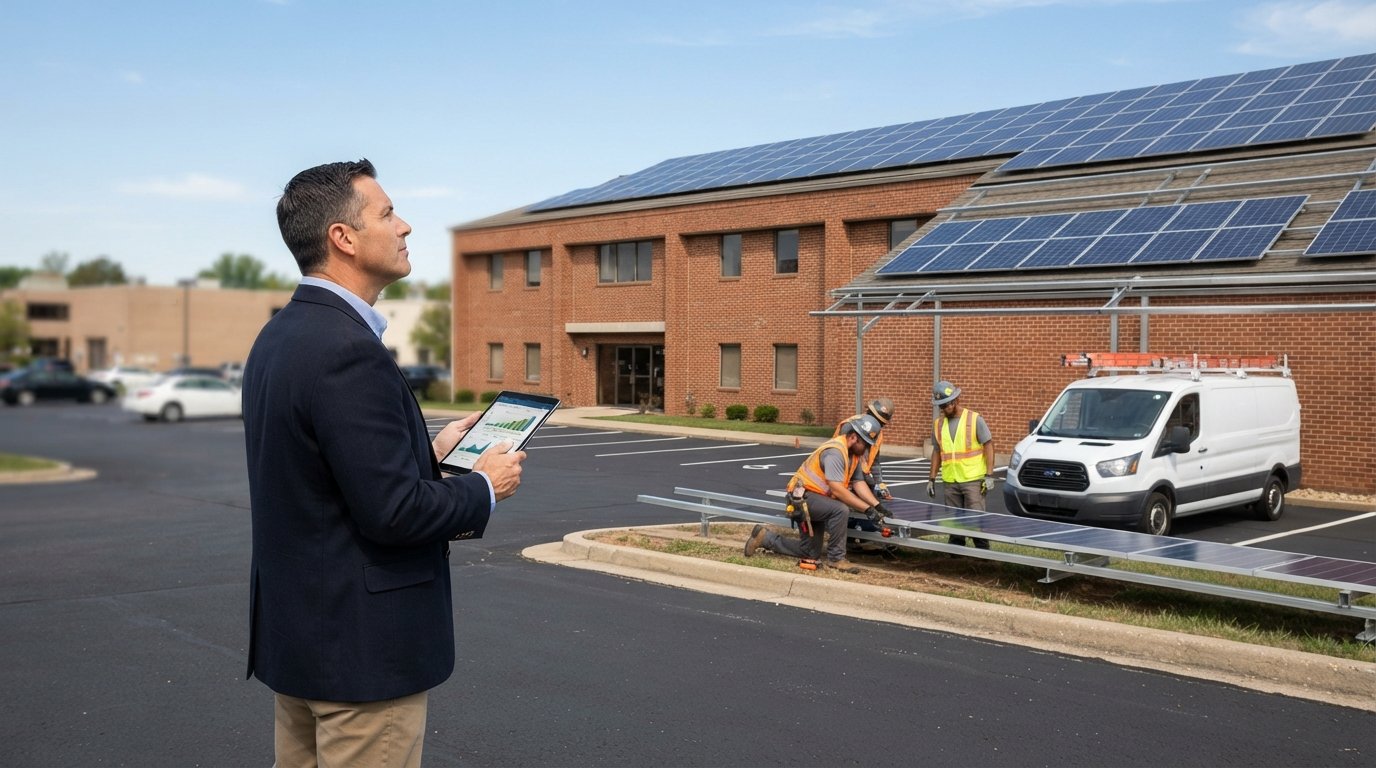
Commercial Solar Panel Installation Costs for Small Business 2026
Understand 2026 commercial solar panel installation costs for small businesses, including incentives, financing, and strategies to maximize ROI.

By Nathan Russell
Learn more about Solar Panel Installation and Repair for guides, costs, and what to expect.
Compare Solar Panel Installation and Repair Pros Near You

Enter your ZIP code to compare top-rated local professionals and request free quotes.
For a small business owner in 2026, the decision to go solar is no longer just about environmental stewardship; it is a strategic financial move. The sticker price of a commercial solar panel installation, however, often feels like a barrier. You have likely seen headlines about plummeting panel prices, yet your own research might show quotes ranging from $50,000 to over $200,000. This wide variance is not a sign of an inefficient market, but rather a reflection of the unique variables that define your property, your energy usage, and your financial goals. Understanding the true cost landscape for commercial solar in 2026 is the first step toward turning a significant capital expense into a long-term profit center.
This guide dissects the real numbers behind commercial solar panel installation costs for small businesses in 2026. We will explore the specific cost components, the impactful incentives that reduce your net investment, and the financing structures that can make going solar a cash-flow positive decision from day one. By the end, you will have a clear framework for evaluating proposals and understanding the return on investment, not just the upfront price tag.
Breaking Down the 2026 Cost per Watt for Commercial Projects
When solar professionals discuss commercial pricing, they rarely quote a single lump sum. Instead, they use a standardized metric: the cost per watt ($/W). This figure allows for an apples-to-apples comparison across different system sizes and configurations. In 2026, the national average for commercial solar panel installation costs for small business projects typically ranges from $1.50 to $2.50 per watt. This is notably lower than residential systems, which often run between $2.50 and $3.50 per watt, primarily due to economies of scale and lower soft costs.
To put this into perspective, a modest 50-kilowatt (kW) system, which is common for small retail stores, restaurants, or small warehouses, would have a gross cost of between $75,000 and $125,000 before incentives. A larger 150-kW system, appropriate for a manufacturing facility or a large office building, would range from $225,000 to $375,000. These figures represent the full turnkey price, including equipment, labor, permitting, and interconnection. It is crucial to understand that this is the gross cost; the net cost after the federal Investment Tax Credit (ITC) and other incentives is what truly matters for your budget.
The ITC remains the single most powerful federal incentive for commercial solar in 2026. It allows you to deduct 30% of the total system cost from your federal taxes. This means a $100,000 system effectively costs $70,000 after the credit is applied. Furthermore, if your business does not have enough tax liability to use the full credit in one year, the rules for 2026 allow you to carry it forward to future tax years. This flexibility makes the ITC a reliable cornerstone of your project's financial plan.
Key Variables That Influence Your Final Quote
While the national average provides a baseline, your specific quote will be shaped by several site-specific factors. Ignoring these can lead to sticker shock or, conversely, a pleasant surprise. The most significant variable is your roof type and its condition. If your roof is nearing the end of its life, you may need to factor in a roof replacement before solar installation, which adds cost but protects your investment. If you have a low-slope or flat roof, installers often use a ballasted mounting system that does not penetrate the roof membrane, which is less expensive than the pitched-roof attachments that require flashing and sealing.
Your electrical infrastructure is another major cost driver. If your business operates with high voltage three-phase power, you may need a more expensive inverter system. A panel upgrade to accommodate the solar input can cost several thousand dollars. Additionally, the distance from your roof to your main electrical panel affects the cost of wiring and conduit. A long run means more materials and labor. Finally, the local permitting and inspection fees, as well as the utility's interconnection review process, can add anywhere from $2,000 to $10,000 to your project, depending on your municipality and utility company.
Here are the top factors that will influence your specific commercial solar panel installation costs in 2026:
- System Size: Larger systems benefit from economies of scale, reducing the per-watt cost.
- Roof Complexity: Flat, unobstructed roofs are cheaper to install on than complex, steep, or shaded roofs.
- Electrical Upgrades: Upgrading your panel or transformer can add 5% to 15% to the total cost.
- Labor Rates: Prevailing wages in your region and the demand for skilled solar installers can vary significantly.
- Equipment Choice: Premium panels and microinverters cost more upfront but can offer higher efficiency and better long-term monitoring.
Understanding these variables helps you ask the right questions when soliciting bids. A more expensive quote may simply reflect higher-quality equipment or the need for more extensive electrical work, not an attempt to overcharge. A cheaper quote might omit crucial items like a new electrical panel or use less efficient panels that require more roof space. Always compare apples to apples by requesting a detailed scope of work from each installer.
Business Solar Incentives and Depreciation in 2026
The 30% federal ITC is only the beginning. Commercial solar projects also qualify for accelerated depreciation under the Modified Accelerated Cost Recovery System (MACRS). This powerful tax benefit allows you to recover the cost of your solar asset over a five-year period, rather than the standard 20 to 25 years for commercial property. In the first year alone, you can often claim a significant portion of the system's value through a combination of the ITC and bonus depreciation. For a business in the 21% corporate tax bracket, this can translate into tens of thousands of dollars in additional savings over the first five years.
On top of federal incentives, many states, municipalities, and utility companies offer their own rebates, performance-based incentives, or Solar Renewable Energy Certificates (SRECs). For instance, a business in New Jersey or Massachusetts might earn an SREC for every megawatt-hour of solar energy produced, which can be sold on an open market for additional revenue. Other states offer upfront cash rebates that can reduce your net cost by 10% to 20%. It is essential to research your specific local offerings, as these incentives can change frequently. An experienced local solar installer will be up to date on all applicable programs and will handle the paperwork to secure them.
To understand how these incentives interact with the actual price, you need to see the net project cost. The calculation is straightforward: Start with the gross cost, subtract the 30% ITC, subtract any state or utility rebates, and then consider the present value of the accelerated depreciation benefits. For a $100,000 system, the ITC reduces the cost to $70,000. A state rebate of $10,000 brings it to $60,000. The depreciation benefits might be worth another $15,000 to $20,000 in tax savings over five years, effectively making your net investment around $40,000 to $45,000. This is the number that should drive your decision.
Financing Options and Cash Flow Analysis
For many small businesses, paying for a solar system entirely in cash is not feasible. Fortunately, the commercial solar market offers a variety of financing solutions that go beyond a traditional bank loan. A commercial solar loan is a common choice, allowing you to own the system and benefit from all incentives while making fixed monthly payments. Many solar lenders offer terms of 10 to 20 years, and with the savings on your utility bill, your monthly loan payment is often less than your previous electric bill, resulting in positive cash flow from the first month.
Another popular option is the Solar Power Purchase Agreement (PPA) or a solar lease. With a PPA, a third-party developer owns and maintains the system, and you agree to purchase the electricity it generates at a predetermined rate, usually lower than your utility's current rate. This requires zero upfront capital and provides immediate savings. The trade-off is that you do not own the system, so you do not qualify for the ITC or depreciation benefits. This is an excellent option for businesses that lack tax appetite or capital.
When evaluating any financing option, you must perform a simple cash flow analysis. Determine your current annual electricity cost. Then, estimate your annual solar savings. Compare that to the annual cost of your loan payments or PPA rate. The goal is to have a positive net cash flow. In our guide on what solar panel installation cost really means in 2026, we break down the hidden costs and long-term value that affect this calculation. A well-structured solar deal should not only cover its own payments but also put money back into your pocket within the first year.
Why the Lowest Bid Could Cost You More
In the competitive solar market, you may be tempted to choose the lowest bidder. However, commercial solar is a 25 to 30 year investment. The quality of the installation, the reliability of the equipment, and the financial stability of the installer are paramount. A low bid may come from a company that is using cheaper, less durable components or that lacks experience with commercial permits and utility requirements. This can lead to costly delays, system underperformance, or even safety hazards down the line.
Instead of focusing solely on the initial quote, evaluate the long-term levelized cost of energy (LCOE) of your system. This metric accounts for the total cost of the system over its lifetime, divided by the total energy it produces. A system with higher efficiency panels and a better warranty may have a lower LCOE than a cheaper system that produces less energy per square foot. You should also vet the installer's track record with commercial projects, their customer service reputation, and their workmanship warranty. A reputable installer should offer a 25-year performance warranty on the panels and a 10 to 12 year workmanship warranty.
The financial complexities of commercial solar are real, but the rewards are substantial. By taking a data-driven approach to your commercial solar panel installation costs in 2026, you can transform a significant expense into a strategic asset that lowers your operating costs, hedges against future energy price volatility, and demonstrates your commitment to sustainability to your customers. For more personalized guidance and to see if your property qualifies, consider getting free, no-obligation quotes from vetted installers through NewSolarQuotes, an independent resource that connects businesses with pre-screened solar providers.